📌 Product Overview
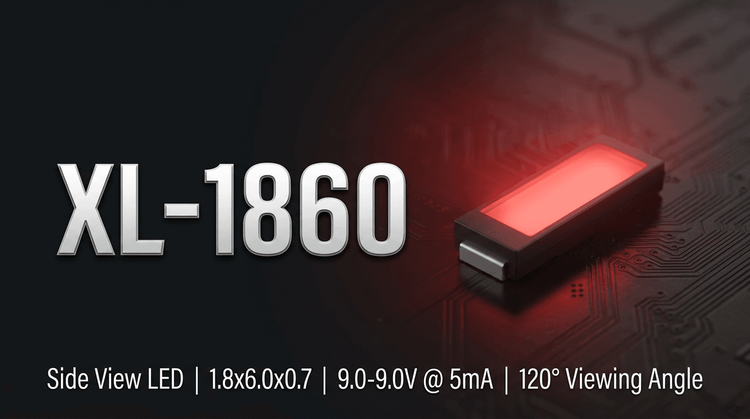
The XL-1860 represents a high-density Flip Chip LED solution tailored for high-lumen applications where space efficiency and thermal management are critical. 💡 With a compact footprint of 1.8x6.0x0.7mm, this component utilizes advanced flip-chip technology to enhance thermal dissipation and luminous efficacy. It is engineered to operate safely as a "cool beam" light source, complying with ROHS environmental standards. 👉 Designed primarily for rigorous environments, it supports a wide operating temperature range, making it suitable for both exterior and interior solid-state lighting designs.
🚀 Typical Applications
Based on its robust thermal and electrical ratings, the XL-1860 is optimized for the following scenarios:
- Automotive Lighting: Headlights, DRLs, and signal indicators requiring high vibration resistance and stability.
- EV/Motorcycle Lighting: High-beam and low-beam modules where compact size and high flux are essential.
- Industrial & Commercial: High-bay lights and outdoor fixtures demanding reliability across a -40°C to +135°C range.
- Exterior Illumination: Architectural and landscape lighting subject to severe environmental stress.
📊 Key Technical Specifications
The following data reflects performance at standard test conditions (Ta=25°C). 💡 Note that forward voltage (Vf) and luminous flux are subject to specific binning codes (S13-3 to S13-5 and N5 to N8) which must be accounted for in BOM planning.
| Parameter | Symbol | Test Condition | Min / Typ / Max | Unit |
|---|---|---|---|---|
| Forward Voltage | Vf | IF = 1000mA | 8.7 - 9.6 | V |
| Luminous Flux | Φ | IF = 1000mA | 1000 - 1500 | lm |
| Color Temp | CCT | IF = 1000mA | 5500 - 7000 | K |
| Viewing Angle | 2θ1/2 | IF = 1000mA | 120 | Deg |
| Junction Temp | Tj | IF = 1000mA | Max 145 | °C |
| Thermal Resistance | Rth(j-s) | IF = 1000mA | 3-5 | °C/W |
⚠️ Absolute Maximum Ratings & Process Limits
Exceeding these parameters risks irreversible damage to the component. 👇 These limits are critical for designing driver safety margins and thermal protection circuits.
| Parameter | Symbol | Max Rating | Unit | Notes |
|---|---|---|---|---|
| Power Dissipation | Pd | 15 | W | Dependent on heatsink |
| Forward Current | If | 1500 | mA | DC operation |
| Peak Pulse Current | Ifp | 2000 | mA | Duty cycle 1/10, 0.1ms pulse |
| Operating Temp. | Topr | -40 to +135 | °C | Case temperature dependent |
| Storage Temp. | Tstg | -40 to +85 | °C | |
| Soldering Temp. | Tsld | 260 | °C | Reflow: <3 seconds |
| ESD Sensitivity | ESD | 2000 | V | Human Body Model (HBM) |
📦 Package, Dimensions & Assembly Notes
- Form Factor: The component measures 1.8mm (L) x 6.0mm (W) x 0.7mm (H).
- Soldering Profile: 🔒 It is rated for MSL Level 3. Ensure reflow profiles adhere to J-STD-020C.
- Lead-Free Process: Peak temp 255°C, time above 217°C: 60-120s.
- Lead Process: Peak temp 235°C, time above 183°C: 60-150s.
- Handling: While classified as a "cool beam" safe-to-touch device, the junction temperature can reach 145°C under load; adequate PCB copper plating is mandatory for heat sinking.
🛒 Sourcing & Supply Considerations
- Binning Management: Supply consistency requires strict adherence to Flux (N5-N8), Voltage (S13), and CCT (UW) bin codes to ensure color and brightness uniformity in the final product.
- MSL Handling: As a Level 3 moisture-sensitive device, verify that suppliers use vacuum-sealed packaging with dry desiccant to prevent popcorn cracking during reflow.
- Procurement: 👉 Cross-reference samples against the "Typical Characteristic Curves" in the full datasheet to validate actual thermal performance in your specific heatsink design.
❓ Frequently Asked Questions
Q: What is the maximum drive current for continuous operation? A: The Absolute Maximum Rating for continuous Forward Current (If) is 1500 mA. However, for optimal longevity and lumen maintenance, engineers often target a drive current of 1000 mA where the forward voltage is approximately 9.0V.
Q: How should I manage the thermal requirements for the XL-1860? A: The thermal resistance (Rth j-s) is rated between 3-5 °C/W. To prevent the junction temperature from exceeding the maximum limit of 145°C, you must utilize a PCB with sufficient thermal mass (copper layers) and potentially an external heatsink, especially when driving at the upper current limits.
Q: What does the "Flip Chip" technology imply for my assembly process? A: Flip chip technology generally offers better thermal performance by connecting the die directly to the substrate, bypassing wire bonds. For assembly, this means the component is robust, but standard SMT reflow soldering profiles (Peak 255°C for lead-free) must be strictly followed to avoid thermal shock.
Q: Are there specific storage requirements to prevent damage? A: Yes, the XL-1860 has a Moisture Sensitivity Level (MSL) of 3. Components must be stored in a dry environment (<30% RH, <25°C) or in a sealed moisture barrier bag with desiccant. If the floor life is exceeded (168 hours), a baking process is required prior to reflow soldering.
Q: Can I use this LED for automotive exterior lighting? A: Yes, the datasheet explicitly lists "Automotive lighting" and "Exterior and interior lighting" as primary applications. The operating temperature range of -40°C to +135°C and high vibration resistance of the flip-chip structure make it suitable for harsh automotive environments.