📌 Product Overview
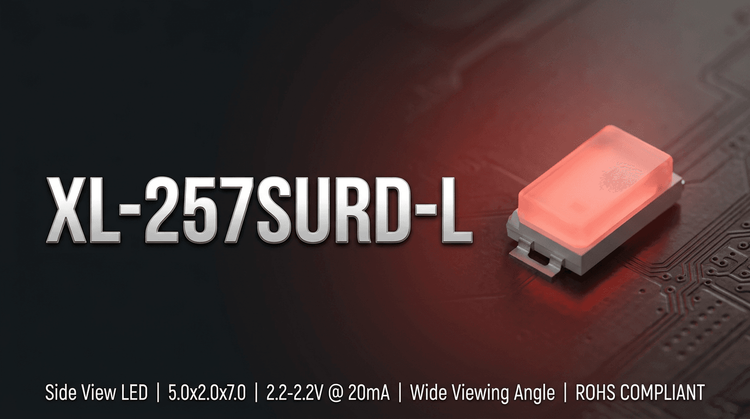
The XL-257SURD-L from XINGLIGHT is a standard 3mm radial LED designed for through-hole mounting (THT). 💡 It features a red diffused lens with a dominant wavelength of 620–625nm, making it suitable for general status indication and backlighting purposes.
Target applications primarily include consumer electronics, automotive instrumentation, and industrial control panels. The device is engineered for high visibility and energy efficiency, offering a viewing angle of 110 degrees. ✨ Design focus should be placed on its low DC drive requirements and compliance with RoHS environmental standards.
🚀 Typical Applications
Based on the 5.0x2.0x7.0mm dimensions and electrical characteristics, the XL-257SURD-L is optimized for the following scenarios:
- Indicator Lights: 📉 Status LEDs for home appliances and power supplies.
- Automotive Electronics: Dashboard illumination and interior signaling (non-critical).
- Consumer Devices: Digital clocks, electronic toys, and communication equipment.
- Industrial & Urban Lighting: Traffic instructions and city beautification projects.
📊 Key Technical Specifications
The following table outlines the electro-optical characteristics at $T_a=25^\circ C$. 💡 Designers should pay close attention to the Luminous Intensity ($I_V$) and Forward Voltage ($V_F$) variances to ensure uniformity.
| Parameter | Symbol | Min | Typ | Max | Unit | Test Condition |
|---|---|---|---|---|---|---|
| Luminous Intensity | $I_V$ | 50 | 200 | 300 | mcd | $I_F = 20\text{mA}$ |
| Dominant Wavelength | $\lambda_d$ | 615 | 620 | 625 | nm | $I_F = 20\text{mA}$ |
| Peak Wavelength | $\lambda_p$ | - | 625 | - | nm | $I_F = 20\text{mA}$ |
| Forward Voltage | $V_F$ | 1.8 | 2.2 | 2.4 | V | $I_F = 20\text{mA}$ |
| Viewing Angle | $2\theta_{1/2}$ | - | 110 | - | deg | $I_F = 20\text{mA}$ |
| Reverse Current | $I_R$ | - | - | 10 | $\mu$A | $V_R = 5\text{V}$ |
⚠️ Absolute Maximum Ratings & Process Limits
Exceeding these ratings may cause permanent device failure. 🔒 These limits are critical for stress testing and reliability assurance.
| Parameter | Symbol | Max Rating | Unit | Notes |
|---|---|---|---|---|
| Power Dissipation | $P_d$ | 70 | mW | |
| Continuous Forward Current | $I_F$ | 20 | mA | |
| Peak Forward Current | $I_{Fp}$ | 80 | mA | Pulse width dependent |
| Operating Temperature | $T_{opr}$ | -20 ~ +85 | $^\circ$C | |
| Storage Temperature | $T_{stg}$ | -40 ~ +85 | $^\circ$C | |
| Soldering (Wave) | $T_{sol}$ | 240 | $^\circ$C | $\le 6\text{s}$ |
| Soldering (Manual) | $T_{sol}$ | 300 | $^\circ$C | $\le 3\text{s}$ |
⚡ Note: Soldering points must be >2.0mm from the colloid base to prevent thermal damage.
📦 Package, Dimensions & Assembly Notes
- Package Type: 5mm Radial Lead (Long leg).
- Dimensions: 5.0 (W) x 2.0 (T) x 7.0 (H) mm.
- Tolerance: $\pm 0.50\text{mm}$ unless noted.
- Moisture Sensitivity: MSL Level 2.
- Packaging: EIA standard, moisture-proof, and anti-static foil bags.
🛠️ Assembly Advice: Ensure the lead spacing matches the PCB footprint. The "Long leg" design aids in wave soldering processes but requires attention to lead integrity during high-speed insertion.
📈 Sourcing & Supply Considerations
- Binning: Verify brightness (A1-A3) and voltage (N12-7/8/9) codes for optical consistency.
- Authenticity: Source only through authorized XINGLIGHT channels to avoid counterfeits.
- Lead Time: Standard EIA packaging allows for rapid automated dispensing.
- Samples: Request pre-production samples to verify color binning under specific operating conditions.
❓ FAQ
Q: What is the forward voltage requirement for this LED? A: The typical forward voltage is 2.2V, with a maximum of 2.4V at 20mA. Ensure your driving circuit can supply sufficient current while regulating voltage within this range.
Q: Is the XL-257SURD-L suitable for outdoor use? A: While the operating temperature ranges from -20°C to +85°C, it is primarily designed for indoor indicators. For outdoor use, additional waterproofing and UV protection measures must be considered.
Q: What does "MSL Level 2" mean for handling? A: Moisture Sensitivity Level 2 means the components can be exposed to a floor life of up to 1 year at $\le 30^\circ$C / 60% RH. If the floor life is exceeded, baking is required before reflow soldering to prevent pop-corning damage.
Q: How is brightness grading handled? A: The devices are binned into codes A1 (50-100 mcd), A2 (100-200 mcd), and A3 (200-300 mcd). Selecting a specific bin code is crucial for applications requiring uniform brightness across multiple LEDs.
Q: What are the soldering limits? A: For wave soldering, do not exceed 240°C for more than 6 seconds. For manual soldering, the limit is 300°C for 3 seconds. The solder joint must be at least 2.0mm away from the epoxy body.