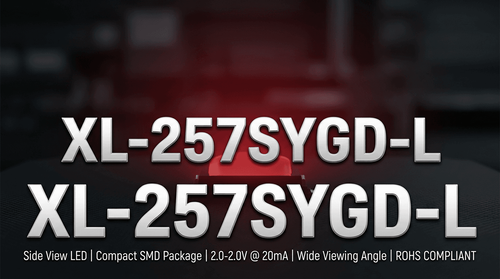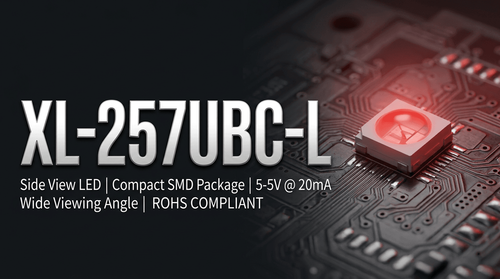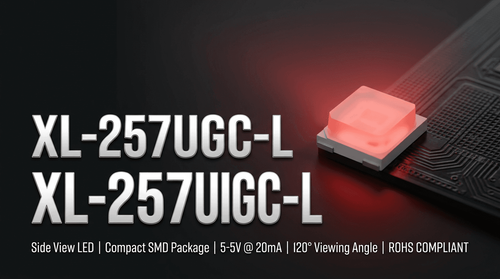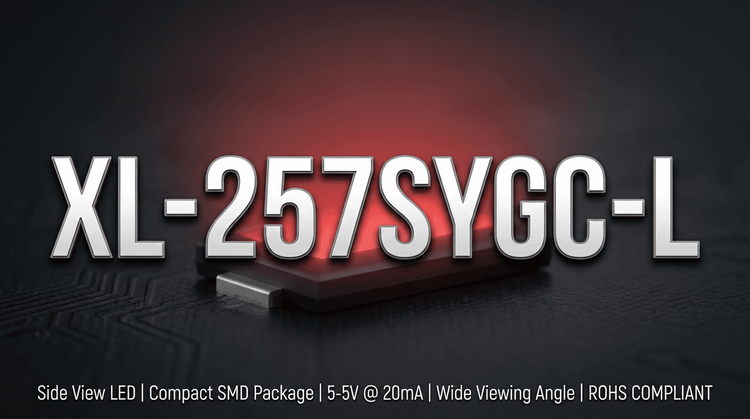
📌 Product Overview
The XL-257SYGC-L is a standard 3mm through-hole LED from XINGLIGHT, featuring a water-clear white lens and a dominant wavelength of 565–575nm (Yellow Green). Designed for general-purpose indication, this component utilizes a long-lead structure (28mm length) to facilitate flexibility during PCB assembly and wave soldering processes.
💡 This device is optimized for applications requiring clear visual status feedback without high-power density. Its compliance with RoHS standards and EIA packaging makes it a viable candidate for consumer electronics and industrial control systems where supply chain consistency is critical.
🚀 Typical Applications
Based on the 110-degree viewing angle and low DC drive requirements, the XL-257SYGC-L is suited for:
- Status Indicators: Power-on lights and signal alerts in home appliances.
- Automotive Electronics: Dashboard illumination and interior panel lights.
- Consumer Electronics: Digital displays and communication device indicators.
- Industrial & Education: Electronic teaching equipment and traffic instruction signals.
📈 Key Technical Specifications
The following table outlines the electro-optical characteristics (Ta=25°C). Designers should pay close attention to the forward voltage variance and luminous intensity grading to ensure uniformity across batches.
| Parameter | Symbol | Min | Typ | Max | Unit | Test Condition |
|---|---|---|---|---|---|---|
| Luminous Intensity | Iv | 50 | - | 100 | mcd | IF = 20mA |
| Dominant Wavelength | λd | 565 | - | 575 | nm | IF = 20mA |
| Peak Wavelength | λp | - | 570 | - | nm | IF = 20mA |
| Forward Voltage | VF | 2.0 | 2.2 | 2.6 | V | IF = 20mA |
| Viewing Angle | 2Ø1/2 | - | 110 | - | deg | IF = 20mA |
| Reverse Current | IR | - | - | ≤10 | μA | VR = 5V |
💡 Note: Voltage binning codes (N12-8, N12-9, N13-1) are available for tighter voltage control in sensitive circuits.
🔒 Absolute Maximum Ratings & Process Limits
Exceeding these ratings may cause permanent device failure. These limits are critical for designing driver circuits and establishing reliability margins.
| Parameter | Symbol | Rating | Unit |
|---|---|---|---|
| Power Dissipation | Pd | 70 | mW |
| Max Continuous Forward Current | IF | 20 | mA |
| Peak Forward Current | IFp | 80 | mA |
| Operating Temperature | Topr | -20 to +85 | °C |
| Storage Temperature | Tstg | -40 to +85 | °C |
⚠️ Soldering Limits:
- Wave Soldering: Max 240°C for ≤6s.
- Manual Welding: Max 300°C for ≤3s.
- Lead Integrity: Solder joint must be >2.0mm from the colloid base to prevent thermal damage to the epoxy.
📦 Package, Dimensions & Assembly Notes
- Package Type: Radial Lead, 3mm Round (T-1).
- Dimensions: 5.0mm (W) x 2.0mm (T) x 7.0mm (H) x 28mm (Lead Length).
- Lens: Water-clear white colloid.
- Assembly: The long leads (28mm) are designed for stability during automated insertion. Ensure the lead spacing matches the PCB footprint to avoid mechanical stress on the resin body during wave soldering.
🛒 Sourcing & Supply Considerations
- Voltage Binning: Request specific voltage bins (e.g., N12-8) if your design has tight voltage regulation constraints.
- Packaging: Supplied in EIA standard compliant packaging for compatibility with automated feeders.
- Authenticity: Verify supply channels to ensure compliance with the stated RoHS and MSL (Level 2) specifications.
- Samples: Contact authorized distributors for pre-production samples to verify color bin consistency.
❓ FAQ
Q: What is the forward voltage requirement for this LED? A: The typical forward voltage is 2.2V, with a maximum of 2.6V at 20mA. It is recommended to design driver circuits assuming a maximum VF of 2.6V to account for batch variations.
Q: Is this LED suitable for automotive environments? A: Yes, the datasheet lists automotive electronics as a primary application. However, ensure that the operating temperature range (-20°C to +85°C) meets the specific thermal requirements of the installation location within the vehicle.
Q: What are the soldering profile limitations? A: For wave soldering, do not exceed 240°C for 6 seconds. For manual soldering, the limit is 300°C for 3 seconds. Crucially, the solder point must be at least 2.0mm away from the epoxy body to prevent damage.
Q: How is brightness consistency controlled? A: Brightness is graded into codes (e.g., A1: 50-100 mcd). When procuring, specify the brightness bin code to ensure visual uniformity across your product line.
Q: What is the moisture sensitivity level (MSL)? A: The XL-257SYGC-L has an MSL of 2. This means it can be exposed to ambient conditions for up to one year before baking is required, simplifying inventory management.