📌 Product Overview
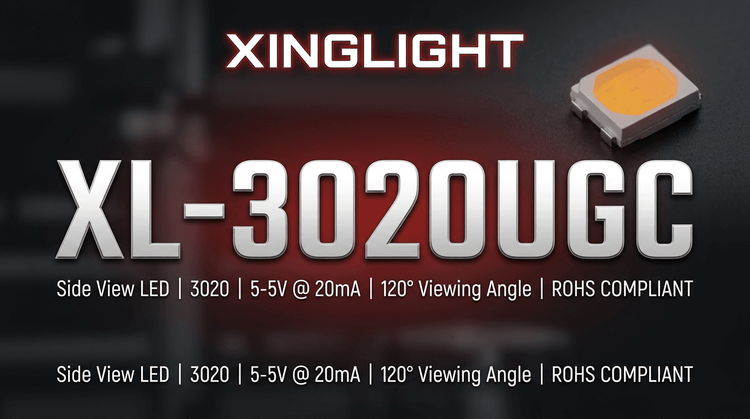
The XINGLIGHT XL-3020UGC is a high-performance Surface Mount Device (SMD) LED designed for applications demanding vivid emerald green illumination. Housed in a compact 3.0 x 2.0 x 1.3mm package with a water-clear colloid, it delivers a dominant wavelength of 515-530nm, making it ideal for vibrant indicator lights and backlighting. 💡 Its design prioritizes a balance of high luminous intensity—up to 1800 mcd—and robust thermal management for stable operation.
Engineered for modern automated assembly, this component is fully compatible with standard SMT processes and infrared reflow soldering. Whether used in flexible light strips or commercial signage, the XL-3020UGC offers reliable performance in environments ranging from -40°C to +85°C. ✨ It is the optimal choice for engineers seeking long-life, ROHS-compliant lighting solutions in space-constrained board layouts.
🚀 Typical Applications
Based on its emerald color characteristics and 120° viewing angle, the XL-3020UGC is suited for a variety of general and commercial lighting scenarios:
- Indoor Lighting: Ideal for fluorescent tubes, downlights, and linear light strips where consistent color rendering is required.
- Commercial Signage: 👉 Provides high visibility for advertising words and light boxes, ensuring messages stand out with vivid green light.
- LCD Backlighting: Suitable for LCD panel illumination due to its compact footprint and efficient light output.
- Decorative Lighting: Excellent for flexible light strips used in accent lighting and architectural decor.
📈 Key Technical Specifications
The following table outlines the electro-optical characteristics (Ta=25°C) to help engineers assess the performance window for their circuit designs:
| Parameter | Symbol | Min. | Typ. | Max. | Unit | Test Conditions |
|---|---|---|---|---|---|---|
| Luminous Intensity | Iv | 1150 | - | 1800 | mcd | IF = 20mA |
| Dominant Wavelength | λd | 515 | - | 530 | nm | IF = 20mA |
| Peak Wavelength | λp | - | 525 | - | nm | IF = 20mA |
| Forward Voltage | VF | 2.8 | - | 3.4 | V | IF = 20mA |
| Viewing Angle | 2Ø1/2 | - | 120 | - | deg | IF = 20mA |
| Reverse Current | IR | - | - | ≤5 | μA | VR = 5V |
💡 Note: The product is sorted into specific bins (Brightness F2-F5, Voltage N13-3 to N13-5) to ensure consistency in mass production.
🔒 Absolute Maximum Ratings & Process Limits
To ensure reliability and prevent permanent damage, designers must strictly adhere to these absolute maximum ratings (Ta=25°C):
| Parameter | Symbol | Max. Value | Unit | Notes |
|---|---|---|---|---|
| Max Power Dissipation | PD | 70 | mW | |
| Max Forward Current | IF | 20 | mA | Continuous operation |
| Peak Forward Current | IFP | 80 | mA | Pulse width ≤0.1ms, Duty ≤1/10 |
| Max Reverse Voltage | VR | 5 | V | |
| Antistatic Ability | ESD | 2000 | V | |
| Operating Temperature | TOPR | -40 ~ +85 | °C | |
| Storage Temperature | TSTR | -40 ~ +85 | °C | |
| Soldering Temp/Time | TSOL | 260 | °C | ≤6 Seconds |
👇 Critical Design Tip: Exceeding the junction temperature or the 20mA continuous current limit will significantly degrade the lifespan and luminous output of the LED.
🏗️ Package, Dimensions & Assembly Notes
The XL-3020UGC utilizes a standard 3020 package form factor, optimized for automated pick-and-place machines.
- Dimensions: The outline measures 3.0mm (L) x 2.0mm (W) x 1.3mm (H).
- Moisture Sensitivity: The MSL is rated at Level 3. 👉 Ensure proper baking and handling if the components have been exposed to ambient humidity for extended periods prior to reflow.
- Soldering Compatibility: Suitable for both Lead (Tmax 235°C) and Lead-Free (Tmax 255°C) infrared reflow processes.
- Assembly: Designed for SMT automatic production. Follow the recommended reflow profile: preheat temperature max 3°C/s, and time above 217°C (lead-free) between 60-120 seconds.
📦 Sourcing & Supply Considerations
When integrating the XL-3020UGC into your bill of materials, keep these supply chain factors in mind:
- Packaging: Components are supplied in EIA standard compliant packaging, facilitating seamless integration into existing SMT feeders.
- Bin Selection: Specify brightness (F2-F5) and voltage (N13) codes during procurement to match your specific driver circuit and brightness requirements.
- Sample Availability: Request samples for color temperature and intensity verification before committing to mass production orders.
- Authenticity: Always source through authorized channels to guarantee ROHS compliance and avoid performance variability caused by counterfeit components.
❓ FAQ
Q: What is the MSL level of the XL-3020UGC, and why does it matter? A: The Moisture Sensitivity Level is 3. This means the components can withstand floor life of up to 168 hours (one week) in a factory environment (<30°C/60% RH) before baking is required. 👉 If floor life is exceeded, the components must be baked at 125°C for a prescribed time to prevent internal cracking ("popcorning") during reflow soldering.
Q: Can this LED be used in outdoor lighting fixtures? A: While the storage and operating temperatures range from -40°C to +85°C, the XL-3020UGC is primarily designed for indoor applications. For outdoor use, it must be housed in an IP-rated fixture with adequate waterproofing, as the water-clear colloid itself is not rated for direct UV or water exposure.
Q: What is the difference between Dominant Wavelength and Peak Wavelength? A: The Peak Wavelength (525nm Typ) is the physical point of maximum spectral emission. The Dominant Wavelength (515-530nm) describes the perceived color of the light by the human eye. For the XL-3020UGC, the dominant wavelength falls within the emerald green spectrum.
Q: What are the specific requirements for Lead-Free reflow soldering? A: For a Lead-Free process, the peak temperature should not exceed 255°C. The time above 217°C should be strictly controlled between 60 to 120 seconds. The ramp-up rate should not exceed 3°C/second to prevent thermal shock to the LED die.
Q: How should I handle the brightness grading codes? A: The XL-3020UGC is graded from F2 to F5 (1150-1800 mcd). If your design requires uniform brightness across a panel, you must specify a single bin code (e.g., only F4). Mixing bins will result in visible patches of different light intensities on the finished product.