📌 Product Overview
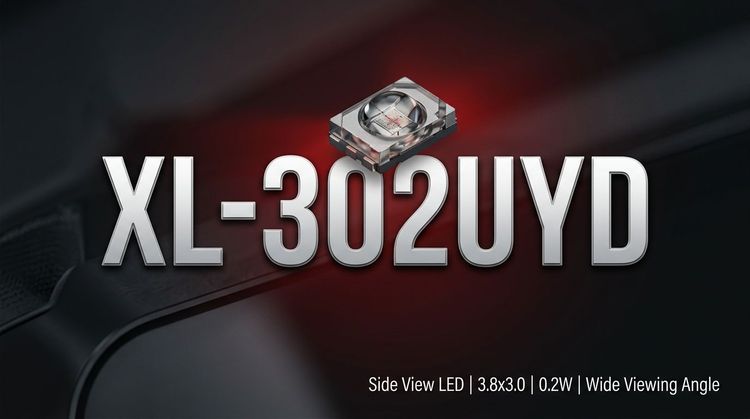
The XL-302UYD is a standard yellow LED component featuring a 3.8x3.0mm footprint and a 5.2mm height. Designed for low-voltage DC drive, it offers high energy efficiency and fast startup. The device is built with a yellow colloid and is categorized for surface mount technology (SMT) integration. Its primary design focus is on providing reliable, cost-effective illumination for applications requiring consistent yellow light output, from consumer electronics to industrial control panels.
📌 Typical Applications
This LED is suitable for a diverse set of applications due to its robust characteristics and form factor.
- Home Appliances & Digital Products: Indicator lights on control panels.
- Automotive Electronics: Status and dashboard illumination.
- Industrial & Commercial: Lighting decoration, traffic instructions, and urban lighting projects.
- Consumer & Medical: Electronic toys, electronic clocks, and medical beauty instruments.
📌 Key Technical Specifications
The core electrical and optical performance of the XL-302UYD is defined under standard test conditions (Ta=25°C, IF=20mA). These parameters are critical for circuit design and brightness consistency.
| Parameter | Symbol | Min | Typ | Max | Unit |
|---|---|---|---|---|---|
| Luminous Intensity | Iv | 200 | 500 | 900 | mcd |
| Dominant Wavelength | λd | 585 | / | 595 | nm |
| Peak Wavelength | λp | / | 590 | / | nm |
| Forward Voltage | VF | 1.8 | 2.2 | 2.4 | V |
| Viewing Angle | 2Ø1/2 | / | 30 | / | deg |
| Spectral Width | △λ | / | 20 | / | nm |
📌 Absolute Maximum Ratings & Process Limits
Adherence to these absolute maximum ratings is non-negotiable for device reliability. Exceeding these values can cause permanent damage. These ratings define the operational boundaries for design and manufacturing processes.
| Parameter | Symbol | Rating | Unit |
|---|---|---|---|
| Consumed Power | Pd | 70 | mW |
| Max Continuous Forward Current | IF | 20 | mA |
| Peak Forward Current | IFp | 80 | mA |
| Operating Ambient Temperature | Topr | -20 ~ +85 | °C |
| Storage Ambient Temperature | Tstg | -40 ~ +85 | °C |
| Reflow Soldering | Tsol | 240°C, ≤6s | - |
📌 Package, Dimensions & Assembly Notes
The XL-302UYD utilizes a compact F3 package with dimensions of 3.8x3.0x5.2mm (LxWxH). For reliable SMT assembly, the soldering point must be at least 2.0mm away from the bottom of the LED's colloid to prevent heat damage. Manual soldering should be performed at 300°C for a maximum of 3 seconds. The device is supplied in moisture-proof, anti-static EIA standard packaging with a Moisture Sensitivity Level (MSL) of 2.
📌 Sourcing & Supply Considerations
- Binning: The XL-302UYD is available in specific brightness (A2-A6), voltage (N12-7 to N12-9), and wavelength (HY03-HY06) grades for consistent performance.
- Reliability: Components have passed extensive reliability tests, including 1000-hour life testing and thermal cycling.
- Compliance: The product is RoHS compliant and suitable for a wide range of general electronics applications.
- Verification: For high-reliability applications (e.g., automotive, medical), direct consultation with XINGLIGHT is required to access specific qualification data.
📌 FAQ
Q: What is the viewing angle of the XL-302UYD?
A: The standard viewing angle (2Ø1/2) is 30 degrees.
Q: What are the brightness options (binning) for this LED?
A: The XL-302UYD is graded for luminous intensity from A2 (200-300 mcd) up to A6 (700-900 mcd) at IF=20mA.
Q: What are the key soldering conditions for this LED?
A: Reflow soldering should be at 240°C for ≤6s. Manual soldering must be at 300°C for ≤3s, with the solder joint at least 2.0mm from the colloid base.
Q: Is this LED suitable for automotive applications?
A: While the LED is used in automotive electronics, for high-reliability or safety-critical automotive components, you must consult XINGLIGHT for specific AEC-Q102 or other relevant qualification data.
Q: What is the dominant wavelength range?
A: The dominant wavelength (λd) is graded from 585nm to 595nm, with a typical peak wavelength (λp) of 590nm.