Key Takeaways • The Event: XL-C3570P8S11-62C3C2 positions a 30W-class 3570 LED at 2000–2800lm with 8.7–9.6V forward voltage at 2000mA. • The Cause: High current density and flip-chip architecture drive luminous output but increase thermal design sensitivity. • The Implication: OEM and EMS teams must tightly manage binning, reflow profiles, and heat dissipation to maintain color and reliability in automotive applications.
🔎 Opening
In high-power automotive lighting, 3570 packages remain a cost-effective platform for headlamps, auxiliary beams, and industrial luminaires. The XL-C3570P8S11-62C3C2 is specified as a 30W-class SMD LED with up to 2800lm output at 2000mA . This article examines what those numbers mean for thermal margins, bin control, and production risk.
📈 What’s Changing
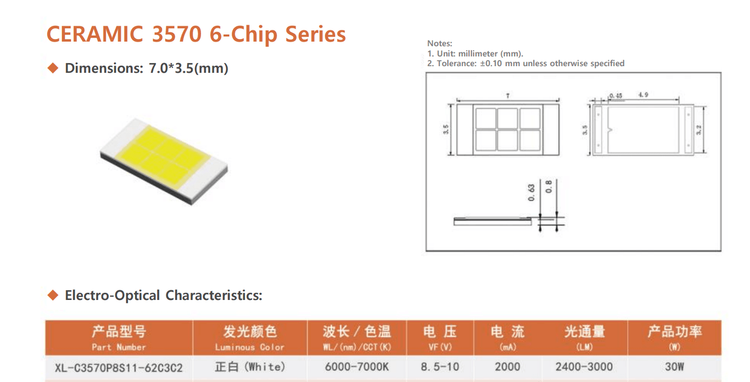
The datasheet defines a forward current of 2000mA (max 3000mA pulse) and power dissipation up to 30W . At IF = 2000mA:
Luminous flux: 2000–2800lm Forward voltage: 8.7–9.6V CCT range: 5500–7000K Viewing angle: 120° Thermal resistance (Rth j-s): 3–5°C/W
Two structural factors stand out:
Flip-chip architecture improves current spreading and thermal path efficiency.
A relatively low thermal resistance (3–5°C/W) enables high flux density within a 3.5 × 7.0 × 0.7mm footprint .
However, the junction temperature limit reaches 145°C, and derating curves (see page 5) indicate current reduction above ~105°C ambient .
📊 Data and Binning Structure
Brightness grading: S3: 2000–2200lm S4: 2200–2400lm S5: 2400–2600lm S6: 2600–2800lm
Voltage grading: 8.7–9.0V 9.0–9.3V 9.3–9.6V
Color temperature bins: 5500–6000K 6000–6500K 6500–7000K
For procurement teams, this implies three simultaneous bin management layers: flux, Vf, and CCT. Without locked bin agreements, multi-lot production may experience visible color shift or driver mismatch in constant-current systems.
🧠 Why Old Assumptions No Longer Work
Assumption 1: “30W LED equals 30W system stability.” At 2000mA and up to 9.6V, electrical input approaches 19.2W nominal. Thermal margin must consider driver inefficiency and board-level heat accumulation. The 30W rating reflects absolute maximum dissipation, not continuous system-level safe operation.
Assumption 2: “High CRI is standard.” The specified CRI is Ra 70 . For automotive forward lighting and industrial flood applications, this is typical. However, it may not meet architectural or retail lighting requirements without optical or bin customization.
Assumption 3: “Reflow is routine.” The product is MSL 3 , requiring moisture control and use within 168 hours after opening (page 12). Exceeding this window increases delamination and optical degradation risk.
🏭 Implications for OEM / EMS / Procurement
Thermal Stack-Up Risk With Rth j-s at 3–5°C/W, a 20W dissipation scenario can generate 60–100°C junction rise above solder point. Heat sink interface flatness, thermal paste uniformity, and dielectric withstand (≥500V per page 13) directly affect field reliability .
Driver Compatibility Constant current drive is mandatory. The datasheet explicitly warns against uncontrolled constant voltage use . Voltage bin spread (8.7–9.6V) must be matched with driver compliance window.
Process Discipline Maximum reflow temperature: 240±5°C for 6s recommended . Reflow cycles: maximum two. Ultrasonic cleaning: ≤300W.
Automotive EMS lines must validate full reflow profile, especially in mixed BOM assemblies.
ESD Sensitivity HBM 2000V rating reduces but does not eliminate surge risk . Grounded handling and anti-static workflow remain mandatory.
🚀 How Smart Teams Are Responding
• Locking triple-bin specifications in supply agreements. • Designing for derated current (e.g., 1700–1800mA nominal) to extend lumen maintenance. • Conducting junction temperature simulation using worst-case Rth and enclosure thermal load. • Verifying MSL workflow with automated humidity cabinets. • Implementing incoming Vf statistical sampling to protect driver yield.
In automotive lighting programs, margin discipline often outweighs peak lumen marketing figures.
🔒 Closing
The XL-C3570P8S11-62C3C2 offers competitive luminous density within a compact 3570 footprint. But its performance envelope is tightly coupled to thermal execution, bin governance, and process control.
For OEM and EMS teams evaluating 30W-class 3570 LEDs, the key question is not peak flux — it is controllable stability across temperature, lot variation, and production scale.
If you are reviewing high-power LED options for automotive or industrial platforms, it may be time to reassess your thermal and binning strategy before scaling volume.