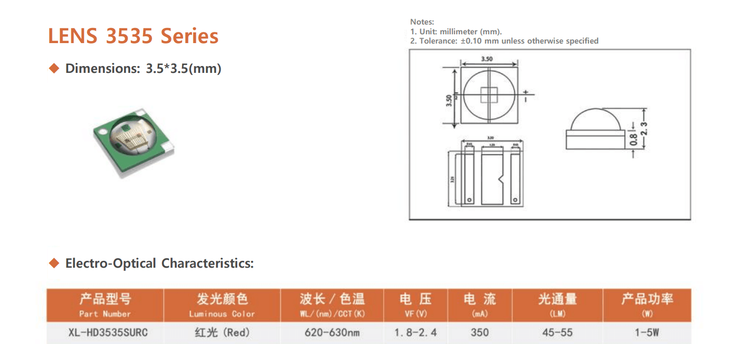
Key Takeaways • The Event: XL-HD3535SURC-A2 is a 1W-class 3535 red LED rated at 350mA, 40–60lm, 615–625nm dominant wavelength. • The Cause: High-current 3535 architecture supports compact, high-intensity signaling and flash applications. • The Implication: Procurement and engineering teams must manage wavelength binning, Vf spread, and thermal derating to ensure uniformity and field stability.
🔎 Opening
In compact signaling, mobile flash, and decorative systems, 3535 red LEDs remain a widely adopted platform due to optical intensity and PCB efficiency. The XL-HD3535SURC-A2 is specified as a 1W 3535 SMD LED with 350mA nominal drive and 40–60lm output at 25°C . This article evaluates its electrical envelope, bin structure, and production implications.
📈 What’s Changing
According to the electrical specification (page 3), key parameters at IF = 350mA include :
Power dissipation: 1000mW Forward current (max): 350mA Peak current: 700mA (≤0.1ms, duty ≤1/10) Forward voltage: 1.8–2.4V Luminous flux: 40–60lm Dominant wavelength: 615–625nm Viewing angle: 130° ESD tolerance: 3000V Junction temperature: 145°C
The device operates across –40°C to +105°C ambient range , positioning it for outdoor signage and automotive interior signaling.
The derating curve on page 5 shows current reduction above ~85–100°C ambient , indicating limited thermal margin in enclosed housings.
📊 Data and Binning Structure
Three independent bin categories are defined (page 4) :
Brightness bins: J5: 39–45lm J6: 45–52lm J7: 52–60lm
Voltage bins: 1.8–2.0V 2.0–2.2V 2.2–2.4V
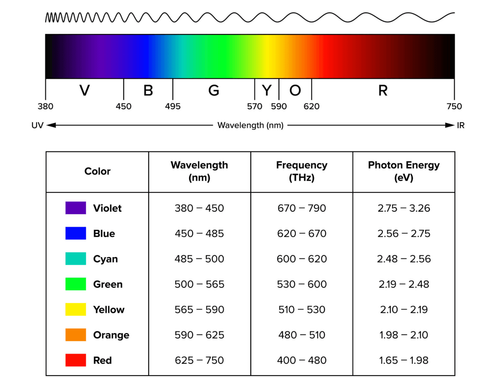
Wavelength bins: 615–620nm 620–625nm 625–630nm
For OEM programs requiring consistent red chromaticity—such as brake indicators, symbol backlighting, or signal panels—wavelength bin locking is critical. A 10nm shift within the 615–625nm band can produce visible hue variation across assembled modules.
🧠 Why Old Assumptions No Longer Work
Assumption 1: “1W class means low thermal risk.” At 350mA and up to 2.4V, electrical input reaches 0.84W. In dense multi-LED arrays, thermal stacking raises board temperature rapidly. Page 13 explicitly highlights the importance of thermal design to prevent brightness decline and color shift .
Assumption 2: “Constant voltage is acceptable.” The datasheet recommends current-regulated Circuit A and discourages constant-voltage Circuit B due to Vf variation . Without current control, LEDs with lower Vf may draw excess current, accelerating degradation.
Assumption 3: “Moisture sensitivity is secondary.” The device is MSL 3 (page 1), requiring use within 168 hours after opening and controlled storage below 30°C/40%RH . Ignoring this increases reflow-induced optical failure risk.
🏭 Implications for OEM / EMS / Procurement
Optical Uniformity Risk Wavelength grading from 615–630nm requires supply agreement clarity. Mixed bins may pass electrical QC yet fail visual uniformity audits.
Driver Margin Planning Vf spread of 1.8–2.4V creates ±0.6V variation. In parallel strings without individual current regulation, imbalance becomes significant.
Reliability Envelope 1000-hour life tests at 25°C and 350mA show zero failure in qualification samples (page 6) . However, elevated temperature cycling (–35°C to 85°C) also appears in test conditions. System designers must replicate these stress profiles at module level.
Reflow Discipline Maximum recommended reflow: 240±5°C / 6s; maximum two cycles . Excess thermal exposure risks resin stress and bond damage.
ESD Control HBM 3000V rating provides moderate robustness, but grounding and anti-static handling remain mandatory (page 12) .
🚀 How Smart Teams Are Responding
• Locking brightness + wavelength bins in AVL documentation. • Designing current-regulated channels per LED string. • Applying thermal simulation in multi-LED PCB clusters. • Verifying reflow profiles under worst-case board mass. • Performing incoming spectral sampling to prevent chromatic drift.
In signaling and flash systems, consistency across units often outweighs maximum lumen output.
🔒 Closing
The XL-HD3535SURC-A2 delivers stable 350mA performance within a compact 3535 footprint, covering 615–625nm red applications with controlled flux and voltage bins.
Its reliability, however, is closely linked to thermal execution, current regulation, and bin governance.
For OEM and EMS teams integrating 1W red LEDs into signaling or flash platforms, the primary risk is not electrical overstress—but uncontrolled variability across production lots.
Re-evaluating bin strategy and driver architecture early can significantly improve field stability and visual consistency.