📌 Product Overview
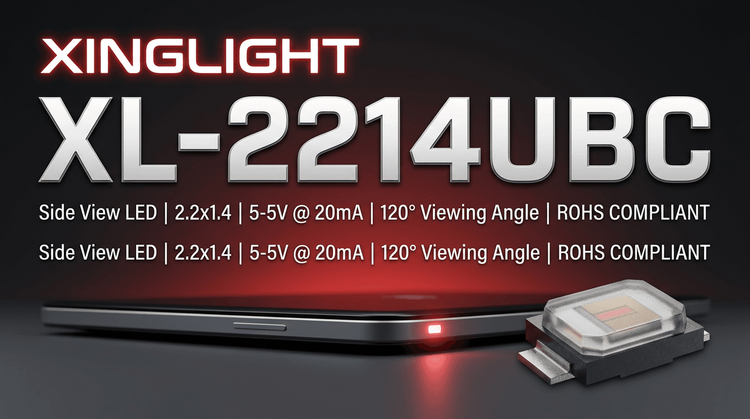
The XL-2214UBC is a compact, high-intensity blue SMD LED designed by XINGLIGHT. 💡 It features a transparent colloid optimized for maximum brightness and a miniature 2.2x1.4mm footprint suitable for high-density board layouts.
Target applications primarily include commercial lighting displays, LCD backlights, and flexible light strips. The real design focus here is maintaining luminous intensity while strictly adhering to thermal management and ESD handling protocols. 👇 This component is engineered for automated SMT processes but requires careful attention to moisture sensitivity levels during assembly.
💡 Typical Applications
Based on its optical characteristics and compact form factor, the XL-2214UBC is best suited for the following scenarios:
- Commercial Lighting & Signage: Ideal for advertising characters and light boxes where consistent color and high visibility are required.
- Automotive Interiors: Designed for dashboard illumination and soft ambient lighting within vehicle cabins.
- Consumer Electronics: Used extensively in LCD backlighting for small displays and indicator panels.
- Decorative Lighting: Its size and output make it perfect for integration into flexible light strips for architectural or accent lighting.
📈 Key Technical Specifications
The following table outlines the critical optoelectronic parameters under standard test conditions ($T_a=25^\circ C$).
| Parameter | Symbol | Test Conditions | Min. | Typ. | Max. | Unit |
|---|---|---|---|---|---|---|
| Luminous Intensity | $I_V$ | $I_F=20mA$ | 500 | - | 700 | mcd |
| Dominant Wavelength | $\lambda_d$ | $I_F=20mA$ | 460 | - | 475 | nm |
| Peak Wavelength | $\lambda_p$ | $I_F=20mA$ | - | 465 | - | nm |
| Viewing Angle | $2\theta_{1/2}$ | $I_F=20mA$ | - | 120 | - | deg |
| Forward Voltage | $V_F$ | $I_F=20mA$ | 2.8 | - | 3.4 | V |
| Reverse Current | $I_R$ | $V_R=5V$ | - | - | 1 | $\mu A$ |
🔒 Absolute Maximum Ratings & Process Limits
Exceeding these ratings may cause permanent damage or failure. ⚠️ Design engineers must ensure the design operates within these limits to guarantee long-term reliability.
| Parameter | Symbol | Value | Unit | Notes |
|---|---|---|---|---|
| Power Dissipation | $P_D$ | 70 | mW | |
| DC Forward Current | $I_F$ | 20 | mA | |
| Peak Forward Current | $I_{FP}$ | 80 | mA | 1/10 Duty, 0.1ms Pulse |
| ESD Capability | ESD | 2000 | V | Human Body Model |
| Operating Temperature | $T_{opr}$ | -40 ~ +85 | $^\circ C$ | |
| Storage Temperature | $T_{stg}$ | -40 ~ +85 | $^\circ C$ | |
| Soldering Temp | $T_{sol}$ | 260 | $^\circ C$ | $\le 6$ Seconds |
📦 Package, Dimensions & Assembly Notes
Physical Characteristics: The XL-2214UBC utilizes a standard 2214 metric package with precise Outline Dimensions: 2.2 x 1.4 x 1.35mm. The transparent water-clear colloid maximizes light output efficiency.
Assembly & Soldering Guidelines:
- Moisture Sensitivity: Classified as MSL 3. Components must be baked according to J-STD-033 standards if exposed to ambient air beyond the floor life to prevent popcorning during reflow.
- Reflow Soldering: Suitable for infrared reflow processes. Reflow should not exceed 2 cycles.
- Hand Soldering: Only recommended for rework. Use an iron $\le 30W$ at $<300^\circ C$ for max 3 seconds per pad. ⚠️ Excessive heat or time can degrade the chip or epoxy.
- Packaging: EIA standard compliant packaging ensures compatibility with automated pick-and-place machinery.
🚀 Sourcing & Supply Considerations
- Supply Chain Verification: Always verify packaging integrity (MSL labels) upon receipt to ensure the components have not been degraded by moisture exposure prior to use.
- Bin Selection: The XL-2214UBC is available in specific brightness (E4-E7) and voltage (N13) bins. Confirm your required bin code (e.g., HB04 for wavelength) with the supplier to ensure color consistency in your final product.
- Sample Evaluation: Request pre-production samples to validate the 460-475nm wavelength range against your specific light guide or diffuser materials, as optical properties can vary by housing.
❓ FAQ
Q: What is the MSL level of the XL-2214UBC and why does it matter? A: The XL-2214UBC has a Moisture Sensitivity Level (MSL) of 3. This means it can be exposed to ambient air for 168 hours (one week) before it must be reflowed. If stored longer or opened past this limit, you must bake the components to remove absorbed moisture; otherwise, the internal steam generated during high-temperature soldering can crack the LED package ("popcorning").
Q: Can I drive this LED at 30mA for higher brightness? A: The Absolute Maximum Rating for DC Forward Current is 20mA. While a pulse current up to 80mA is allowed (very short duration), driving it continuously at 30mA will likely accelerate thermal degradation, shorten lifespan, and potentially void the warranty. Always design within the 20mA DC limit.
Q: What is the typical forward voltage I should account for in my driver design? A: The typical forward voltage is not directly listed, but the range is 2.8V to 3.4V at 20mA. For driver circuit design, you should plan for a worst-case maximum of 3.4V to ensure sufficient voltage headroom, while assuming a typical load around 3.0V for power consumption calculations.
Q: Is this LED suitable for outdoor applications? A: The datasheet specifies an operating range of -40°C to +85°C, which covers most environmental extremes. However, the LED itself is not waterproof. For outdoor use (e.g., advertising light boxes), it must be housed in an IP-rated enclosure with appropriate potting or silicone sealing to protect the leads and package from water ingress.
Q: How should I handle these components during manual assembly? A: Hand soldering is permitted for repair only. You must use a soldering iron with power less than 30W and tip temperature below 300°C. Crucially, the soldering time must not exceed 3 seconds per terminal, and each terminal should only be soldered once. Repeated heating will damage the internal die bond.