📌 Product Overview
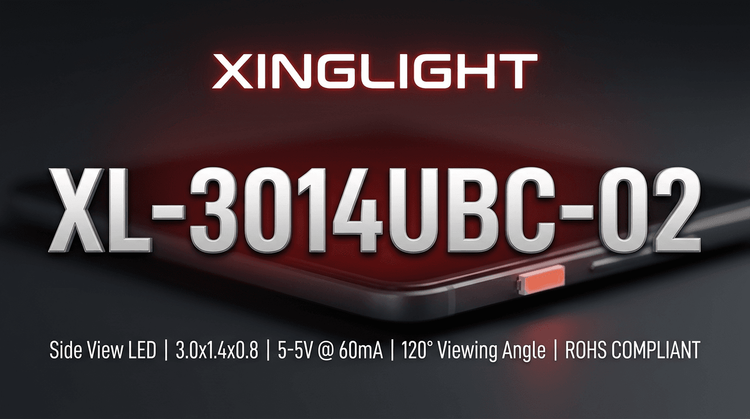
The XL-3014UBC-02 from XINGLIGHT is a high-performance Blue SMD LED designed for space-constrained lighting solutions. 💡 Housed in a compact 3.0x1.4x0.8mm package with a transparent colloid, it delivers luminous intensity up to 1800 mcd. 👇 This component is ideal for engineers balancing high brightness with dense PCB integration, such as LCD backlights and rigid light strips. Design focus must prioritize thermal dissipation to maintain the 60mA drive current and ensure consistent color output.
🚀 Typical Applications
Based on its 120° viewing angle and high-intensity output, the XL-3014UBC-02 is optimized for:
- Indoor Lighting: High-density lamp tubes and flexible light strips.
- Commercial Displays: 📈 Bright advertising boards and signage requiring uniform blue light.
- Backlighting: LCD units where the 3.0mm profile aids thinness.
- Decorative & Automotive: Metal plate hard light strips and internal auxiliary car lighting.
- Consumer Electronics: Indicator lights and status displays.
⚡ Key Technical Specifications
The following electrical and optical characteristics are measured at Ta=25°C (IF=60mA). 💡 Designers should pay close attention to the "F" Brightness Grading and "HB" Wavelength Bins to ensure batch consistency.
| Parameter | Symbol | Min. | Typ. | Max. | Unit | Notes |
|---|---|---|---|---|---|---|
| Luminous Intensity | Iv | 1000 | - | 1800 | mcd | Grading: F1-F5 |
| Dominant Wavelength | λd | 455 | - | 470 | nm | Blue (HB03-HB05) |
| Forward Voltage | VF | 2.8 | - | 3.4 | V | Grading: N13-3 to 5 |
| Viewing Angle | 2Ø1/2 | - | 120° | - | deg | - |
| Peak Wavelength | λp | - | 465 | - | nm | - |
| Reverse Current | IR | - | - | ≤5 | μA | VR=5V |
🔒 Absolute Maximum Ratings & Process Limits
Exceeding these parameters risks irreversible damage. 🔒 Crucial for reliability: The Absolute Maximum Ratings define the stress boundaries, while the soldering profiles dictate assembly yield.
| Parameter | Symbol | Max. Value | Unit | Conditions |
|---|---|---|---|---|
| Max Power Dissipation | PD | 200 | mW | - |
| Max Forward Current | IF | 60 | mA | Continuous |
| Peak Forward Current | IFP | 120 | mA | Pulse ≤0.1ms, Duty≤1/10 |
| Max Reverse Voltage | VR | 5 | V | - |
| ESD Ability | ESD | 2000 | V | Human Body Model |
| Operating Temp. | TOPR | -40 ~ +85 | °C | - |
| Soldering Temp. | TSOL | 260 | °C | ≤6 Seconds |
📦 Package, Dimensions & Assembly Notes
- Outline Dimensions: 3.0 (L) x 1.4 (W) x 0.8 (H) mm.
- Soldering Guidelines: The device supports both Lead and Lead-Free infrared reflow processes.
- Lead-Free: Peak temp 255°C (Time above 217°C: 60-120s).
- Lead: Peak temp 235°C (Time above 183°C: 60-150s).
- Moisture Sensitivity: 🚨 MSL Level 3. Ensure proper baking and dry storage to prevent "popcorning" during reflow.
- Packaging: EIA standard compliant, suitable for fully automated SMT placement.
🛒 Sourcing & Supply Considerations
- Bin Selection: Verify brightness (F-code) and voltage (N-code) bins with your distributor to match your driver circuit design.
- Authenticity: Source exclusively through XINGLIGHT authorized channels to avoid counterfeits that fail reliability testing.
- Samples: Request engineering samples for thermal testing under your specific housing conditions.
- Lead Time: Check stock for high-grade bins (F4/F5), as these may have longer lead times than standard grades.
❓ FAQ
Q: What does the "MSL Level 3" rating mean for my assembly process?A: MSL (Moisture Sensitivity Level) 3 means the components have a floor life of 168 hours after opening the vacuum seal. If they are exposed to ambient air longer than this before soldering, you must bake them (typically at 125°C for 24 hours) to remove absorbed moisture. Failure to do so can cause internal cracking ("popcorning") during the high heat of reflow soldering.
Q: Can I drive this LED at the peak current of 120mA continuously?A: No. The 120mA rating is strictly for pulsed operation (pulse width ≤0.1ms, duty cycle ≤1/10). Driving it continuously at 120mA will likely exceed the maximum power dissipation (200mW) and cause immediate thermal failure or significantly reduced lifespan. The safe continuous current is 60mA.
Q: How do I choose the right brightness grading (F1 vs F5) for my design?A: This depends on your optical mixing and uniformity requirements. If you are using a light guide diffuser (like in LCD backlighting), mixing F1 and F5 LEDs on the same board can help average out brightness variations. If you are using direct view (like an indicator), ensure all LEDs on a single board come from the same bin code to avoid visible patches of different brightness levels.
Q: What is the difference between Dominant Wavelength and Peak Wavelength?A: Peak Wavelength (λp=465nm) is the physical intensity maximum on the spectral curve. Dominant Wavelength (λd=455-470nm) is the color perceived by the human eye. For design matching, focus on Dominant Wavelength, as that determines the visual color consistency of your product.
Q: Are there specific storage requirements to maintain warranty?A: Yes. Store the LEDs at temperatures between -40°C and +85°C with relative humidity below 90%. Always keep them in their original sealed anti-static bags until ready for production. Exposure to high humidity or extreme temperatures outside these ranges can degrade the transparent colloid or the phosphor performance over time.