Opening
In LED lighting design, wattage is often treated as a shortcut for performance. The assumption is simple: same watts, similar light. In reality, this is one of the most common misconceptions in luminaire selection. The way light behaves is defined far less by electrical input and far more by how the LED source is constructed. This distinction becomes especially clear when comparing COB and SMD LEDs—and explains why identical wattage can produce radically different visual and optical outcomes.
What’s Changing
Modern lighting projects are increasingly application-driven rather than component-driven. Designers now prioritize beam control, glare limitation, and visual comfort alongside efficiency. As a result, the structural differences between COB and SMD LEDs are no longer academic details; they directly influence luminaire performance, compliance, and end-user perception.
Why Old Assumptions No Longer Work
For years, many buyers evaluated LEDs primarily by wattage and lumen output. This approach ignores how light exits the source.
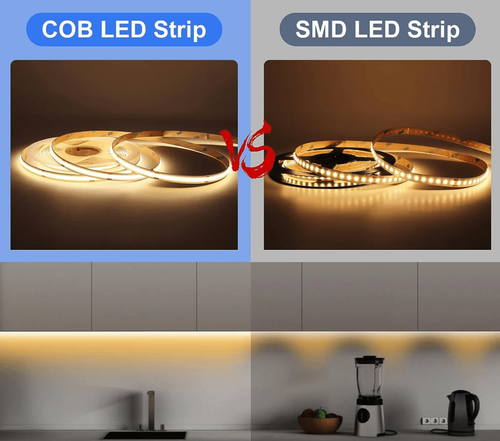
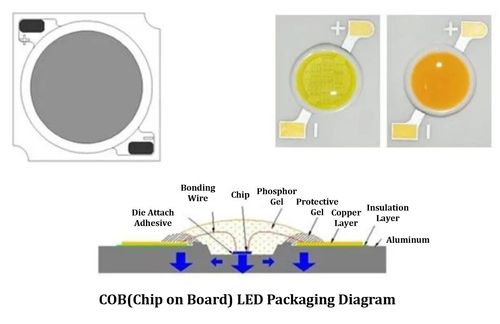
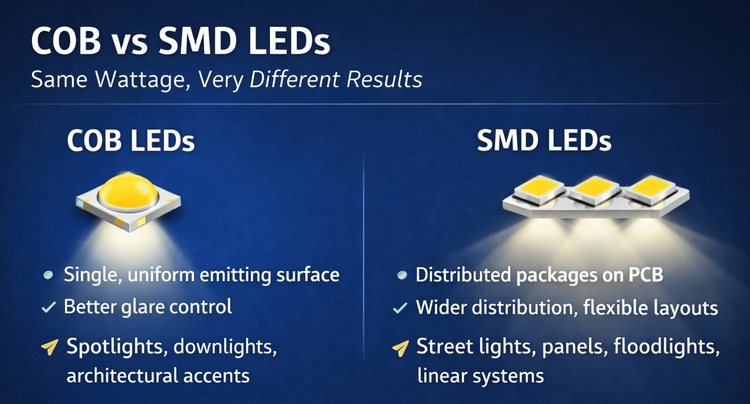
COB (Chip on Board) LEDs integrate multiple chips into a single, uniform emitting surface. The result is high luminance density with predictable optical control. When paired with reflectors or lenses, COB sources allow tighter beams and better glare management.
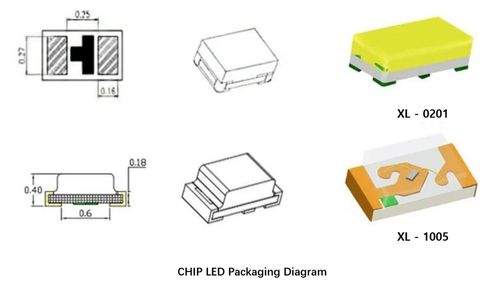
SMD (Surface-Mounted Device) LEDs distribute many small packages across a PCB. Light is emitted from multiple points, naturally creating wider distribution and enabling flexible layouts, scaling, and thermal balancing.
Treating these two formats as interchangeable simply because the wattage matches leads to poor beam quality, glare issues, or inefficient optics.
Implications for OEM / EMS / Procurement
For OEMs and EMS providers, the COB vs SMD decision affects more than light quality:
Optical design: COB favors spot, downlight, and accent luminaires; SMD suits panels, streetlights, floodlights, and linear systems.
Cost structure: SMD solutions often scale more easily and reduce per-unit cost at volume, while COB can lower secondary optical complexity.
Risk management: Misalignment between LED format and application often results in redesign cycles, certification delays, or field complaints.
Procurement teams that specify only wattage without optical intent tend to absorb these downstream costs later.
How Smart Teams Are Responding
More experienced teams start from the application, not the component. They define how light should behave—beam angle, uniformity, glare threshold—before selecting COB or SMD.
In practice, this means using both formats deliberately. With partners such as XINGLIGHT, sourcing strategies increasingly combine SMD LEDs (2835, 3030, 5050, including automotive-grade options) alongside COB strips and modules for low-glare architectural designs. At LDeepAI, this dual-track approach reflects a broader industry shift: watts are a constraint, not a design goal.
Closing
Good lighting does not start with wattage. It starts with understanding how light should work—then choosing the LED structure that delivers that intent consistently. Long-term performance depends less on power numbers and more on optical clarity.
#LEDLighting
#COBLED
#SMDLED
#LightingDesign
#ArchitecturalLighting