🏁 Product Overview
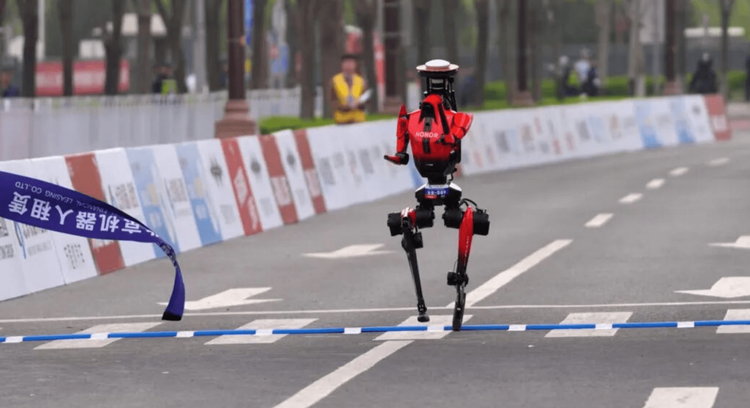
On April 19, 2026, Honor’s autonomous humanoid robot “Shandian” won the Beijing E-Town humanoid half-marathon in 50 minutes 26 seconds on a 21.0975 km course. The bigger signal for the electronics industry is not the headline time alone, but the fact that the event rewarded autonomy, stability, endurance, and recovery under mixed-terrain conditions rather than pure sprint speed.
For OEM, EMS, and component teams, this result is best read as a system-integration milestone. Official race materials and race-day reporting point to the same bottlenecks: path planning, dynamic balance, thermal performance, component durability, battery lifetime, and response speed.
🚀 Typical Applications
Factory inspection and repetitive industrial assistance.
Retail reception and guided interaction.
Public-space service robots with visible status indication.
Companion and sports-adjacent platforms that combine mobility, sensing, and user feedback.
📊 Key Technical Specifications
The table below captures the verified race and platform facts most relevant to component and subsystem teams.
Item Verified detail
Winning robot Honor “Shandian,” autonomous navigation
Winning time 50:26 net time
Course length 21.0975 km
Terrain Flat sections, slopes, turns, narrow sections, near-90° corners
Ranking method Autonomous and remote-control teams mixed together
Scoring coefficients Autonomous 1.0; remote-control 1.2
Entry constraints Humanoid, bipedal, self-moving; 75 cm to 180 cm height
Race support 7 supply stations; RFID chip timing with 0.1 s precision
Verified from official race rules and race-day coverage.
⚠️ Absolute Maximum Ratings & Process Limits
What mattered in this event was not only motion capability, but compliance with process limits.
Constraint Engineering meaning
Start interval: 1 robot every 30 seconds Stable boot, launch, and initial balance matter
Max 2 robot replacements Reliability must be designed in, not repaired in-field
First/second replacement penalty 15 min / 20 min
More than 3 illegal manual interventions Team is reclassified to remote-control scoring
Full-course cutoff 3 h 40 min after the last robot starts
On-track fault handling Cooling/restart allowed in some cases; no part replacement or parameter retuning on the course
That is why thermal design, connectors, wiring integrity, battery management, and mechanical robustness are component-level issues, not secondary details. Xinhua’s race coverage explicitly highlighted heat dissipation, lightweighting, and hardware reliability, while Reuters preview coverage called out component durability and battery lifetime as central variables.
📦 Package, Dimensions & Assembly Notes
Honor’s larger “Shandian” platform is reported at 169 cm, with autonomous perception/navigation and a self-developed high-dynamic motion system. The smaller “Yuanqizai” is reported at 136.9 cm and targets interactive use cases with multimodal perception and understanding.
From an assembly perspective, the practical priorities are lightweight structures, thermally efficient power paths, compact but serviceable sensor integration, vibration-resistant connectors, and cable routing that survives repeated gait cycles. Reporting also indicates Shandian supports real-time interaction feedback such as light-strip effects, which makes LED packaging, drivers, and optical consistency part of the HMI design problem rather than a decorative afterthought.
🔌 What This Means for Electronic Components and LED Chips
The race does not reveal the exact vendor list inside the winning robot. What it does reveal, quite clearly, is which component classes decide whether a humanoid platform stays upright, responsive, cool, and serviceable over real distance: motion-control semiconductors, processors, sensors, power devices, passives, connectors, batteries, thermal materials, and robust electromechanical interfaces.
LED chips matter in two practical layers. First, they support robot-state visibility through communication, mode, and safety indicators; industrial robot control ecosystems already use dedicated status and safety LEDs for fault and operating-state feedback. Second, in some vision subsystems, controlled LED illumination improves image consistency and lowers integration risk when chosen early. That makes LED selection a reliability and usability decision, not only a styling decision.
🔗 Sourcing & Supply Considerations
A robot that wins under weighted autonomy rules is usually backed by a stable subsystem BOM, not by a single standout algorithm.
For procurement teams, the priority is long-term availability, lot consistency, second-source readiness, and counterfeit-risk control across motion ICs, sensors, power devices, connectors, and LED components.
For engineering teams, solderability, thermal margin, cable-flex life, and retention under repeated impact cycles should be validated against real motion profiles.
At LDeepAI, sourcing discussions are most useful when they begin with subsystem risk and process compatibility, not with nominal headline specs alone.
❓ FAQ
Q1: Did Shandian really beat the human half-marathon record?
A: It beat the 57:20 men’s benchmark from Lisbon cited by Xinhua, AP, and World Athletics. Some media comparisons also referenced 56:42, but Reuters reported that faster Barcelona run as non-ratified because of unauthorized pacing.
Q2: Why was the first robot across the line not the champion?
A: Because the event used weighted scoring. A remote-controlled Honor robot reportedly crossed first in 48:19, but remote-control results were multiplied by 1.2, while autonomous robots used a 1.0 coefficient.
Q3: What did this race really test?
A: Beyond speed, it tested endurance, path planning, balance, thermal control, hardware reliability, and system response under complex terrain.
Q4: Where do LED chips fit in a humanoid robot BOM?
A: In status indication, safety signaling, interaction light bars, and in some machine-vision lighting setups where repeatable image quality matters.
Q5: Is this already a mass-market humanoid robot industry?
A: Not yet. The technical progress is real, but Reuters and AP both note that broad commercial deployment still depends on better software capability, reliability, and economics.