📌 Product Overview
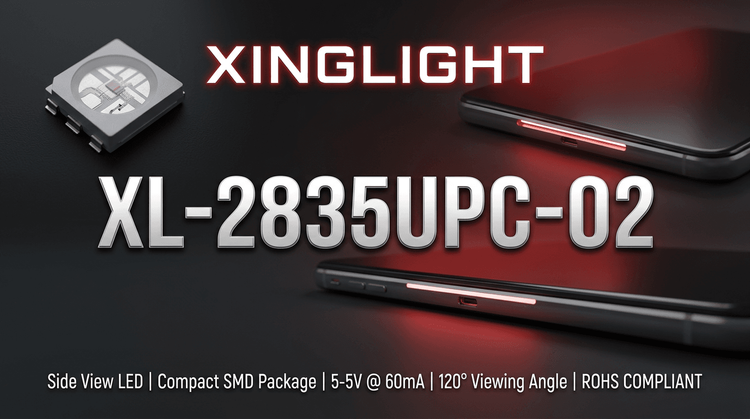
The XL-2835UPC-02 is a high-reliability Surface Mount Device (SMD) LED from XINGLIGHT, featuring a specialized pink luminous color with a matching pink colloid. 💡 It utilizes the standard industry 2835 footprint (2.8mm x 3.5mm), making it ideal for high-density LED arrays on flexible strips and rigid boards. While often categorized under decorative lighting, its 120-degree viewing angle and robust optical characteristics make it suitable for commercial signage and LCD backlighting. ✨ Designers should focus on its specific voltage grading and thermal dissipation requirements to ensure consistent color stability and longevity in end products.
🚀 Typical Applications
Based on its pink chromaticity and optical power, the XL-2835UPC-02 is optimized for the following scenarios:
- Commercial Lighting & Signage: Ideal for advertising words, light boxes, and channel letters where high CRI pink light is required.
- Decorative & Ambient Lighting: Suitable for flexible light strips used for holiday lighting, accent lighting, and architectural decoration.
- Indoor Functional Lighting: Can be integrated into fluorescent tubes or downlights for specific ambiance requirements.
- LCD Backlighting: Provides stable pink illumination for display panels and indicator lights.
📈 Key Technical Specifications
The performance of the XL-2835UPC-02 is defined by its optical and electrical behavior under standard test conditions (Ta=25℃).
| Parameter | Symbol | Min. | Typ. | Max. | Unit | Test Conditions |
|---|---|---|---|---|---|---|
| Luminous Intensity | Φ | 13 | — | 23 | LM | IF = 60mA |
| Forward Voltage | Vf | 2.8 | — | 3.4 | V | IF = 60mA |
| Viewing Angle | 2θ1/2 | — | 120 | — | Deg | IF = 60mA |
| Reverse Current | Ir | — | — | 5 | μA | VR = 5V |
| Chromaticity (x) | x | — | 0.287 | — | — | IF = 60mA |
| Chromaticity (y) | y | — | 0.117 | — | — | IF = 60mA |
🔒 Note: The product is subject to Brightness (H8/H9/J1) and Voltage (N13-3 to N13-5) grading. Ensure your supply chain matches the specific bin codes required for your design to avoid luminance variation.
⚠️ Absolute Maximum Ratings & Process Limits
Exceeding these parameters may result in permanent device failure. 👇 These limits are critical for safety and reliability design.
| Parameter | Symbol | Max. Value | Unit | Notes |
|---|---|---|---|---|
| Max Power Dissipation | PD | 200 | mW | |
| Max Continuous Forward Current | IF | 60 | mA | |
| Peak Forward Current | IFP | 150 | mA | Pulse width ≤0.1ms, Duty ≤1/10 |
| Max Reverse Voltage | VR | 5 | V | |
| ESD Ability | ESD | 2000 | V | |
| Operating Temperature | TOPR | -40 ~ +85 | ℃ | |
| Storage Temperature | TSTR | -40 ~ +85 | ℃ | |
| Soldering Temp/Time | TSOL | 260 | ℃ | ≤ 6 Seconds |
📦 Package, Dimensions & Assembly Notes
The XL-2835UPC-02 is designed for automated SMT production and infrared reflow soldering processes.
- Dimensions: The outline measures 2.8mm x 3.5mm x 0.8mm (L x W x H).
- MSL Level: 🚨 The component is classified as Moisture Sensitivity Level (MSL) 3. It must be baked according to J-STD-033 standards before reflow if the dry pack is exposed to ambient air for longer than the specified floor life (usually 168 hours).
- Soldering Guidelines: Compatible with both Lead-free (Peak 255℃) and Lead (Peak 235℃) reflow profiles. Ensure the cooling rate does not exceed 6℃/second to prevent thermal shock.
- Packaging: Provided in EIA standard compliant tape and reel formats to facilitate high-speed automated placement.
🛒 Sourcing & Supply Considerations
To ensure production yield and supply chain stability for the XL-2835UPC-02, consider the following factors:
- Bin Consistency: Verify that the supplier can guarantee consistent Brightness (H8-J1) and Voltage (N13-3 to N13-5) bins across different production batches.
- Authenticity: Source exclusively through authorized channels to avoid counterfeits that may not meet the ROHS compliance or thermal resistance specs.
- Sample Support: Request pre-production samples to validate the pink chromaticity coordinates (x=0.287, y=0.117) against your specific housing materials.
- Technical Support: Engage with suppliers who provide detailed reliability data (e.g., 1000h high-temperature storage life) to support your own product certification processes.
❓ FAQ
Q: What does the "MSL 3" rating mean for my assembly process?
A: MSL 3 (Moisture Sensitivity Level 3) means the LED is sensitive to moisture absorption. If the vacuum-sealed bag is opened and the components are not used within 168 hours (1 week), they must be baked at a specific temperature (e.g., 125±5℃) to drive out moisture before reflow soldering. Failure to do so can cause "popcorning" or internal delamination during the high-temperature soldering process.
Q: Can I drive the LED at 150mA continuously?
A: No. The datasheet specifies 60mA as the Max Continuous Forward Current. The 150mA rating is strictly for pulsed operations (pulse width ≤0.1ms, duty cycle ≤1/10). Running at 150mA continuously will likely overheat the die and significantly reduce lifespan or cause immediate failure.
Q: Why are there multiple codes like H8, H9, and J1?
A: These are brightness grading codes. Due to manufacturing variances, not all LEDs produce exactly the same amount of light. H8 covers 13-17 LM, H9 covers 17-20 LM, and J1 covers 20-23 LM. For a uniform light appearance in your final product, you should generally use LEDs from the same brightness bin code.
Q: Is this LED suitable for outdoor flexible light strips?
A: While the XL-2835UPC-02 is designed for flexible strips, its standard operating range is -40℃ to +85℃. For outdoor use, you must ensure the final light strip has an IP-rated waterproofing coating (e.g., silicone encapsulation) to protect the LED from rain and humidity, as the component itself is not inherently waterproof.
Q: What is the typical forward voltage I should design my driver for?
A: The forward voltage ranges from 2.8V to 3.4V. When designing a constant current driver, you should account for the maximum voltage (3.4V) to ensure sufficient voltage headroom, and consider the minimum voltage (2.8V) to calculate power dissipation in your current limiting components.