📌 Product Overview
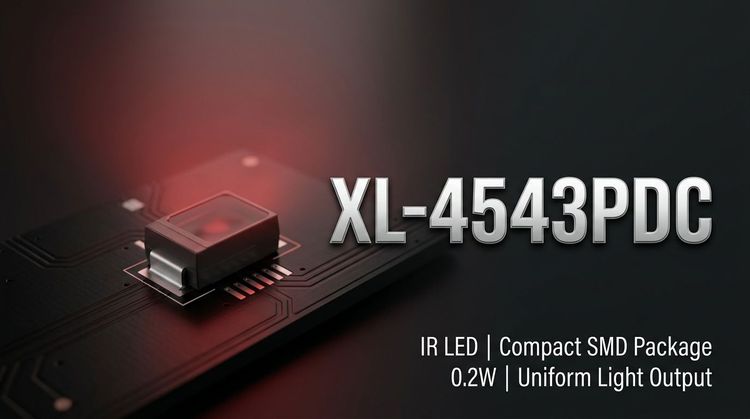
The XL-4543PDC is a 940nm infrared phototransistor characterized by high energy efficiency and fast signal response. 📦 Encapsulated in a black epoxy colloid to minimize ambient light interference, this component is engineered for reliable performance in various photodetection scenarios. Designed for seamless SMT integration, it features an EIA standard-compliant package suitable for high-density PCB assembly.
🚀 Typical Applications
Based on its spectral sensitivity (700–1100nm) and switching speed (Tr/Tf ≤ 30ns), the XL-4543PDC is optimized for:
- Consumer Electronics: Infrared remote controllers and camera monitoring heads.
- Industrial Automation: Counters, thermal imaging sensors, and smart metering interfaces.
- Robotics: Intelligent cars and navigation sensors requiring precise obstacle detection.
- Wireless Systems: Short-range signal transmission and photoelectric switching logic.
📊 Key Technical Specifications
The table below outlines the electro-optical characteristics (Ta=25°C) essential for circuit design calculations.
| Parameter | Symbol | Min | Typ | Max | Unit | Test Condition |
|---|---|---|---|---|---|---|
| Peak Wavelength | $\lambda_p$ | - | 940 | - | nm | - |
| Light Current | $I_L$ | 25 | 35 | 45 | $\mu A$ | $V_R=5V, E=1.0mW/cm^2$ |
| Dark Current | $I_D$ | - | - | 30 | $nA$ | $V_R=10V, E=0$ |
| Rise / Fall Time | $T_r / T_f$ | - | 30 | - | $ns$ | $V_{CE}=5V, R_L=1k\Omega$ |
| Reverse Voltage | $V_r$ | 30 | - | - | $V$ | $I_r=100\mu A$ |
| View Angle | $2\theta_{1/2}$ | - | - | $\pm60$ | deg | $\lambda=940nm$ |
⚠️ Absolute Maximum Ratings & Process Limits
Exceeding these ratings may cause permanent device failure. ⚡ Designers must strictly observe the Collector-Emitter voltage and power dissipation limits during operation.
| Parameter | Symbol | Max Rating | Unit | Notes |
|---|---|---|---|---|
| Collector-Emitter Voltage | $V_{CEO}$ | 30 | $V$ | - |
| Emitter-Collector Voltage | $V_{ECO}$ | 5 | $V$ | - |
| Operating Temperature | $T_{opr}$ | -20 ~ +85 | $^\circ C$ | Ambient range |
| Storage Temperature | $T_{stg}$ | -40 ~ +85 | $^\circ C$ | - |
| Soldering (Reflow) | $T_{sol}$ | 260 | $^\circ C$ | Max 6 seconds |
| Soldering (Manual) | - | 300 | $^\circ C$ | Max 3 seconds |
Note: Pulse width must be ≤ 0.1ms with a duty cycle ≤ 1/10.
📐 Package, Dimensions & Assembly Notes
The component features a compact appearance dimension of 4.8 x 4.4 x 8.7 mm.
- Soldering Profile: 👇 Recommended max reflow temperature is 240°C ± 5°C for 6s.
- Moisture Sensitivity: Classified as MSL 3. Devices must be baked prior to reflow if moisture-sensitive handling is required to prevent popcorning.
- Handling: Avoid direct contact with the epoxy encapsulant to prevent contamination or static damage. Do not apply mechanical stress to the resin during high-temperature phases.
📦 Sourcing & Supply Considerations
- Compliance: 🌱 The product adheres to ROHS environmental directives, ensuring compatibility with global lead-free manufacturing standards.
- Packaging: Supplied in EIA standard tape and reel formats, facilitating automated feeder setup for pick-and-place machines.
- Quality Control: Typical luminous intensity error is guaranteed within ±15%, supporting consistent binning for mass production.
❓ Frequently Asked Questions (FAQ)
Q: What is the recommended soldering profile for the XL-4543PDC?
A: For lead-free reflow soldering, the peak temperature should not exceed 260°C for 6 seconds. If manual soldering is necessary for repairs, use an iron below 30W and limit contact time to 3 seconds at 300°C to protect the internal die and bonds.
Q: How does the black epoxy colloid affect performance?
A: The black encapsulant filters out visible light noise, enhancing the signal-to-noise ratio for the 940nm infrared receiver. This ensures reliable operation in environments with high ambient light intensity, such as near monitors or under industrial lighting.
Q: Can this component be used for high-speed data transmission?
A: With a typical rise/fall time of 30ns, the XL-4543PDC supports moderate-speed carrier frequencies common in standard remote control protocols (e.g., 38kHz). However, for very high-speed data links, engineers should verify the bandwidth against specific signal modulation requirements.
Q: What are the storage requirements to prevent damage?
A: The storage ambient temperature range is -40°C to +85°C. Given the MSL 3 classification, if the sealed bag has been opened, the components should be soldered within a specified window (usually 168 hours) or baked according to IPC/JEDEC standards to prevent moisture-induced damage during reflow.