2. Article Body
📌 Product Overview
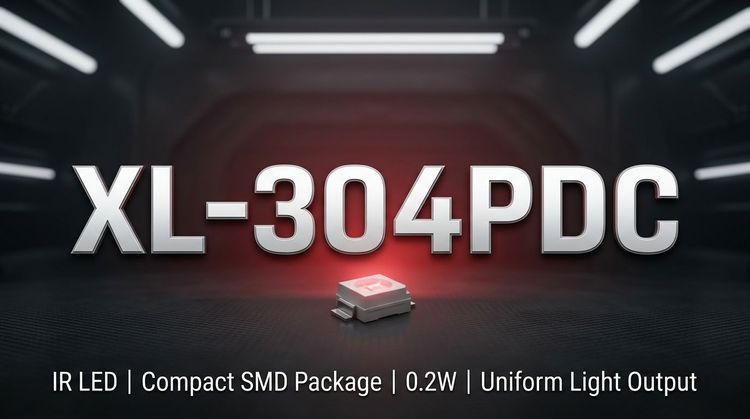
The XL-304PDC is a silicone-based infrared phototransistor packaged in a standard 3mm (F3) radial form factor. Designed for ambient light filtering and signal reception, it features a black epoxy colloid that minimizes visual noise while enhancing infrared sensitivity. 🎯 Target applications primarily involve non-contact sensing and optical data transmission in compact circuit designs.
This component is engineered to support switching speeds with rise and fall times typically around 3μs. It is suitable for through-hole assembly (THT) processes, offering mechanical stability for industrial environments where vibration resistance is required.
⚙️ Typical Applications
Based on its spectral sensitivity (940nm) and electrical characteristics, the XL-304PDC is utilized in the following scenarios:
- Consumer Electronics: Infrared receiver modules for remote controls and home automation interfaces.
- Industrial Automation: Optical counters, photoelectric switches, and proximity sensors in production lines.
- Smart Systems: Integration into intelligent toys and robotics for obstacle detection and pathfinding.
- Instrumentation: Pulse detection in utility meters and basic data transmission modules.
📊 Key Technical Specifications
The performance of the XL-304PDC is defined by its electro-optical response under standard test conditions (Ta=25°C).
| Parameter | Symbol | Min | Typ | Max | Unit | Condition |
|---|---|---|---|---|---|---|
| Collector-Emitter Breakdown | V(BR)CEO | 30 | - | - | V | Ic=100μA |
| Emitter-Collector Breakdown | V(BR)ECO | 5 | - | - | V | Ie=100μA |
| Collector Dark Current | Io | - | - | 100 | nA | Vce=10V |
| On-State Collector Current | I(on) | 0.1 | - | 0.4 | mA | Ee=1mW/cm² |
| Rise Time | Tr | - | 3 | - | μs | Vce=5V, RL=100Ω |
| Fall Time | Tf | - | 3 | - | μs | Vce=5V, RL=100Ω |
Note: Luminous intensity guarantees a brightness error of ±15%.
⚠️ Absolute Maximum Ratings & Process Limits
Exceeding these ratings may cause permanent device failure or degradation. These limits are critical for designing safety margins into power supply and signal conditioning circuits.
| Parameter | Symbol | Max Rating | Unit | Notes |
|---|---|---|---|---|
| Collector-Emitter Voltage | Vceo | 30 | V | Reverse bias limit |
| Emitter-Collector Voltage | Veco | 5 | V | Forward bias limit |
| Operating Temp Range | Topr | -20 to +85 | °C | Ambient environment |
| Storage Temp Range | Tstg | -40 to +85 | °C | Non-operating |
| Soldering (Reflow) | Tsol | 240 | °C | Max 6 seconds |
| Soldering (Manual) | Tsol | 300 | °C | Max 3 seconds |
🔒 Critical Note: Pulse width handling must not exceed 0.1ms with a duty cycle ≤1/10 to maintain thermal integrity.
📦 Package, Dimensions & Assembly Notes
The component utilizes the F3 package standard, offering a balance between PCB space economy and mechanical robustness.
- Dimensions: 3.85mm (L) x 3.0mm (W) x 5.3mm (H) with a standard lead pitch.
- Tolerance: General dimensional tolerances are ±0.50mm unless noted.
- Mounting: Designed for through-hole soldering. Ensure solder points are >2.0mm from the colloid base to prevent thermal damage to the epoxy.
- Lead Forming: Leads must be bent at a minimum distance of 2mm from the colloid body to avoid stress fractures.
🤝 Sourcing & Supply Considerations
- Authenticity Verification: Verify supply channels to ensure EIA standard packaging and ROHS compliance are met.
- Binning Management: Luminous intensity variance (±15%) should be accounted for in optical circuit design.
- Storage Conditions: Adhere to MSL Level 2 guidelines; use within 3 months if stored in original packaging at <30°C / <70% RH.
- Sample Evaluation: Request specific wavelength sensitivity data (940nm peak) for critical receiver applications.
❓ FAQ
Q: What is the operating temperature range for the XL-304PDC?
A: The device is rated for an operating ambient temperature range of -20°C to +85°C, making it suitable for standard industrial and consumer environments.
Q: Can this component be used for reflow soldering?
A: Yes, it supports reflow soldering with a maximum peak temperature of 240°C for ≤6 seconds. However, through-hole soldering is the primary integration method.
Q: What is the moisture sensitivity level (MSL) of this device?
A: The XL-304PDC is classified as MSL Level 2. It should be stored in a dry environment and opened packaging should be used within the specified floor life to prevent moisture-induced damage.
Q: How should the leads be handled during assembly?
A: Leads must be clamped and bent at least 2mm away from the epoxy colloid bottom. Forming must occur prior to soldering to prevent mechanical stress transfer to the die.
Q: What is the typical response time of this phototransistor?
A: Under typical conditions (Vce=5V, RL=100Ω), both rise and fall times are approximately 3μs, allowing for adequate signal response in remote control and switch applications.