📌 Product Overview
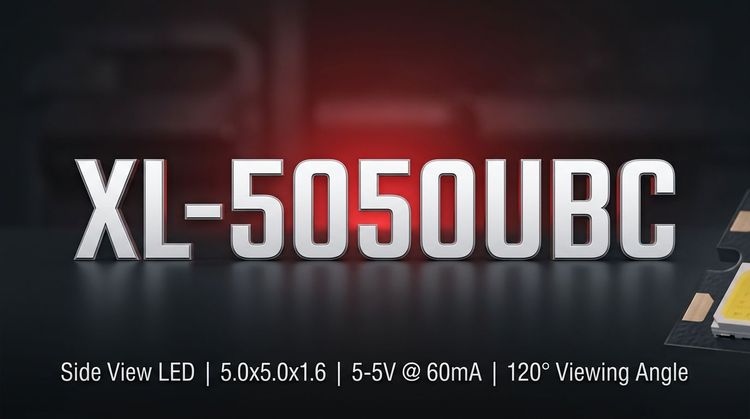
The XL-5050UBC from XINGLIGHT is a surface-mount device (SMD) LED characterized by a 5.0x5.0x1.6mm footprint, integrating three chips to achieve high-intensity blue light emission (460nm peak). It utilizes a transparent water colloid encapsulation suitable for high-brightness requirements. Designed explicitly for compatibility with standard SMT production lines and infrared reflow processes, this component addresses the engineering requirement for compact, high-power light sources in indoor and accent illumination fixtures. 🏭
💡 Typical Applications
Based on its luminous intensity (1800mcd typ.) and compact 5050 form factor, the XL-5050UBC is optimized for:
- General Indoor Lighting: Residential and commercial ambient fixtures.
- Accent & Display Lighting: Jewelry display cabinets and counter lighting requiring high CRI and clarity.
- Signage & Advertising: Light boxes and luminescent characters.
- Auxiliary Backlighting: Indicator lights and supplementary mood lighting systems.
⚙️ Key Technical Specifications
The following optical and electrical parameters are measured at Ta=25°C and IF=60mA:
| Parameter | Symbol | Min. | Typ. | Max. | Unit | Condition |
|---|---|---|---|---|---|---|
| Luminous Intensity | Iv | 1400 | 1800 | 2200 | mcd | IF=60mA |
| Dominant Wavelength | λd | 455 | — | 470 | nm | IF=60mA |
| Forward Voltage | VF | 2.8 | — | 3.4 | V | IF=60mA |
| Viewing Angle | 2Ø1/2 | — | 120 | — | deg | IF=60mA |
| Reverse Current | IR | — | — | ≤5 | μA | VR=5V |
Note: Luminous intensity deviation is ±10%, and Forward Voltage deviation is ±0.1V. Tight binning codes (F4-F7, N13-3 to N13-5) are available for consistency.
⚠️ Absolute Maximum Ratings & Process Limits
To ensure reliability and prevent catastrophic failure during operation or assembly, design margins must stay within these limits (Ta=25°C):
| Parameter | Symbol | Max. Value | Unit | Notes |
|---|---|---|---|---|
| Max Power Dissipation | PD | 200 | mW | Derate above 25°C ambient |
| Max Forward Current | IF | 60 | mA | 20mA * 3 Chips |
| Peak Forward Current | IFP | 120 | mA | Pulse ≤0.1ms, Duty ≤1/10 |
| Max Reverse Voltage | VR | 5 | V | — |
| ESD Ability | ESD | 2000 | V | Human Body Model |
| Operating Temp. | TOPR | -40 ~ +85 | °C | — |
| Storage Temp. | TSTR | -40 ~ +85 | °C | — |
| Soldering Temp/Time | TSOL | 260 | °C | ≤6 Seconds |
⚠️ Critical: The component has a Moisture Sensitivity Level (MSL) of 3. Baking is required if the floor life is exceeded prior to reflow to prevent internal "popcorn" cracking.
📦 Package, Dimensions & Assembly Notes
- Outline Dimensions: 5.0mm (L) x 5.0mm (W) x 1.6mm (H).
- Packaging: Standard EIA-compliant tape and reel packaging for automated pick-and-place machines.
- Soldering Compatibility: Designed for Infrared Reflow soldering.
- Lead-Free Process: Peak temp 255°C (+0/-5°C), time above 217°C: 60-120s.
- With-Lead Process: Peak temp 235°C (+5/-0°C), time above 183°C: 60-150s.
- Suitability: Validated for automated SMT production lines.
🚢 Sourcing & Supply Considerations
- Binning Management: Verify specific binning codes for Voltage (N13) and Wavelength (HB) to ensure color consistency in the final product.
- MSL Handling: Confirm storage conditions with suppliers; MSL 3 requires strict inventory control (168 hours floor life) to avoid soldering defects.
- Compliance: The unit is RoHS compliant, meeting standard environmental protection directives for electronic waste.
- Samples: Request pre-production samples to validate thermal management at the maximum 60mA drive current.
❓ Frequently Asked Questions
Q: What does the 3-level Moisture Sensitivity Level (MSL) mean for my production line?
A: MSL 3 means the components can be exposed to ambient air (≤30°C/60%RH) for 168 hours (1 week) after opening the vacuum seal before they must be soldered. If this time is exceeded, you must bake the components at a specific temperature (usually 125°C for 24-48 hours depending on thickness) to drive out moisture. Failure to do so can cause internal cracking during the high heat of reflow soldering.
Q: Can I drive this LED at a higher current for a "turbo" mode?
A: The Absolute Maximum Rating for continuous forward current is 60mA. While a pulsed current up to 120mA is allowed (≤0.1ms pulse width, ≤1/10 duty cycle), driving it continuously above 60mA will rapidly degrade the junction and significantly shorten the lifespan or cause immediate failure. 💥
Q: Why are there separate codes for F4-F7 and N13-3 to N13-5?
A: These are binning codes. 'F' codes sort the LEDs by brightness (Luminous Intensity), and 'N' codes sort by Forward Voltage. Using mixed bins in the same product can result in visible brightness differences or uneven current draw. For a uniform lighting panel, you should specify a single bin code (e.g., F5 and N13-4) to your supplier.
Q: Is this LED suitable for outdoor applications?
A: The datasheet specifies an operating temperature range of -40°C to +85°C, which covers most environments. However, the "water colloid" packaging is primarily for optical clarity. If used outdoors, it must be housed in an IP-rated enclosure to protect against direct water ingress, UV exposure (which may yellow the colloid over time), and physical stress.
Q: What is the typical forward voltage I should design my driver for?
A: The forward voltage varies from 2.8V to 3.4V at 60mA. For a robust driver design, you should plan for a compliance range covering the max 3.4V to ensure consistent brightness, even if the batch leans toward the higher voltage bin.