📌 Product Overview
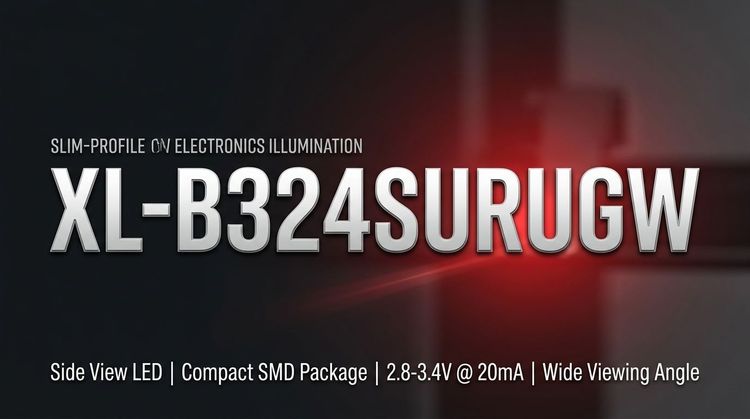
The XL-B324SURUGW is a high-brightness, dual-color (red and green) LED featuring a compact F3 package and transparent epoxy colloid. Designed for demanding applications, it offers high energy efficiency, fast startup, and a long operating life. Its core design focus is on providing reliable, cost-effective illumination for environments where dual-color indication or backlighting is required, with an emphasis on manufacturability and performance consistency.
🚀 Typical Applications
- Backlight Modules: Ideal for LCD and keypad backlighting in consumer electronics.
- Automotive Interiors: Used for interior lighting, switch illumination, and dashboard indicators.
- Signal Indication: Effective status and warning lights in control panels and machinery.
- Smart Home Devices: Provides visual feedback and ambient lighting in connected home products.
- General Lighting: Suitable for indicator and accent lighting in various fixtures.
🔑 Key Technical Specifications
| Parameter | Red | Green | Unit | Test Condition |
|---|---|---|---|---|
| Luminous Intensity | 400-700 | 2100-4000 | mcd | IF=20mA |
| Dominant Wavelength | 630-640 | 520-530 | nm | IF=20mA |
| Forward Voltage | 1.8-2.4 | 2.8-3.4 | V | IF=20mA |
| Viewing Angle | 30 | 30 | deg | IF=20mA |
⚠️ Absolute Maximum Ratings & Process Limits
| Parameter | Red | Green | Unit |
|---|---|---|---|
| Max Power Dissipation | 50 | 70 | mW |
| Max Continuous Forward Current | 20 | 20 | mA |
| Max Peak Forward Current | 80 | 80 | mA |
| Operating Temperature | -20 to +85 | °C | |
| Reflow Soldering | 240°C, ≤6s |
📏 Package, Dimensions & Assembly Notes
The XL-B324SURUGW utilizes a compact F3 package with dimensions of 3.8 x 3.0 x 5.2mm. It is packaged according to EIA standard specifications for automated handling. For manual soldering, the temperature must not exceed 300°C for 3 seconds, with the soldering point kept a minimum of 3.5mm from the base of the LED body to prevent damage.
📈 Sourcing & Supply Considerations
- Binning Codes: Critical for color consistency (wavelength), brightness (mcd), and forward voltage (V) matching.
- MSL Level: Moisture Sensitivity Level 2-3 requires strict dry storage and baking procedures before SMT reflow.
- Supply Chain: Authenticity verification is essential to avoid counterfeit components that may fail reliability tests.
- Documentation: Request the full datasheet and reliability test reports for production validation.
❓ FAQ
Q: What do the brightness and voltage grading codes (e.g., A6, N12-9) mean?
A: These codes define specific binning ranges for luminous intensity (A5-A6 for Red, B3-B6 for Green) and forward voltage (N12-7 to N12-9 for Red, N13-3 to N13-5 for Green), ensuring batch-to-batch consistency for your application's requirements.
Q: Is this LED suitable for high-temperature automotive environments?
A: Yes, its operating temperature range of -20°C to +85°C makes it suitable for many automotive interior applications, provided it is operated within its absolute maximum ratings.
Q: What is the recommended soldering process for this component?
A: For reflow soldering, use a peak temperature of 240°C for a maximum of 6 seconds. For manual soldering, limit the temperature to 300°C for 3 seconds, ensuring the solder joint is at least 3.5mm from the LED body.
Q: How does the MSL rating impact production?
A: The MSL 2-3 classification means the component is moderately sensitive to moisture. It must be stored in a dry environment and may require a pre-surf bake before reflow soldering to prevent internal delamination or popcorning.
Q: Can this LED be used for outdoor general lighting?
A: While its specifications support general lighting, its IP rating is not specified. It is more commonly used for indoor or protected applications like signal indication and backlighting.
Q: What are the key differences between the red and green electrical characteristics?
A: The green LED has a significantly higher luminous intensity (2100-4000 mcd vs. 400-700 mcd) and a higher forward voltage (2.8-3.4V vs. 1.8-2.4V), requiring different drive circuit design considerations.