📌 Product Overview
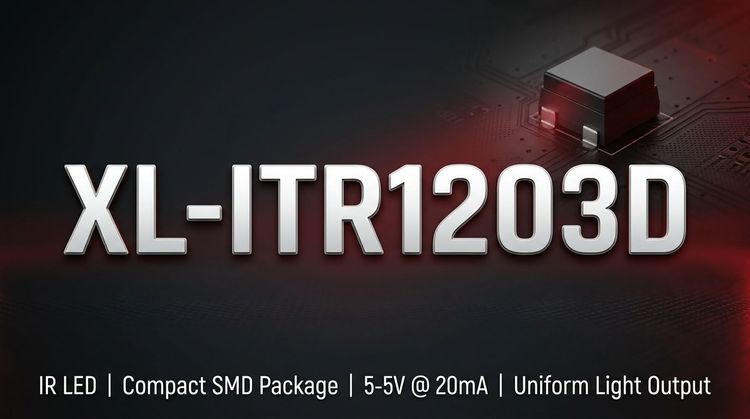
The XL-ITR1203D from Xinglight is a standard through-beam photoelectric switch, integrating an infrared emitter and a phototransistor detector. 💡 It is specifically engineered for applications requiring fast response times and high photosensitivity, operating at a peak wavelength of 940nm. 👇 This component is optimized for low-voltage drive scenarios, making it suitable for compact consumer electronics and automatic sensing systems. Designers should focus on its CTR (Current Transfer Ratio) consistency and power dissipation limits during the schematic design phase.
🎯 Typical Applications
Based on its technical specifications, the XL-ITR1203D is designed for integration into non-critical sensing loops in consumer electronics:
- Office Automation: Ideal for paper detection in fax machines and document scanners.
- Gaming & Vending: Used for coin or object detection in slot machines and dispensers.
- Home Appliances: Implements non-contact safety limits or position sensing in small home appliances.
- Automatic Sensors: Serves as a compact trigger in automatic sensor modules requiring fast response times.
⚡ Key Technical Specifications
| Parameter | Symbol | Test Conditions | Min | Typ | Max | Unit |
|---|---|---|---|---|---|---|
| Forward Voltage | $V_F$ | $I_F$ = 20mA | - | 1.2 | 1.6 | V |
| Reverse Current | $I_R$ | $V_R$ = 5V | - | - | 10 | $\mu$A |
| Peak Wavelength | $\lambda_p$ | $I_F$ = 20mA | - | 940 | - | nm |
| Collector Current | $I_{C(on)}$ | $I_F=20mA, V_{CE}=5V$ | 0.3 | - | - | mA |
| Response Time | $t_r / t_f$ | $V_{CE}=5V, I_C=1mA$ | - | 15 | - | $\mu$s |
Table 1: Electro-Optical Characteristics ($T_a=25^\circ C$)
⚠️ Absolute Maximum Ratings & Process Limits
🔒 Exceeding these ratings may cause permanent damage to the device. Strict adherence during PCB design and thermal simulation is required.
| Parameter | Symbol | Max Rating | Unit | Notes |
|---|---|---|---|---|
| Power Dissipation | $P_D$ | 75 | mW | *Per element (Emitter/Detector) |
| Forward Current | $I_F$ | 50 | mA | Continuous DC operation |
| Peak Forward Current | $I_{FP}$ | 1000 | mA | Pulse width $\le 100\mu s$, 1% duty |
| Collector-Emitter Voltage | $V_{CEO}$ | 30 | V | Output Detector limit |
| Operating Temp. | $T_{opr}$ | -25 ~ +85 | $^\circ C$ | Ambient range |
| Storage Temp. | $T_{stg}$ | -40 ~ +85 | $^\circ C$ | - |
📦 Package, Dimensions & Assembly Notes
- Package Type: Standard molded through-hole package (See "Outline Dimension" in datasheet).
- Dimensions: 📏 Unit is in millimeters (mm). Tolerance is $\pm 0.3mm$ unless specified.
- Soldering Guidelines:
- Max Temp: $260^\circ C$.
- Duration: $\le 5$ seconds.
- Distance: Soldering iron must be kept at least 2mm away from the epoxy resin body to prevent thermal damage.
- MSL Level: 2 (Moisture Sensitivity Level). indicates safe handling in standard indoor environments (<30°C/85%RH).
🚀 Sourcing & Supply Considerations
- Compliance: The component is RoHS compliant and manufactured with lead-free materials, meeting EU environmental standards for hazardous substances.
- Binning Management: 💡 Verify voltage grading codes (e.g., R2-4) and output current (IC6-18) with the supplier to ensure uniformity in optical sensitivity across mass production batches.
- Packaging: Supplied in moisture-proof and anti-static foil bags to preserve MSL integrity during transit and storage.
❓ FAQ
Q: What is the maximum safe soldering temperature for the XL-ITR1203D?
A: The maximum lead soldering temperature is $260^\circ C$. It is critical to maintain a distance of at least 2mm from the device body during soldering and complete the process within 5 seconds to prevent degradation of the internal optical coupling.
Q: Can this sensor be used for outdoor applications?
A: The XL-ITR1203D is primarily designed for indoor use. While the operating temperature range is -25 to +85$^\circ C$, the 940nm wavelength can be affected by strong ambient sunlight. For outdoor use, significant optical shielding or modulation is required to prevent false triggers.
Q: What does the "R2-4" and "IC6-18" grading code mean?
A: These codes refer to manufacturing binning for consistency. R2-4 indicates the Forward Voltage ($V_F$) range (1.2V-1.6V), and IC6-18 indicates the Collector Current ($I_{C(on)}$) range (0.3mA-0.9mA). Selecting a specific bin code ensures uniform signal gain across your product line.
Q: Is this component suitable for battery-powered devices?
A: Yes, with a typical forward voltage of 1.2V and low power dissipation (75mW), it is suitable for low-voltage battery circuits. However, designers must account for the 50mA continuous current limit to avoid draining the battery quickly or damaging the emitter.
Q: How do I verify the authenticity of XINGLIGHT components?
A: Always procure from authorized distributors. Authentic units will feature clear, laser-etched markings matching the XL-ITR1203D model and correct binning codes, and should be packaged in sealed, static-dissipative bags with the correct XINGLIGHT labeling.