Decision Paths
Type / Application / Risk
A procurement navigation guide for OEM, EMS, distributor and engineering teams comparing memory technologies, supplier coverage, qualification risks and RFQ paths.
A procurement navigation guide for OEM, EMS, distributor and engineering teams comparing memory technologies, supplier coverage, qualification risks and RFQ paths.
Use this page to choose the correct technical, supplier, traceability, alternative or RFQ path without confusing a sourcing capability page with a part-number directory.

Type / Application / Risk
Specs / Channel / Risk
Review generation, density, organization, speed grade, ECC, platform support and lifecycle.
Compare storage or firmware use, interface behavior, endurance, controller requirements and product status.
Check JEDEC generation, capacity, package, host compatibility, endurance and lifecycle.
Review SRAM, EEPROM, FRAM, MRAM and long-lifecycle requirements for industrial or embedded designs.
Memory qualification priorities change with the system, lifecycle and buyer approval requirements.
Prioritize bandwidth, capacity planning, thermal design, allocation exposure and platform qualification.
Prioritize lifecycle, temperature grade, firmware compatibility, traceability and controlled change management.
Prioritize qualification evidence, long-term support, batch control and buyer-side validation.
Balance performance, power, package, controller support, volume planning and product-transition risk.
Use these technology paths as a starting point; part-level validation remains required.
Technology Scope: DDR, LPDDR, GDDR and HBM
Typical Applications: System memory, mobile, graphics and AI computing
Qualification Focus: Check generation, density, organization, speed, voltage, package and platform compatibility.
Technology Scope: Raw NAND and managed storage foundations
Typical Applications: SSD, embedded storage and high-density data storage
Qualification Focus: Check cell type, endurance, ECC, controller/firmware dependency and lifecycle.
Technology Scope: Serial, parallel and high-speed NOR
Typical Applications: Firmware, boot code and embedded systems
Qualification Focus: Check interface, commands, boot behavior, voltage, package and lifecycle.
Technology Scope: Embedded managed Flash
Typical Applications: Industrial, mobile, automotive and IoT devices
Qualification Focus: Check JEDEC version, host support, package, firmware, endurance and product status.
Technology Scope: SRAM, EEPROM, FRAM and MRAM
Typical Applications: Industrial, medical, automotive and long-lifecycle designs
Qualification Focus: Check technology-specific endurance, retention, interface, qualification and availability requirements.
The correct choice depends on platform support, part-level evidence and buyer validation.
Start with system function and host support, then narrow by exact electrical, package, lifecycle and qualification requirements. The table is a procurement screening guide, not a substitute for the current datasheet.
| Technology | Best fit | Key selection fields | Primary sourcing risk |
|---|---|---|---|
| DDR / LPDDR DRAM | Working memory for computing, networking, mobile and embedded platforms | Generation, density, organization, ranks, speed/timing, ECC, voltage, package and temperature | Platform qualification, generation transitions, allocation and suffix mismatch |
| GDDR / HBM | Graphics and high-bandwidth accelerator memory | Generation, bandwidth, organization, thermal/interface requirements and platform design | Tight platform coupling, limited qualified options and advanced packaging constraints |
| Raw NAND | High-density storage behind a qualified controller | SLC/MLC/TLC, geometry, interface, ECC, endurance, package and controller support | Controller/firmware incompatibility, generation changes and endurance assumptions |
| Serial / Parallel NOR | Boot code, firmware storage and execute-in-place applications | Density, voltage, interface, speed, package, commands, registers, security and retention | Firmware behavior differs despite apparent pin compatibility |
| eMMC / UFS | Managed embedded storage for industrial, mobile, automotive and IoT systems | JEDEC version, capacity, package, host mode, endurance, grade, firmware and lifecycle | Host/boot compatibility, opaque internal NAND changes and product transitions |
| EEPROM / SRAM / FRAM / MRAM | Configuration, buffering, logging and specialty long-life functions | Interface, organization, speed, write endurance, retention, voltage, package and grade | Small-volume lifecycle exposure and technology-specific behavior |
The same memory family can require very different evidence and qualification depending on where it is used.
| Application | Technical priority | Supply priority | RFQ details that change the answer |
|---|---|---|---|
| AI server / data center | Bandwidth, capacity, ECC, thermals, platform validation and sustained workload | Allocation exposure, qualified vendor list, ramp timing and continuity | Server/platform, workload, module/device form, speed, capacity, forecast and qualification window |
| Industrial embedded | Temperature, retention, endurance, boot stability and long-term firmware support | Lifecycle, change control, date/lot policy and traceability | Controller/SoC, operating profile, expected service life, grade and approved changes |
| Automotive | Qualified grade, functional reliability, temperature and controlled configuration | Lot control, PCN/EOL handling, documentation and long support horizon | Exact qualification requirement, application location, PPAP/evidence expectations and approval process |
| Networking / telecom | Throughput, boot reliability, ECC, power and thermal behavior | Long production programs, revision control and forecast visibility | Platform, traffic/workload, boot device role, redundancy and field-update process |
| Mobile / consumer | Performance per watt, package height, host compatibility and user workload | Volume ramp, rapid transitions and cost | SoC, form factor, capacity, speed mode, forecast and launch schedule |
| Medical / high-reliability | Data integrity, retention, controlled changes and validated operating limits | Traceability, lifecycle and documented qualification | Regulatory/quality constraints, validation ownership and prohibited changes |
Use manufacturer coverage to create a research list, not to imply authorization, stock or a commercial relationship. Confirm each exact product family and status through current official sources.
| Landscape segment | Examples to research | What to verify | Procurement use |
|---|---|---|---|
| Broad DRAM and NAND portfolios | Samsung, SK hynix and Micron | Exact generation, density, package, grade, lifecycle and current product status | Platform-qualified primary or second-source planning |
| NAND and managed storage | Kioxia, Western Digital/SanDisk, Samsung, SK hynix/Solidigm and Micron | Raw versus managed product, controller/firmware dependencies, endurance and lifecycle | Embedded storage, SSD and raw-NAND sourcing research |
| NOR Flash | Infineon, Winbond, Macronix, GigaDevice, Micron and other qualified vendors | Interface, voltage, commands, security features, package and product status | Boot and firmware device comparison |
| Specialty and legacy memory | Alliance Memory, ISSI, Renesas and technology-specific vendors | Technology ownership, exact ordering code, longevity program, grade and package | Long-lifecycle, maintenance and constrained-design requirements |
| Modules and storage products | Manufacturer and qualified module/SSD suppliers | Underlying components, BOM control, firmware, qualification, warranty and change notice policy | Systems needing modules or storage devices rather than bare memory ICs |
A complete RFQ separates exact requirements from acceptable flexibility. This prevents offers that match only a short base number or headline capacity.
| RFQ field | Required detail | Why it changes sourcing | Example of an unsafe omission |
|---|---|---|---|
| Exact identity | Manufacturer, complete ordering code, acceptable revisions and approved alternatives | Suffixes can encode package, speed, temperature, voltage or qualification | Requesting only a base family number |
| Architecture | Technology, generation, density/capacity, organization, ranks or geometry | Host support depends on more than capacity | Requesting 8 Gb DRAM without x8/x16 organization |
| Interface and performance | Speed bin, timing, protocol version, bus width and required modes | Controller, BIOS and firmware support may be limited | Requesting eMMC capacity without JEDEC/host requirements |
| Mechanical and environment | Package, ball map/footprint, height, temperature, moisture and qualification grade | Assembly and operating conditions can disqualify an otherwise similar part | Assuming the same ball count means the same footprint |
| Commercial and evidence | Quantity, forecast, target date, delivery country, date-code policy, labels, documents and inspection | Availability and evidence vary by lot and channel | Asking for stock without defining acceptable date code or evidence |
| Alternative limits | Permitted brands and changes, sample quantity, validation owner and deadline | Candidate screening needs clear non-negotiable constraints | Saying alternatives accepted without platform details |
A requirement-complete RFQ reduces false matches and avoidable qualification delays.
Share the manufacturer, full part number, memory type and application or platform.
Define density or capacity, organization, speed, voltage, package and temperature grade.
Provide quantity, target lead time, delivery country, date-code and documentation requirements.
State whether alternatives are acceptable and which electrical, firmware, package or qualification changes are prohibited.
Continue to the relevant checklist, commercial capability, directory or authority guide.
Choose the supported DDR generation by platform, ECC, module type, qualification evidence and RFQ readiness.
Open ResourceChoose managed embedded storage by SoC, boot chain, software, package, workload and qualification evidence.
Open ResourceChoose boot/code storage, raw high-density data storage or managed storage by host support, geometry, ECC and lifecycle evidence.
Open ResourceReview SRAM, EEPROM, F-RAM, MRAM and legacy-memory continuity paths by interface, write behavior, lifecycle evidence and redesign gates.
Open ResourceConvert industrial mission profiles into exact memory requirements, evidence, validation gates and controlled release decisions.
Open ResourcePrepare exact automotive memory RFQs with application, grade, qualification, traceability, PCN/EOL and buyer evidence requirements.
Open ResourceReview date code, lot, marking, packing-label and documentation evidence before purchase.
Open ResourceCompare electrical, package, timing, firmware, lifecycle and qualification requirements.
Open ResourceReview LDeepAI's commercial Memory sourcing scope, process and RFQ requirements.
Open ResourceBrowse the current Memory & Storage part-number directory.
Open Resource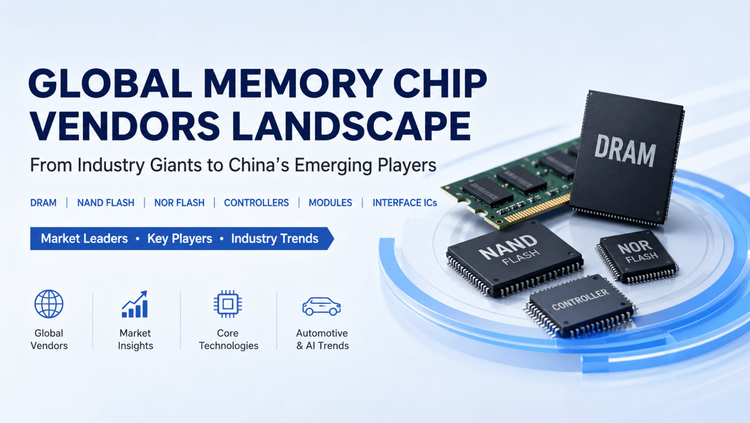
A comprehensive overview of global memory semiconductor vendors across DRAM, NAND Flash, NOR Flash, SSD controllers, memory modules, and interface ICs, including Samsung, SK hynix, Micron, YMTC, CXMT and leading Chinese memory suppliers driving AI infrastructure growth.
Comprehensive analysis of the global memory semiconductor industry in 2026. Covering DRAM, NAND Flash, NOR Flash, controllers, and modules, highlighting key players like Samsung, CXMT, and YMTC.
Send the exact part number or technical requirement, quantity, schedule, application and evidence needs. LDeepAI can help review sourcing and possible alternative paths.
It covers DRAM and DDR families, NAND Flash, NOR Flash, eMMC, UFS and specialty memory such as SRAM, EEPROM, FRAM and MRAM.
No. It is a procurement guide. Stock, lead time, date code and documentation must be confirmed for each part number and channel.
Compare the required technology, package, platform compatibility, qualification, lifecycle, documentation and supply continuity rather than brand name alone.
LDeepAI can help screen possible options and supporting evidence, but final engineering and quality approval belongs to the buyer.
Provide the manufacturer, full part number, memory type, capacity or density, organization, speed, package, grade, quantity, date-code requirement, lead time, delivery country and required documents.


