Key Takeaways
• The Event: Many global sourcing projects stall despite aligned pricing and specs.
• The Cause: Buyers and suppliers optimize for different communication risks and timelines.
• The Implication: Expectation alignment, not translation, has become a core supply chain capability.
🌍 Opening
Global sourcing failures are often blamed on cost disputes or technical gaps. In reality, many OEM–supplier relationships break down much earlier—at the communication layer. Emails go unanswered, documents arrive late, and “quick calls” replace formal records. The friction is not cultural misunderstanding, but mismatched expectations around how decisions should move forward.
🔄 What’s Changing
As supply chains globalize, communication itself has become a risk variable.
Overseas OEMs and EMS buyers increasingly operate under compliance-driven systems that prioritize documentation, traceability, and auditability.
Meanwhile, many Chinese suppliers operate in highly competitive environments where speed of response and relationship momentum determine survival.
These two models are colliding more frequently as sourcing cycles compress and supplier qualification becomes more complex.
📊 Data / Comparison
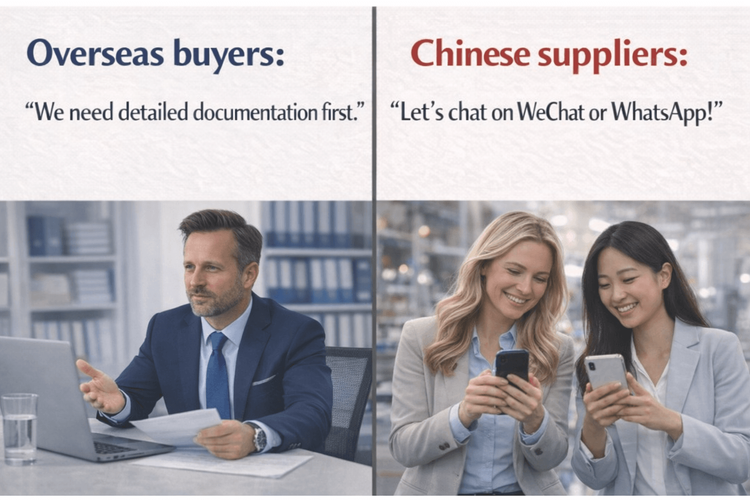
Overseas buyers typically expect:
• Structured email threads with clear ownership
• Complete documentation (certifications, drawings, change logs)
• Formal data-handling and privacy processes
• Written traceability for pricing, specs, and revisions
Chinese suppliers often default to:
• Instant messaging via tools like WeChat or WhatsApp
• Rapid iteration over incomplete information
• Trust built through frequent interaction, not paperwork
• “Discuss first, formalize later” workflows
Neither approach is inefficient on its own. Each is optimized for a different risk profile.
🧠 Why Old Assumptions No Longer Work
The assumption that “good suppliers will adapt to buyer processes” is increasingly flawed.
From the supplier side, investing heavily in documentation without confirmed commitment increases opportunity cost.
From the buyer side, proceeding without written clarity increases compliance, IP, and audit risk.
When both sides push their default model, progress stalls—not because of resistance, but because risk is being managed in opposite directions.
📦 Implications for OEM / EMS / Procurement
For procurement and engineering teams, this gap shows up as:
• Longer RFQ and qualification cycles
• Repeated clarification loops with no closure
• Hidden misalignment on revision control and change ownership
• Frustration that escalates into supplier churn
The cost impact is rarely visible on the BOM, but it materializes as delay, rework, and lost optionality.
🚀 How Smart Teams Are Responding
Leading sourcing teams are reframing communication as an operational interface, not a soft skill.
They explicitly define when speed matters and when formality is non-negotiable.
They separate exploratory discussions from commitment-triggering documentation.
They use intermediaries or internal roles to align expectations before friction appears.
The goal is not to slow suppliers down—or to force buyers to move informally—but to synchronize momentum with certainty.
🔑 Closing
The real value in modern global sourcing is not language translation or price negotiation.
It is expectation alignment—knowing when to move fast, and when to lock things down.
That is how resilient supply chains actually move forward.
Reach out to discuss how communication structure impacts sourcing resilience.