📊 Overview
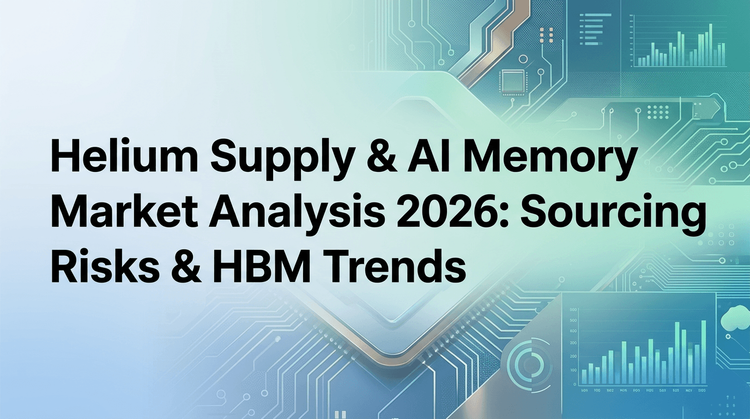
The global memory and storage supply chain is currently navigating a convergence of geopolitical instability and unprecedented structural demand shifts. Recent geopolitical tensions in the Middle East have specifically impacted the helium supply chain, a critical resource for manufacturing high-capacity Hard Disk Drives (HDDs) and advanced semiconductors. With approximately one-third of the global helium capacity offline due to shutdowns at Qatar’s Ras Laffan facility, the industry faces a immediate constraint that threatens to exacerbate existing shortages.
Simultaneously, the rapid acceleration of Artificial Intelligence (AI) infrastructure development has fundamentally altered traditional market dynamics. 🚀 The "boom-and-bust" cyclical nature of the memory market is being replaced by a sustained period of high demand and pricing pressure. This shift is driven by hyperscale data centers aggressively securing capacity for High Bandwidth Memory (HBM) and high-capacity storage, leaving consumer electronics sectors to compete for allocated resources. For procurement professionals and engineering teams, this environment necessitates a strategic pivot from just-in-time sourcing to capacity-secured partnerships.
📈 Key Trends
The most significant trend currently reshaping the landscape is the prioritization of AI-driven manufacturing capacity. Leading memory manufacturers, including SK Hynix and Micron, have indicated a fundamental change in customer behavior. Hyperscalers and cloud providers are moving away from standard one-year procurement agreements, opting instead for long-term contracts that span three to five years. Broadcom has publicly confirmed securing memory supply through 2028, a clear signal that capacity is being locked down well in advance to support AI roadmaps.
💡 This structural shift means that supply availability for non-AI applications, such as laptops and smartphones, is becoming increasingly constrained. We are observing a reallocation of production lines towards HBM and high-density NAND, squeezing the supply for traditional commodity memory. Consequently, the industry is witnessing a decoupling of price trends; while consumer demand may fluctuate, enterprise and AI memory prices are projected to rise steadily through 2026.
On the storage front, the focus is shifting from unit volume to density. Seagate’s strategy highlights this transition: rather than increasing the total number of units, the industry is leveraging technologies like Heat-Assisted Magnetic Recording (HAMR) to deliver 30TB+ drives. This approach mitigates the impact of helium supply constraints by maximizing data yield per drive, a crucial metric for AI data centers where floor space and power efficiency are paramount.
🎯 Market Analysis
The current market is characterized by a severe supply-demand imbalance driven by three core factors: supply chain fragility, technological bottlenecks, and explosive demand. The disruption in helium supply is not merely a logistical hurdle; it acts as a force multiplier for the broader memory shortage. As Seagate’s leadership noted, prolonged disruptions force manufacturers to prioritize critical AI storage solutions over general-purpose components. This creates a bifurcated market where AI-capable storage commands a premium, while legacy drives face allocation risks.
🔒 Risk assessment for procurement teams must now account for "trade friction" and "resource scarcity" as primary variables. The global nature of the semiconductor supply chain, often crossing multiple borders, exposes OEMs to significant volatility. The sentiment expressed by industry leaders suggests that price increases are no longer temporary adjustments but a "new normal" required to fund the massive capital expenditures (CapEx) needed for expanding fabrication capacity.
However, new supply capacity is not imminent. Leading industry analysts forecast that meaningful capacity relief will not arrive until post-2027. This lag creates a dangerous window for procurement professionals. The logic of the past—waiting for prices to correct—has been invalidated by the sheer scale of AI infrastructure investment. Companies that fail to secure long-term allocation now risk facing critical shortages in 2025 and 2026, potentially stalling product rollouts.
💡 Recommendations
For engineering and procurement teams, the immediate priority must be the diversification of the Bill of Materials (BOM) and the restructuring of supplier contracts. Relying on spot markets for memory or storage components is highly inadvisable in the current climate. Instead, teams should prioritize the following actions:
- Secure Long-Term Agreements: Negotiate multi-year contracts with strategic suppliers to lock in pricing and allocation. While this increases inventory carrying costs, it mitigates the higher risk of production stoppages.
- Design for Density: Update engineering specifications to utilize higher-density storage solutions (e.g., HAMR drives) and higher-capacity memory modules. This reduces the total number of components required per system, lowering the exposure to per-unit shortages.
- Supplier Diversification: Audit the supply chain for single points of failure, particularly regarding critical materials like helium or specific node fabrication. Develop secondary sources for essential components to buffer against geopolitical shocks.
👇 The era of low-cost, abundant memory has effectively ended. Successful sourcing strategies will be defined by the ability to forecast demand accurately and secure capacity early. By treating memory and storage as strategic assets rather than commodities, OEMs can navigate this period of volatility and maintain their production schedules amidst the global AI expansion.