💡 Key Takeaways
• XINGLIGHT infrared photodiodes deliver 20dB higher sensitivity than competitors
• 1.8V-15V wide operating voltage eliminates need for separate LDO
• Chip-level TIA integration with >60dB EMI suppression
🎯 Opening
Infrared sensing applications require photodiodes that combine ultra-high sensitivity with wide voltage compatibility. XINGLIGHT's infrared photodiodes achieve exceptional performance while simplifying BOM requirements.
📊 What's Changing
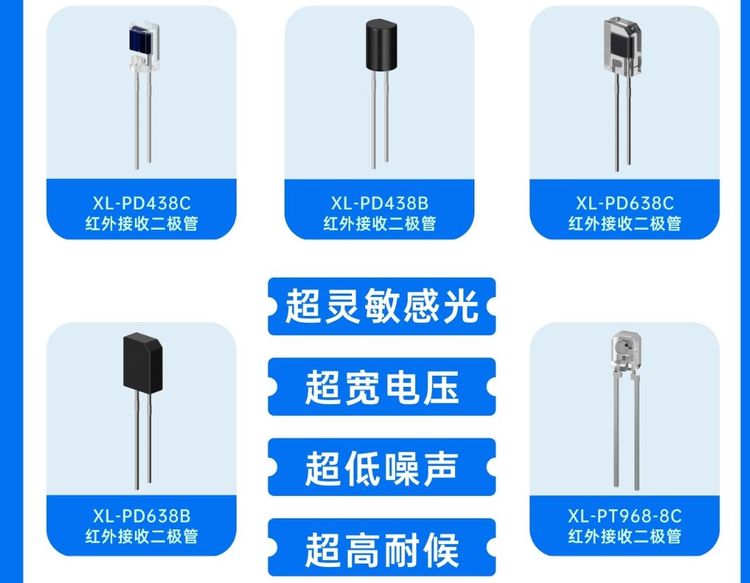
The product lineup includes XL-PD438C, XL-PD438B, XL-PD638C, XL-PD638B, and XL-PT968-8C infrared photodiodes. These components feature imported InGaAs PIN photodiode structure with dark current ≤1nA, maintaining 50mV output at 0.1μW/cm² illumination—20dB higher than comparable devices.
📗 Data / Comparison
The 850nm and 940nm dual peak wavelengths ensure perfect compatibility with mainstream infrared emitters without requiring secondary calibration. The 1.8V-15V wide operating voltage range enables single-component coverage for 3.3V microcontrollers, 5V logic circuits, and 12V relay drivers, eliminating the need for separate LDO components.
🔍 Why Old Assumptions No Longer Work
Traditional infrared photodiodes often require narrow voltage ranges or external amplifiers to achieve acceptable performance. XINGLIGHT's chip-level TIA integration with metal shielding provides >60dB EMI suppression and <2mVpp output ripple, enabling direct connection to MCU ADC without external op-amps.
⚡ Implications for OEM / EMS / Procurement
Procurement teams can leverage full ceramic and black epoxy dual package options with -40℃ to 105℃ operating range and <3% drift. The IP67 potting boards have passed 96h salt spray and 1000h high temperature/humidity testing, ensuring reliability in harsh environments.
🚀 How Smart Teams Are Responding
OEMs are integrating these infrared photodiodes into industrial automation systems, consumer electronics, and optical sensing applications. The wide voltage compatibility and integrated TIA simplify circuit design while reducing component count and overall BOM costs.
✨ Closing
Reach out to discuss integration options for your infrared sensing applications.