Product Overview
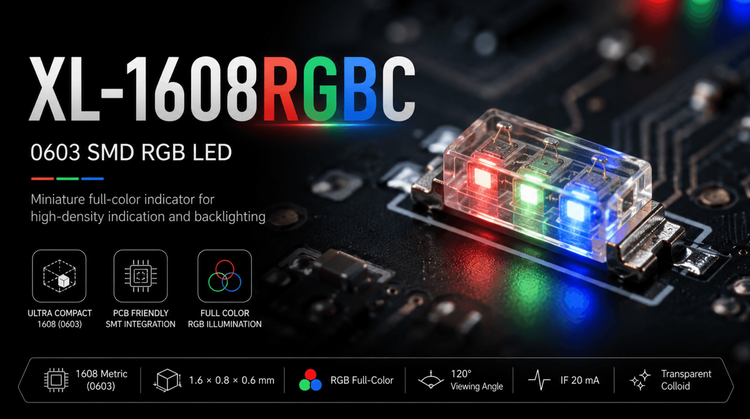
The XL-1608RGBC is a standard 0603 (1608 metric) Surface Mount Device (SMD) RGB LED designed for high-density indication and backlighting applications. As a full-color component in a miniature form factor, it enables vibrant status indicators and compact illumination on space-constrained PCBs.
For engineering teams, the critical selection variable is the forward voltage (Vf) variance between the Red, Green, and Blue chips. Designing the driver circuit to accommodate the highest Vf (Green @ 3.3V Max) rather than the average is essential to prevent current mismatch and color instability.
Typical Applications & Design Context
- Consumer Electronics & Mobile Devices: Ideal for smartphone backlight buttons and status indicators due to the low profile (0.6mm height).
- Consumer IoT & Smart Home: Used in front-panel LED rings or status bars where the 120-degree viewing angle provides wide visibility.
- Indoor Displays: Suitable for small-pitch screens where the 1.6mm x 0.8mm footprint allows for high pixel density.
💡 Design Insight: The "Transparent Colloid" (water-clear package) maximizes light output but requires careful consideration of light mixing if used on white PCBs, as unlit chips may be visible.
Key Technical Specifications
| Parameter | Symbol | Red (R) | Green (G) | Blue (B) | Unit |
|---|---|---|---|---|---|
| Forward Current | IF | 20 | 20 | 20 | mA |
| Peak Forward Current | IFP | 60 | 80 | 80 | mA |
| Luminous Intensity | IV | 150 | 700 | 180 | mcd (Typ) |
| Forward Voltage | VF | 2.3 | 3.3 | 3.2 | V (Max) |
| Dominant Wavelength | λD | 620-630 | 520-535 | 460-475 | nm |
| Viewing Angle | 2θ1/2 | 120 | 120 | 120 | Deg |
👇 Validation Note: Note the significant intensity gap. The Green chip provides >3x the luminous intensity of Red/Blue. If color uniformity is critical for your application, binary codes (brightness grading) in the BOM must be strictly enforced to segregate high/low bins.
Absolute Maximum Ratings & Process Limits
| Parameter | Rating | Unit | Failure Mode / E-E-A-T Insight |
|---|---|---|---|
| Power Dissipation (Pd) | 70 (G/B) / 50 (R) | mW | Exceeding this causes thermal sag and permanent wavelength shift. |
| Reverse Voltage (VR) | 5 | V | >5V reverse bias will likely cause immediate open-circuit failure of the chip. |
| ESD Capability | 2000 | V | 💡 Risk: 2000V is relatively low for RGB LEDs. Strict ESD protocols (wrist straps, ionizers) are mandatory during handling. |
| Operating Temp | -40 ~ +85 | °C | Junction temperature must be managed to prevent luminosity degradation. |
| Soldering (Reflow) | 260°C, 6s | Max | ⚠️ Process Trap: Exceeding 260°C or prolonged time >6s risks delaminating the copper layer from the substrate. |
Package, Dimensions & Assembly Notes
- Package: 1608 Metric (Imperial 0603).
- Dimensions: 1.6mm (L) x 0.8mm (W) x 0.6mm (H).
- Moisture Sensitivity Level (MSL):Level 3.
- Requirement: Floor life < 168 hours. If the sealed bag is opened and components are not used within 1 week, baking is required (125°C for 24-48 hours typically based on IPC/JEDEC standards) before reflow to prevent "popcorning" (internal cracking).
- Solder Pad Design: Standard EIA 0603 footprint. Ensure thermal relief pads are optimized for the 70mW dissipation of the Green/Blue chips.
Procurement & Sourcing Insights
- Bin Code Management: This datasheet explicitly lists Brightness (D3-E9), Voltage (N11-N13), and Wavelength (HB/HG/HR) codes.
- Supply Chain Reality: Never accept "random bin" shipments for this model. If you mix Bin D3 (120mcd) with Bin E7 (700mcd) on Green, the white balance will be impossible to calibrate.
- MSL Compliance: Distributors in humid regions (like South China) must verify storage conditions. Dry-packed components with humidity indicator cards (HIC) showing >10% humidity should be rejected.
- Alternative Validation: When swapping brands, check the Lens Height. Some "cheap" alternatives might be 0.6mm vs 0.8mm, causing a collision with the bezel or cover glass.
FAQ
Q: Can I drive the R, G, and B channels with a single constant current source?
A: No. The forward voltages differ significantly (Red: ~2.0V, Green/Blue: ~3.0V+). A single source would either underdrive the Blue/Green or burn out the Red. Individual channel control or dedicated RGB LED drivers are required.
Q: What happens if I ignore the MSL 3 rating?
A: If the components absorb moisture and go through reflow without baking, the internal moisture expands into steam. This causes the LED encapsulant to crack (popcorning), leading to immediate field failures or latent reliability issues.
Q: The Green LED is much brighter (700mcd) than Red (150mcd). Is this normal?
A: Yes, this is typical for InGaN Green chips. In your PCB design, you must adjust the resistor values (limiting current) or PWM duty cycle for the Green channel to balance the perceived brightness with the Red and Blue channels.
Q: Is this suitable for outdoor outdoor lighting?
A: The datasheet lists "Indoor and outdoor lighting," but this refers to sealed fixture applications. The component itself is not IP-rated. For outdoor use, ensure your housing design provides full protection against water ingress, and respect the -40°C to +85°C operating limit.