📌 Product Overview
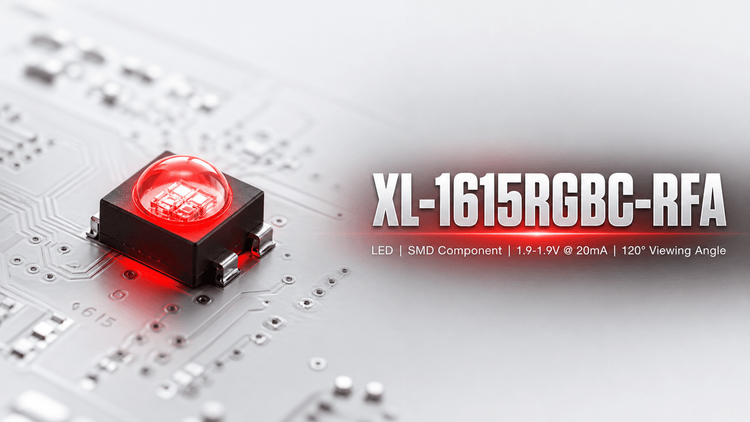
The XL-1615RGBC-RFA is a compact 1.6mm x 1.5mm x 0.6mm SMD RGB chip LED designed for high-density status indication and compact backlighting. It integrates Red, Green, and Blue chips into a single transparent colloid package to enable full-color mixing in a minimal footprint.
For engineering teams, the critical selection variables are the wide Vf variance between Red (1.9V) and Green/Blue (2.6V+) requiring careful driver design, and MSL 3 moisture sensitivity that dictates strict floor-life control during SMT assembly.
🎯 Typical Applications & Design Context
Based on its 1615 compact form factor and RGB capabilities, this component targets space-constrained consumer electronics:
- Smart Home & IoT: Ideal for status rings or buttons on smart switches and sensors.
- Appliances & Instrumentation: Suitable for control panel indicators on white goods or automotive dashboard clusters (non-critical illumination).
- Portable Devices: The 0.6mm height is optimized for slim wearable devices or Bluetooth audio indicators.
The transparent epoxy package is chosen for high light extraction efficiency but requires consideration of light crosstalk between adjacent PCB components.
📊 Key Technical Specifications
The optical performance of this LED varies significantly by color binning. Engineering validation must account for the Green chip's dominance in luminous intensity.
| Parameter | Red (R) | Green (G) | Blue (B) | Unit | Test Condition |
|---|---|---|---|---|---|
| Forward Voltage (Vf) | 1.9 - 2.3 | 2.6 - 3.4 | 2.6 - 3.4 | V | IF = 20mA |
| Luminous Intensity (IV) | 80 - 240 | 700 - 1300 | 100 - 240 | mcd | IF = 20mA |
| Dominant Wavelength | 620 - 630 | 520 - 530 | 460 - 475 | nm | IF = 20mA |
| Viewing Angle (2θ1/2) | - | - | 120 | deg | IF = 20mA |
| ESD Capability | - | - | 2000 | V | Human Body Model |
Note: Green intensity is significantly higher than Red/Blue. Visual color balance requires current ratio adjustment in firmware.
⚠️ Absolute Maximum Ratings & Process Limits
Exceeding these parameters risks catastrophic silicon junction failure or epoxy carbonization.
| Parameter | Symbol | Rating (Red) | Rating (G/B) | Unit | Notes |
|---|---|---|---|---|---|
| Power Dissipation | Pd | 50 | 70 | mW | Derate above 25°C ambient |
| Forward Current | IF | 20 | 20 | mA | Continuous DC limit |
| Peak Pulse Current | IFP | 80 | 80 | mA | ≤0.1ms pulse, Duty ≤1/10 |
| Reverse Voltage | VR | 5 | 5 | V | Exceeding causes leakage/open |
| Operating Temp | Topr | -40 ~ +85 | °C | Performance degrades at >85°C | |
| Storage Temp | Tstg | -40 ~ +85 | °C | MSL 3 requires dry storage |
💡 E-E-A-T Insight:
While the datasheet allows a peak reflow temperature of 260°C for 6 seconds, proximity to this limit carries a high risk of epoxy discoloration (yellowing), which permanently alters the RGB color mixing (specifically reducing Blue intensity). A profile max of 245°C-250°C is recommended for mass production to ensure color consistency.
🧩 Package, Dimensions & Assembly Notes
- Package Type: 1615 (1.6mm L x 1.5mm W)
- Thickness: 0.6mm (Low profile)
- Solder Pad Design: Standard EIA compliant.
- MSL Level:Level 3.
- ⚠️ Critical Risk: Floor life after opening the sealed vacuum bag is 168 hours (at <30°C / 60% RH). If the components are exposed to ambient shop floor conditions (>30°C/70% RH) for more than 168 hours, baking (125°C for 24 hours) is mandatory before reflow to prevent "popcorning" or delamination.
🔍 Procurement & Sourcing Insights
For procurement teams, the Brightness (D2-F2) and Voltage (N11-N13) bin codes are the primary leverage points for supply consistency.
- 🚀 Availability & Lead Time: As a standard 1615 RGB package, this is typically a spot-market item, but specific bin codes (e.g., high-brightness F2) often require factory ordering, extending lead times by 4-6 weeks.
- 🔒 Binning Tolerance: The datasheet allows a ±10% brightness error. Mixing batches from different production dates without re-qualifying the visual white point (Duv) will result in visible color shifts on the production line.
- ⚠️ Counterfeit Risk: In the Huaqiangbei supply chain, lower-bin LEDs (e.g., D2 brightness) are frequently relabeled as high-bin (F2). Procurement must require the original Label/COB trace proving the bin code, or a sample verification of IV (Luminous Intensity) at 20mA before bulk approval.
❓ FAQ
Q: Can I drive the R, G, and B channels with a single constant current source?
A: No. The forward voltages differ significantly (Red: ~2.1V, Green/Blue: ~3.0V). A single source would cause the Red channel to consume excessive current or the Green/Blue channels to remain dim. You must use separate channels or individual resistors for each anode.
Q: What is the risk if I ignore the MSL 3 rating?
A: Ignoring the 168-hour floor life (since vacuum seal break) risks internal moisture vaporizing during reflow, causing the package to crack or delaminate. If your production line humidity is high, baking is required even if the 168h window hasn't fully passed to ensure yield.
Q: The Green LED is much brighter than Red/Blue. Is this a defect?
A: No. This is normal physics for RGB chips. The human eye is most sensitive to Green, and the Green die in this series is optically more efficient (700-1300 mcd vs 240 mcd). Your firmware must lower the PWM duty cycle or current for the Green channel to achieve a balanced white color.
Q: Is this component suitable for outdoor lighting?
A: Not for the light source itself. It is rated for -40°C to +85°C. While it can handle outdoor ambient temperatures, the transparent epoxy is not UV-resistant. Prolonged exposure to sunlight will degrade the epoxy and shift the color over time. It is best used behind light guides or enclosures.