📌 Product Overview
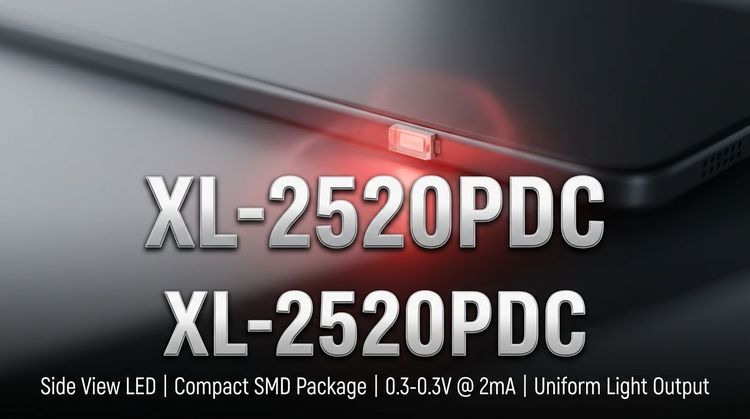
The XL-2520PDC is a compact, surface-mount (SMD) NPN silicon phototransistor packaged in a black epoxy resin, optimized for infrared detection and reception. 💡 With dimensions of 2.1mm (L) x 2.3mm (W) x 2.6mm (H) and a Ø1.8mm aperture, it is specifically engineered for automated SMT production lines requiring space-efficient components. The device exhibits peak sensitivity at 880nm, making it suitable for standard infrared communication and optical switching tasks.
🎯 Typical Applications
Based on its spectral response and high current gain, the XL-2520PDC is utilized in the following scenarios:
- Consumer Electronics: Infrared receivers for remote controls and sensor feedback loops.
- Industrial Control: Counters, thermal imaging interfaces, and smart metering systems.
- Robotics: Intelligent cars and robotic obstacle detection or line-following modules.
- Wireless Systems: Short-range wireless communication and signal transmission interfaces.
- Security: Camera monitoring heads utilizing active infrared illumination.
⚡ Key Technical Specifications
The XL-2520PDC operates with a collector-emitter saturation voltage (VCE(sat)) not exceeding 0.3V at test conditions. 📉 Its photocurrent performance is graded according to the following codes, allowing for precise BOM matching:
| Parameter | Symbol | Test Conditions | Min | Typ | Max | Unit |
|---|---|---|---|---|---|---|
| Collector Current | Ic | VCE=5V, Ee=1mW/cm² | 300 | - | 600 | μA |
| Current Gain | hFE | VCE=5V, IC=2mA | 200 | - | 2300 | - |
| Dark Current | ICEO | VCE=20V, Ee=0 | - | - | 30 | nA |
| Breakdown Voltage | V(BR)CEO | ICEO=100μA | 30 | - | 100 | V |
| Peak Wavelength | λp | - | - | 880 | - | nm |
| Rise/Fall Time | Tr / Tf | VCE=5V, RL=1kΩ | - | 15 | - | μS |
🚨 Absolute Maximum Ratings & Process Limits
Exceeding these ratings may cause permanent device failure. 🔒 Note the strict differential between Collector-Emitter (30V) and Emitter-Collector (5V) voltage limits.
| Parameter | Symbol | Rating | Unit | Notes |
|---|---|---|---|---|
| Power Dissipation | Pc | 100 | mW | @ Ta=25°C |
| Collector Current | Ic | 50 | mA | Max continuous current |
| C-E Voltage | Vceo | 30 | V | Reverse bias limit |
| E-C Voltage | Veco | 5 | V | Forward bias limit |
| ESD Capability | ESD | 2000 | V | Human Body Model |
| Temp Range | Topr / Tstg | -40 ~ +85 | °C | Operating / Storage |
📦 Package, Dimensions & Assembly Notes
The component utilizes a "Small Butterfly" form factor (Reverse Mount) with a black colloid to minimize visible light interference.
- Dimensions: 2.1 (L) x 2.3 (W) x 2.6 (H) mm.
- Soldering: Designed for infrared reflow soldering with a peak temperature of 260°C for 6 seconds.
- Manual Welding: Max 300°C for 3 seconds.
- MSL Level: Level 3 (Floor life 168 hours @ 30°C / 70% RH). 📦 Requires baking if exposed beyond this limit.
- Packaging: EIA standard compliant tape and reel for automated pick-and-place.
📈 Sourcing & Supply Considerations
To ensure manufacturing yield and consistency, procurement teams should consider the following:
- Photocurrent Grading: Specify the correct grade code (PD3 for 300-400μA or PD5 for 500-600μA) based on circuit sensitivity requirements.
- MSL Compliance: Verify storage and handling procedures align with MSL Level 3 standards to prevent popcorning during reflow.
- Authenticity: Source through authorized channels to guarantee ROHS compliance and ESD protection ratings.
❓ FAQ
Q: What is the voltage tolerance for the XL-2520PDC?
A: The Collector-Emitter voltage (Vceo) is rated up to 30V, while the Emitter-Collector voltage (Veco) is rated at 5V. Designers must ensure the circuit does not exceed these limits to avoid breakdown.
Q: What is the difference between Grade PD3 and PD5?
A: These codes indicate the photocurrent (Ic) binning. PD3 ranges from 300-400μA, while PD5 ranges from 500-600μA. Selecting the specific grade ensures consistent sensitivity across mass production units.
Q: Can this component be used for lead-free soldering?
A: Yes, the datasheet explicitly lists suitability for infrared reflow soldering at 260°C for 6 seconds, which accommodates standard lead-free profiles.
Q: What are the storage requirements?
A: The XL-2520PDC has a Moisture Sensitivity Level (MSL) of 3. It must be used within 168 hours of exposure to ambient conditions (30°C/70% RH) after the sealed bag is opened, otherwise, baking is required prior to reflow.
Q: How does the black colloid affect performance?
A: The black epoxy colloid filters out visible light, reducing noise and ensuring the phototransistor responds primarily to infrared signals within its 880nm peak sensitivity.