📌 Product Overview
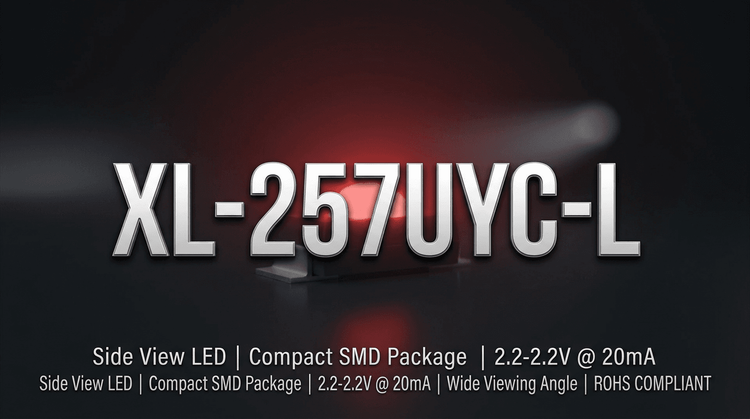
The XL-257UYC-L is a standard 3mm radial LED from XINGLIGHT, utilizing a yellow chip encapsulated in a white water-clear colloid to enhance light contrast. It is designed primarily for through-hole assembly (THT) processes where robust physical mounting and wide-angle visibility are required. With a dominant wavelength of 585–595nm, this component serves as a reliable indicator light in general-purpose circuitry. 💡 The design focus here is on balancing luminous intensity with energy efficiency, offering a typical forward voltage of 2.2V to minimize power consumption in battery-operated or densely populated boards.
🛠️ Typical Applications
- Status & Signal Indication: Ideal for power on/off indicators and status displays in home appliances and digital communication devices.
- Automotive Electronics: Suitable for non-critical interior instrument panel lighting, provided the specific automotive temperature grades are verified against the datasheet.
- Consumer Electronics: Integration into electronic toys, electronic clocks, and educational equipment where cost-effective visual feedback is required.
- Industrial & Decorative: Usage in urban lighting projects and traffic instruction signs, leveraging the 110-degree viewing angle for high visibility.
📊 Key Technical Specifications
The following optical and electrical parameters are measured under standard test conditions (Ta=25°C, IF=20mA). ⚡ Engineers should pay close attention to the Luminous Intensity (Iv) and Forward Voltage (VF) binning codes to ensure consistency in mass production.
| Parameter | Symbol | Min | Typ | Max | Unit | Test Condition |
|---|---|---|---|---|---|---|
| Luminous Intensity | Iv | 50 | 200 | 300 | mcd | IF = 20mA |
| Dominant Wavelength | λd | 585 | - | 595 | nm | IF = 20mA |
| Peak Wavelength | λp | - | 590 | - | nm | IF = 20mA |
| Forward Voltage | VF | 1.8 | 2.2 | 2.4 | V | IF = 20mA |
| Viewing Angle | 2Ø1/2 | - | 110 | - | deg | IF = 20mA |
| Reverse Current | IR | - | - | ≤10 | μA | VR = 5V |
⚠️ Absolute Maximum Ratings & Process Limits
Exceeding these ratings may cause permanent device failure or degradation of optical performance. 🔒 Design margins must account for the Power Dissipation (Pd) limit and thermal environments.
| Parameter | Symbol | Rating | Unit | Notes |
|---|---|---|---|---|
| Power Dissipation | Pd | 70 | mW | Derate above 25°C ambient |
| Max Continuous Forward Current | IF | 20 | mA | DC operation |
| Peak Forward Current | IFp | 80 | mA | Pulse width/duty cycle limited |
| Operating Temperature | Topr | -20 ~ +85 | °C | Ambient range |
| Storage Temperature | Tstg | -40 ~ +85 | °C | Non-operating |
| Soldering (Wave) | Tsol | 240 | °C | ≤6 seconds duration |
| Soldering (Manual) | Tsol | 300 | °C | ≤3 seconds duration |
⚠️ Critical Note: The soldering point must be kept at least 2.0mm away from the colloid base to prevent thermal damage to the epoxy.
📦 Package, Dimensions & Assembly Notes
The XL-257UYC-L features a 5mm (T-1 3/4) radial package with long leads, conforming to EIA standard packaging dimensions.
- Dimensions: The outer diameter is approximately 5.0mm, with a total length of 28mm including the leads.
- Tolerance: Unless specified, dimensional tolerances are ±0.50mm.
- Assembly: The component is packed in moisture-proof and anti-static foil bags. It has a Moisture Sensitivity Level (MSL) of 2.
- Soldering: Recommended for standard wave soldering or manual soldering processes. Ensure the 2.0mm clearance from the base is maintained during the soldering operation to avoid compromising the internal bond wires.
🚀 Sourcing & Supply Considerations
When integrating the XL-257UYC-L into your BOM, consider the following supply chain factors to ensure yield and consistency:
- Binning Verification: Always specify the Brightness (A1-A3) and Voltage (N12-7/8/9) bin codes to your distributor to avoid brightness variation in the final product.
- Authenticity: Verify packaging markings to ensure compliance with ROHS environmental standards.
- Sample Testing: Given the ±10% light intensity tolerance, request a sample batch to validate the actual brightness against your specific diffuser or lens design.
- Lead Time: As a standard radial LED, lead times are generally stable, but confirm stock availability for high-volume orders to prevent production line stoppages.
❓ FAQ
Q: What is the correct soldering profile for this LED to prevent damage?
A: For wave soldering, do not exceed 240°C for 6 seconds. For manual welding, the limit is 300°C for 3 seconds. Crucially, the soldering point must be >2.0mm from the bottom of the epoxy body to prevent thermal stress damage.
Q: Can the XL-257UYC-L be used in automotive outdoor applications?
A: While it is listed under "Automotive Electronics," the operating temperature range is -20°C to +85°C. For under-hood or extreme exterior environments, you may need a component with a wider temperature range (e.g., -40°C to +100°C).
Q: How do I interpret the brightness grading codes?
A: The datasheet specifies three bins: A1 (50-100 mcd), A2 (100-200 mcd), and A3 (200-300 mcd). Selecting a specific bin code ensures that all LEDs in your batch have uniform brightness.
Q: What does "White Water Colloid" mean for the light output?
A: It refers to the clear epoxy casing. When the LED is off, it looks clear/white. When on, it emits the yellow light of the chip. This typically provides a higher luminous intensity and a wider viewing angle compared to diffused colored lenses.
Q: Is this component RoHS compliant?
A: Yes, the datasheet explicitly states that the XL-257UYC-L is an environmental protection product meeting ROHS requirements, making it suitable for EU and other international markets with hazardous substance restrictions.