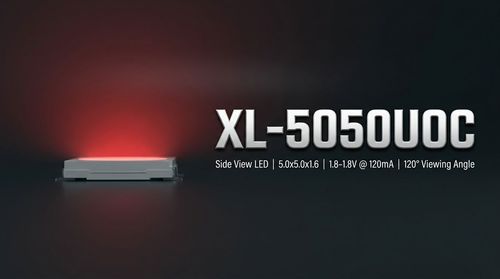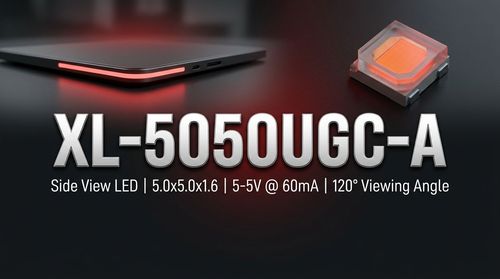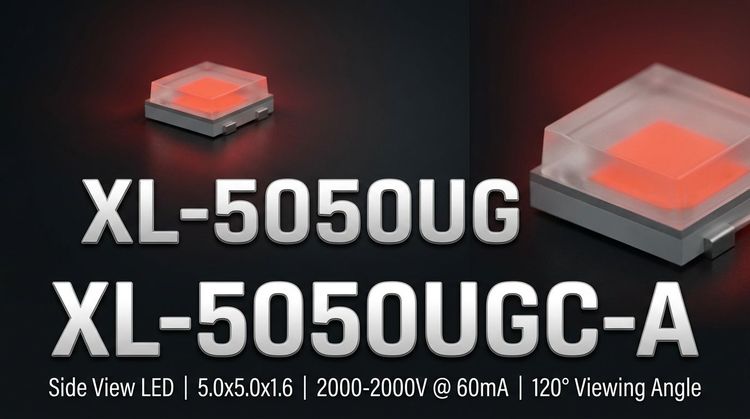
📌 Product Overview
The XL-5050UGC-A is a high-brightness green SMD LED 📦 housed in a standard 5050 surface-mount package (5.0x5.0x1.6mm). It utilizes a water-clear colloid to optimize light transmission and viewing angles 💡. Designed for automated assembly, this component is fully compliant with ROHS directives and suitable for standard SMT processes.
Engineers should focus on the component's forward voltage characteristics and thermal management when designing for continuous operation in high-density arrays.
🚀 Typical Applications
Based on its optical characteristics and form factor, the XL-5050UGC-A is ideal for:
- General Indoor Illumination:💡 High-efficiency ceiling and panel lighting.
- Retail & Display: Counter lighting, jewelry display cabinets, and shop lighting.
- Signage: Luminescent characters and advertising module lighting.
- Auxiliary Lighting:🔦 Supplemental backlighting for architectural features.
⚡ Key Technical Specifications
The following optical and electrical parameters are measured under standard test conditions (Ta=25°C, IF=60mA):
| Parameter | Symbol | Min. | Typ. | Max. | Unit |
|---|---|---|---|---|---|
| Luminous Intensity | Iv | 4000 | - | 6000 | mcd |
| Dominant Wavelength | λd | 515 | - | 530 | nm |
| Peak Wavelength | λp | - | 525 | - | nm |
| Forward Voltage | VF | 2.8 | - | 3.4 | V |
| Viewing Angle | 2Ø1/2 | - | 120° | - | deg |
| Reverse Current | IR | - | - | ≤5 | μA |
🔒 Absolute Maximum Ratings & Process Limits
Exceeding these ratings may cause permanent device failure ⚠️. Design margins must account for these limits (Ta=25°C unless noted).
| Parameter | Symbol | Value | Unit | Notes |
|---|---|---|---|---|
| Max Power Dissipation | PD | 200 | mW | - |
| Max Forward Current | IF | 60 | mA | 20mA * 3 chips |
| Peak Forward Current | IFP | 120 | mA | Pulse ≤0.1ms, Duty ≤1/10 |
| Max Reverse Voltage | VR | 5 | V | - |
| ESD Ability | ESD | 2000 | V | Human Body Model (HBM) |
| Operating Temperature | TOPR | -40 ~ +85 | °C | - |
| Storage Temperature | TSTR | -40 ~ +85 | °C | - |
| Soldering Temp/Time | TSOL | 260 | °C | ≤6 Seconds |
📦 Package, Dimensions & Assembly Notes
The device features a compact outline with dimensions 📏 5.0mm (L) x 5.0mm (W) x 1.6mm (H).
- Packaging: EIA standard compliant for automated feeders.
- Moisture Sensitivity: Classified as MSL 3. Ensure proper baking before reflow if exposed to ambient air beyond floor life limits.
- Soldering: Compatible with Infrared Reflow processes. Recommended profiles: Max 260°C for <6s (Lead-based) or 255°C for <10s (Lead-free).
- Assembly: Designed for high-volume SMT automation 🤖.
📈 Sourcing & Supply Considerations
- Binning Codes: Voltage (N13-x) and Brightness (G6-G9) binning codes must be specified for batch consistency to avoid color variation in finished modules.
- Authenticity: Verify packaging integrity to ensure compliance with ROHS and MSL standards.
- Yield Management:🚀 The ESD rating of 2000V requires strict handling protocols during PCBA to prevent latent defects.
- Samples: Evaluation samples are recommended to verify optical compatibility in specific housing designs.
❓ Frequently Asked Questions
Q: What is the typical forward voltage for this LED?
A: The forward voltage (VF) ranges from a minimum of 2.8V to a maximum of 3.4V when driven at the rated current of 60mA. Designers should consider the upper limit for driver circuit sizing.
Q: Can this component be used in outdoor environments?
A: While the operating temperature supports a wide range (-40°C to +85°C), the datasheet primarily specifies indoor lighting applications. Outdoor use requires additional IP-rated protection against water ingress, as the standard package is not inherently waterproof.
Q: What does the "60mA" current rating imply?
A: The XL-5050UGC-A contains 3 internal chips. The rating 20mA * 3 = 60mA indicates the total continuous forward current the package can dissipate without exceeding thermal limits.
Q: How strict is the Moisture Sensitivity Level (MSL)?
A: The component is rated MSL 3. This means it can be exposed to factory floor conditions (30°C/60% RH) for up to 168 hours before baking is required to prevent popcorning damage during reflow soldering.
Q: What precautions are necessary for soldering?
A: Do not exceed the maximum soldering temperature of 260°C for longer than 6 seconds. For lead-free processes, control the ramp-up rate to ≤3°C/second to minimize thermal shock to the epoxy body.