💡 Key Takeaways
• XL-S2008RHIRC combines red and infrared wavelengths for blood oxygen monitoring applications
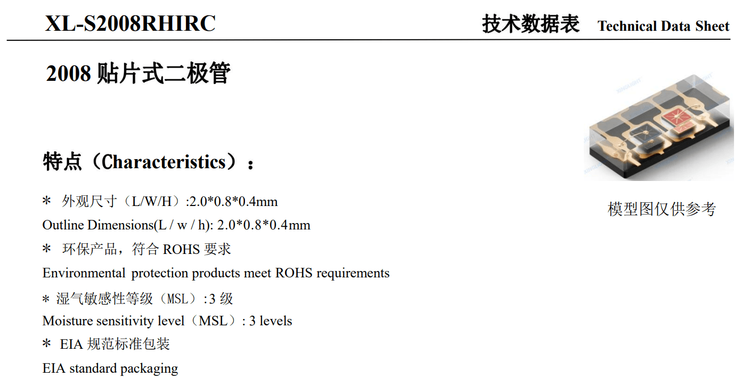
• Compact 2.0×0.8×0.4mm design fits wearable and portable devices
• Wide -40℃ to +85℃ operating range supports diverse deployment environments
🎯 Opening
Blood oxygen monitoring and pulse detection have become essential components in modern health monitoring devices. The XL-S2008RHIRC addresses this demand by combining red (655-665nm) and infrared (850-890nm) wavelengths in a single compact package, making it suitable for pulse oximeters, heart rate monitors, and electronic watches.
📊 What's Changing
Health monitoring applications increasingly require dual-wavelength LED solutions for accurate blood oxygen (SpO2) measurement. The XL-S2008RHIRC responds with 200mA pulse forward current and 50mA continuous forward current, supporting both detection accuracy and device longevity.
📗 Data / Comparison
Electrical specifications show robust performance across both wavelengths. Red light operates at 655-665nm peak wavelength with optical output of 8.5-10.5mW. Infrared emission spans 850-890nm with optical output of 6-7.2mW.
Forward voltage characteristics support efficient operation: red light at 2.5V and infrared at 1.7V (at 20mA). Maximum reverse voltage reaches 5V, providing design margin for circuit protection.
Physical dimensions measure 2.0×0.8×0.4mm (L/W/H), enabling integration into compact wearable devices. SMT compatibility with EIA standard packaging supports automated production lines.
🔍 Why Old Assumptions No Longer Work
Traditional pulse oximeter designs often require separate LEDs for red and infrared wavelengths, increasing component count and PCB footprint. The XL-S2008RHIRC demonstrates that dual-wavelength integration reduces BOM complexity while maintaining independent wavelength control.
The compact 2.0×0.8×0.4mm footprint enables space-constrained designs that were previously impossible with larger LED packages. This allows engineers to reduce device thickness without sacrificing optical performance.
⚡ Implications for OEM / EMS / Procurement
The wide operating temperature range of -40℃ to +85℃ supports deployment across diverse climates and indoor environments. Wearable devices exposed to outdoor conditions can rely on consistent performance across full specification range.
Procurement teams benefit from SMT compatibility. EIA standard packaging enables automated pick-and-place assembly, reducing manufacturing costs for high-volume production of pulse oximeters and health monitoring equipment.
The ROHS-compliant design meets environmental regulations for global market access. Manufacturers targeting European and North American markets can integrate this component without additional certification requirements.
🚀 How Smart Teams Are Responding
Blood oxygen monitoring applications utilize the dual-wavelength capability for SpO2 measurement. Red light (655-665nm) and infrared (850-890nm) wavelengths are specifically selected for optimal absorption characteristics in hemoglobin.
Heart rate monitoring and pulse detection benefit from the 200mA pulse forward current rating. This allows short-duration high-intensity pulses for accurate detection while maintaining device efficiency during continuous monitoring.
Electronic watches and wearable devices leverage the compact 2.0×0.8×0.4mm footprint. The small form factor enables thin-profile designs that prioritize user comfort and device aesthetics.
Reflow soldering compatibility supports automated SMT production lines. Manufacturers implementing high-volume production can achieve consistent quality with 260℃ soldering temperature and standard EIA packaging.
✨ Closing
Blood oxygen and pulse monitoring continue to drive demand for reliable dual-wavelength LED components. The XL-S2008RHIRC provides compact form factor, wide temperature range, and dual-wavelength performance for health monitoring applications. Engineers designing pulse oximeters and wearable devices should consider wavelength accuracy, forward current specifications, and SMT compatibility when specifying components for new designs.