📌 Product Overview
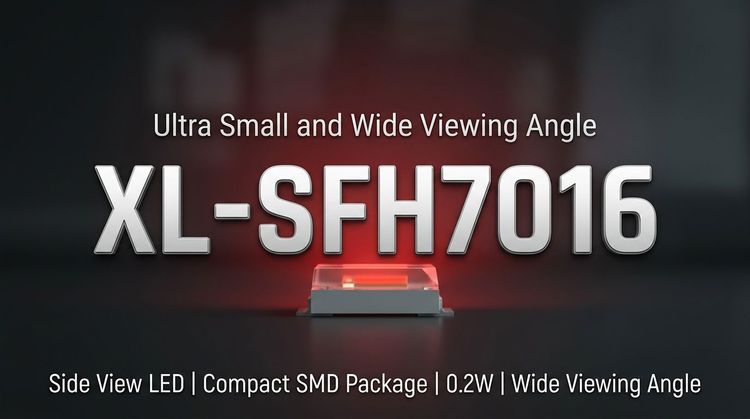
The XL-SFH7016 is a multi-die SMD LED component from XINGLIGHT, specifically engineered for optical biosensing applications. 📦 Housed in a compact 1.85 x 1.65 x 0.6 mm package, it integrates Red (655nm), Green (522nm), and Infrared (945nm) emitting elements into a single footprint. This integration is critical for wearables requiring multi-spectral analysis, such as heart rate monitoring (HRM) and blood oxygen detection (SpO2), where distinct wavelengths are necessary to isolate hemoglobin absorption characteristics. 💡 The design focus is on maximizing optical power output within a minimal physical envelope, ensuring compatibility with space-constrained PCB layouts.
🎯 Typical Applications
Based on its tri-wavelength architecture and compact form factor, the XL-SFH7016 is optimized for the following scenarios:
- Medical-Grade Consumer Wearables: Integration into smartwatches and fitness trackers for continuous heart rate and SpO2 monitoring. 🩺
- Pulse Oximetry: Dedicated diagnostic tools where the 655nm (Red) and 945nm (IR) pairing is essential for calculating oxygen saturation levels.
- General Health Monitoring: Implementation in portable health devices requiring Green LED (522nm) for high-contrast pulse signal detection in various skin tones.
- SMT Automation: Designed for high-volume surface mount production lines suitable for automatic placement machines.
⚡ Key Technical Specifications
The optical and electrical performance of the XL-SFH7016 is characterized by distinct parameters for each wavelength. The following data outlines the typical behavior under standard test conditions (Ta=25°C).
| Parameter | Symbol | Red (655nm) | Green (522nm) | Infrared (945nm) | Unit |
|---|---|---|---|---|---|
| Forward Voltage | Vf | 2.0 | 2.6 | 1.3 | V |
| Peak Wavelength | λp | 655 | 522 | 945 | nm |
| Optical Power | Po | 8 | 8 | 8 | mW |
| Half Viewing Angle | θ1/2 | ±62 | - | - | deg |
Note: Pulse testing conditions for Optical Power are IF=20mA. 💡 The component delivers a typical optical power of 8mW per diode under continuous current.
⚠️ Absolute Maximum Ratings & Process Limits
To ensure reliability and prevent catastrophic failure during both operation and assembly, engineers must strictly adhere to the following limits. ⚠️ Exceeding these values may cause permanent thermal or electrical damage to the LED dies.
| Parameter | Symbol | Max. Value | Unit | Conditions |
|---|---|---|---|---|
| Forward Current | IF | 50 | mA | Continuous (DC) |
| Pulse Forward Current | IFP | 200 | mA | Pulse width 0.5ms, Duty 1/10 |
| Reverse Voltage | VR | 5 | V | - |
| Operating Temp | TOPR | -40 ~ +85 | °C | Ambient |
| Storage Temp | TSTR | -40 ~ +100 | °C | - |
| Soldering Temp | TSOL | 260 | °C | ≤ 6 Seconds |
Note: The Moisture Sensitivity Level (MSL) is classified as Level 3. 🔒 This necessitates pre-baking before reflow if the components have been exposed to ambient humidity for extended periods.
🏗️ Package, Dimensions & Assembly Notes
The XL-SFH7016 utilizes a standard 1816 (1.8mm x 1.6mm) footprint, optimized for high-density SMT processes.
- Dimensions: The body profile is 1.85mm (L) x 1.65mm (W) x 0.6mm (H). 📏 Designers should account for a standard tolerance of ±0.1mm on non-critical dimensions.
- Soldering Compatibility: The component is rated for reflow soldering processes, withstanding peak temperatures of 260°C for up to 6 seconds.
- Assembly: Designed for automatic pick-and-place machines. The EIA standard packaging ensures smooth feeder operation in high-volume EMS environments.
- Layout: The ±62° viewing angle requires careful optical cavity design in the target device to minimize crosstalk between the LED and the photodiode.
🚚 Sourcing & Supply Considerations
When integrating the XL-SFH7016 into production BOMs, consider the following supply chain factors:
- MSL Compliance: Verify that your supply chain partner adheres to MSL Level 3 handling (dry packing) to prevent popcorning during reflow. 🛡️
- Consistency: For biometric applications, binning consistency regarding wavelength and forward voltage is critical for algorithm stability.
- Sampling: Always request production samples for optical validation against your specific photodiode sensors before full-scale procurement.
- Lead-Time: As an active component in the health-tech sector, verify current stock availability to avoid line-down situations.
❓ FAQ
Q: What are the specific wavelength tolerances for the XL-SFH7016?
A: The typical peak wavelengths are Red (655nm), Green (522nm), and IR (945nm). The datasheet specifies a dominant wavelength tolerance of approximately ±1nm, though spectral width varies (Red ~18nm, Green ~28nm, IR ~30nm). 📉 This tight tolerance is crucial for maintaining the accuracy of SpO2 algorithms.
Q: Can this component be used for high-current pulse applications?
A: Yes, the XL-SFH7016 supports a pulsed forward current (IFP) of up to 200mA. ⚡ However, this is strictly conditional on the pulse width being 0.5ms with a duty cycle of 1/10 to prevent thermal overload.
Q: What are the storage requirements to prevent moisture damage?
A: The component has a Moisture Sensitivity Level (MSL) of 3. 💧 If the vacuum-sealed bag is opened and the components are not used within 168 hours (1 week), they must be baked at 125°C for a specified duration (usually 8-24 hours depending on floor life) to drive out moisture before reflow soldering.
Q: Is the XL-SFH7016 compatible with standard lead-free soldering processes?
A: Yes, it is rated for soldering temperatures up to 260°C for a maximum of 6 seconds. 🔥 This makes it fully compatible with standard lead-free reflow profiles used in modern SMT assembly lines.