📌 Key Takeaways
- China's AI computing ecosystem now covers AI training, inference, edge AI, GPUs, TPUs, PPUs, DCUs, and FPGA accelerators across multiple application scenarios.
- Instead of focusing on rankings, understanding each company's technical positioning and product roadmap is more valuable for OEMs, EMS providers, and enterprise buyers evaluating domestic AI hardware.
- Different AI chips target different workloads. Selecting the right architecture depends on model size, software ecosystem, deployment environment, and supply chain stability.
Opening
China's AI semiconductor industry has evolved from a small number of GPU developers into a diverse ecosystem covering cloud AI training, edge inference, intelligent computing centers, autonomous driving, industrial AI, and embedded intelligence.
Each company focuses on different computing architectures and application scenarios, making technical positioning more meaningful than simple rankings.
What's Changing
Large language models, multimodal AI, and edge intelligence are driving demand for specialized AI accelerators.
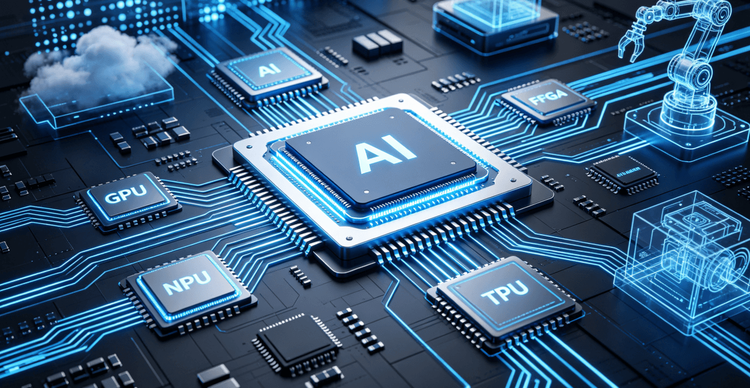
Instead of relying on a single architecture, China's AI chip industry now includes:
- GPU
- NPU
- TPU
- PPU
- DCU
- FPGA
- Dedicated AI accelerators
These architectures are designed for different workloads and deployment environments.
Overview of China's AI Computing Chip Companies
Huawei Ascend
One of China's most influential AI computing platforms.
Major Products
- Ascend 950
- Integrated AI training and inference for next-generation AI clusters.
- Ascend 910C
- Optimized for large-scale AI model training with high computing density and mature CANN software ecosystem.
Applications
- Large Language Models (LLMs)
- Cloud AI Infrastructure
- Government Computing Centers
- Enterprise AI Platforms
MetaX
Focuses on high-performance AI accelerators and general-purpose computing.
Major Products
- C370
- Integrated training and inference processor.
- C590
- High-performance AI training accelerator for foundation models.
Applications
- AI Cloud Computing
- Intelligent Computing Centers
- Enterprise AI Deployment
Hygon Information Technology
Develops domestic DCU accelerators for heterogeneous computing.
Major Products
- Deep Computing DCU Series
Applications
- AI Training
- High Performance Computing (HPC)
- Scientific Computing
- Enterprise Computing Infrastructure
Kunlunxin (Baidu)
Develops AI accelerators integrated with Baidu's AI ecosystem.
Major Products
- P800
- AI training processor.
- M100
- Cloud inference accelerator.
Applications
- Search
- Cloud AI
- Autonomous Driving
- Enterprise AI
Alibaba T-Head
Develops processors covering AI and cloud computing.
Major Products
- Zhenwu PPU
Applications
- Integrated AI training and inference within Alibaba Cloud.
Enflame Technology
Specializes in AI accelerators for data centers.
Major Products
- Suiyuan N Series
- AI inference processors.
- CloudBlazer C Series
- AI training accelerators.
Applications
- Large AI Clusters
- Intelligent Computing Centers
Moore Threads
Develops full-function domestic GPUs.
Major Products
- MTT S5000
Applications
- AI Computing
- Graphics Rendering
- Cloud Virtualization
- HPC
Iluvatar CoreX
Focuses on GPU computing.
Major Products
- Tianji Series
- AI training processors.
- Zhihui Series
- AI inference processors.
Applications
- AI Computing
- Graphics
- Enterprise AI
TsingMicro Intelligent
Major Products
- TX81 RPU
Applications
- Integrated AI Training and Inference
Biren Technology
Develops high-performance AI GPUs.
Major Products
- BR100
- BR104 (166 Series)
Applications
- Foundation Model Training
- Cloud AI
- High Performance Computing
Denglin Technology
Major Products
- Suisi Series
Applications
- Cloud AI Training
- AI Inference
Hualong Technology
Major Products
- HL100
Applications
- Integrated AI Computing Platforms
Denglin Technology (Goldwasser Series)
Major Products
- Goldwasser Series
Applications
- AI Training
- AI Inference
Innosilicon
Major Products
- SV100
- Video AI inference processor.
- SG100
- General-purpose GPU.
Applications
- Video Analytics
- Intelligent Vision
- GPU Computing
Jingjia Micro
Major Products
- JM11 Series
Applications
- Desktop Graphics
- Embedded Computing
- GPU Acceleration
Muxi
Major Products
- Antoum Series
Applications
- Cloud AI Inference
- Intelligent Computing
Xiangdixian
Major Products
- Tiangou Series
Applications
- General-purpose GPU Computing
Biren Cloud Technology
Major Products
- CAISA Series
Applications
- Cloud AI Inference
Sophgo Computing
Major Products
- BM1690
Applications
- Integrated AI Training and Inference
RockAI Computing
Major Products
- 7G100 Series
Applications
- General-purpose GPU Acceleration
Qiwang
Major Products
- Qiwang S3
Applications
- AI Inference Acceleration
Yuntian Lofly
Major Products
- DeepEdge Series
Applications
- Edge AI
- Intelligent Devices
Taichu Yuji
Major Products
- Yuji T100 Series
Applications
- Integrated AI Computing Platforms
Zhonghao Chip
Major Products
- Nata TPU
Applications
- AI Training
- AI Inference
Einstein Computing
Major Products
- EIC7702 Series
Applications
- AI Inference Acceleration
Unisplendour Tongchuang
Major Products
- Titan-3 FPGA
Applications
- FPGA AI Acceleration
- Edge Computing
Lingfan Technology
Major Products
- KA200(S) Series
Applications
- Edge AI Inference
Lanxin Computing
Major Products
- LX500
Applications
- AI Inference Acceleration
Anlu Technology
Major Products
- SALPHOENIX FPGA Series
Applications
- FPGA AI Acceleration
- Industrial Control
- Embedded Computing
Ximu Computing
Major Products
- STCP920
Applications
- AI Inference
- Edge Intelligent Computing
Procurement Insight
For OEMs and EMS manufacturers, selecting an AI processor is no longer determined solely by peak TOPS or TFLOPS.
Key evaluation factors now include:
- Software maturity
- Compiler support
- Framework compatibility
- Server ecosystem
- Thermal design
- Power efficiency
- Deployment costs
- Long-term supply continuity
Different AI workloads—including:
- Large Language Model (LLM) Training
- Retrieval-Augmented Generation (RAG)
- Computer Vision
- Edge AI
- Industrial Automation
often require completely different processor architectures.
Many international buyers evaluating domestic AI chips increasingly compare:
- SDK availability
- PyTorch adaptation
- Operator compatibility
- Cluster scalability
- Lifecycle support
before qualifying alternative computing platforms.
Why Architecture Matters More Than Rankings
China's AI computing market has become increasingly diversified.
Different companies specialize in different areas:
- Large-scale AI training
- Cloud inference
- Edge AI deployment
- General-purpose GPUs
- FPGA acceleration
- Heterogeneous computing
Each architecture serves different industries, deployment environments, and performance requirements.
Understanding technical capabilities and ecosystem maturity provides far greater value than comparing simple rankings.
Implications for OEMs, EMS and Procurement Teams
When evaluating AI computing suppliers, procurement teams should assess:
- Computing performance for target workloads
- Software ecosystem
- Developer tools
- AI framework compatibility
- Long-term supply capability
- Server platform integration
- Product lifecycle
- Roadmap stability
- Technical support
- Deployment experience
Closing
China's AI computing industry has entered a stage of diversified innovation.
GPU, NPU, TPU, FPGA, and dedicated AI accelerators are rapidly expanding across:
- Cloud Computing
- Edge AI
- Intelligent Infrastructure
Understanding each company's technical focus and product positioning enables global OEMs, EMS providers, and enterprise buyers to make more informed architecture and sourcing decisions while building resilient AI supply chains.