🚀 Key Takeaways
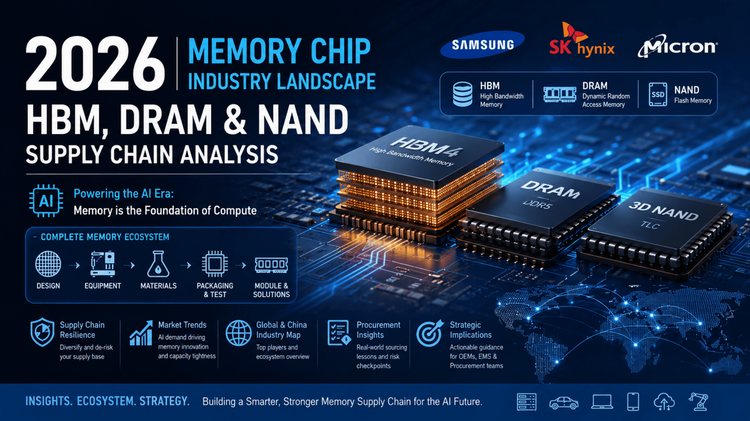
• AI infrastructure has made HBM, DRAM, and NAND the three most strategic semiconductor categories in 2026.
• The advanced memory market remains highly concentrated among a few global manufacturers, while China's domestic supply chain continues expanding across fabrication, packaging, materials, equipment, and modules.
• Modern procurement decisions require evaluating the complete ecosystem—including packaging, firmware compatibility, traceability, and supply continuity—not just chip pricing.
📌 Opening
Memory is no longer simply another BOM component. As AI servers, accelerated computing, and high-performance storage systems become mainstream, memory bandwidth, capacity, and supply availability directly determine system performance.
For OEMs, EMS providers, procurement managers, and hardware architects, understanding the complete memory supply chain has become essential for long-term sourcing and product planning.
📈 What's Changing
The rapid expansion of AI infrastructure has fundamentally transformed the global memory industry.
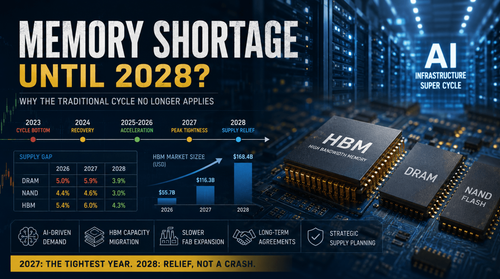
High Bandwidth Memory (HBM) has become one of the industry's most capacity-constrained products due to explosive demand from AI GPUs.
Enterprise DDR5 DRAM continues migrating toward higher-density server deployments, while high-capacity 3D NAND remains essential for AI storage clusters, enterprise SSDs, cloud infrastructure, and edge computing.
At the same time, China's domestic memory ecosystem continues expanding investment across:
- Wafer fabrication
- Semiconductor equipment
- Specialty chemicals
- Advanced packaging
- Testing services
- Storage modules
- Design tools
The result is a much broader supply ecosystem than just memory manufacturers.
📊 Global Memory Manufacturers
Samsung Electronics
Samsung remains one of the world's largest suppliers of DRAM, NAND Flash, and next-generation HBM technologies.
Its ecosystem extends across:
- Advanced packaging
- Memory substrates
- HBM materials
- Semiconductor design tools
SK hynix
SK hynix continues leading commercial HBM production capacity and remains a critical supplier for AI accelerator platforms.
Its supplier ecosystem includes companies supporting:
- Advanced packaging
- Semiconductor materials
- Wet chemicals
- Testing equipment
- Authorized distribution
- System integration
Micron Technology
Micron remains a major supplier of:
- Enterprise DRAM
- Data center SSDs
- Industrial memory
- Server storage solutions
Its ecosystem also includes interface chips, EDA software, semiconductor chemicals, and enterprise memory modules.
🇨🇳 China's Domestic Memory Manufacturers
ChangXin Memory Technologies (CXMT)
CXMT continues expanding domestic DRAM production while strengthening its qualified supplier ecosystem covering:
- Equipment
- Packaging
- Testing
- Distribution
- Semiconductor materials
The company represents China's leading DRAM manufacturer.
Yangtze Memory Technologies (YMTC)
YMTC remains China's flagship 3D NAND manufacturer.
Its supply chain includes advanced semiconductor equipment, wafer processing materials, and process inspection technologies supporting high-layer NAND production.
💾 Memory Product Segments
DRAM
Applications include:
- AI servers
- Enterprise servers
- Desktop memory
- Workstations
Representative technologies:
- DDR5
- DDR6 roadmap
- Server RDIMM
- ECC memory
LPDDR
Designed for:
- Smartphones
- Automotive electronics
- Embedded systems
- Consumer devices
Primary focus:
- Low power consumption
- High bandwidth
- Thermal efficiency
NAND Flash
Used in:
- Enterprise SSD
- AI storage
- Cloud infrastructure
- Industrial systems
The transition toward higher-layer 3D NAND continues improving density and cost efficiency.
NOR Flash
Widely deployed in:
- Automotive electronics
- Industrial controllers
- Firmware storage
- Embedded boot memory
NOR Flash remains one of the strongest localized semiconductor segments in China.
EEPROM
Typical applications include:
- Automotive electronics
- Industrial control
- Configuration storage
- Parameter memory
Although small in capacity, EEPROM remains indispensable across industrial electronics.
Memory Modules
The module ecosystem includes:
- Server DIMMs
- Consumer memory
- Embedded modules
- Industrial storage
Module suppliers play an increasingly important role in qualification and lifecycle management.
🖥 Storage Products
The downstream ecosystem includes:
SSD Manufacturers
Products include:
- Enterprise SSD
- Industrial SSD
- Consumer SSD
- Embedded storage
SSD Controllers
Controller architecture increasingly determines:
- Performance
- Endurance
- Firmware flexibility
- AI storage optimization
Memory Interface Chips
High-speed memory interface solutions are becoming essential for:
- DDR5
- HBM
- AI accelerators
- High-performance servers
🏭 Upstream Manufacturing Ecosystem
Advanced memory manufacturing depends heavily on upstream suppliers.
Key segments include:
Semiconductor Materials
- HBM packaging materials
- High-purity chemicals
- Advanced substrates
- Packaging compounds
Semiconductor Equipment
Critical manufacturing equipment includes:
- Wafer processing
- Inspection systems
- Packaging equipment
- Precision automation
Advanced Packaging
As AI memory bandwidth requirements continue increasing, advanced packaging has become one of the industry's most valuable manufacturing capabilities.
HBM packaging now represents one of the highest barriers within the semiconductor supply chain.
💡 Procurement Insight
From LDeepAI's daily sourcing projects supporting overseas OEMs and EMS companies, one trend has become increasingly clear:
Memory procurement is no longer simply selecting a DRAM or NAND part number.
Successful sourcing projects require validating the complete ecosystem behind each component.
Experienced procurement teams typically evaluate:
- PCB package compatibility
- BIOS compatibility
- Firmware revisions
- SSD controller interoperability
- Thermal characteristics
- Authorized distribution
- Traceability documentation
- Product lifecycle commitment
- Multi-year production capacity
Many engineering change orders encounter delays not because of silicon quality, but because package revisions, firmware differences, or supply-chain traceability were overlooked during qualification.
This challenge becomes even more significant when evaluating second-source suppliers or localized alternatives.
🔍 Why Old Assumptions No Longer Work
Historically, buyers primarily compared:
- Unit pricing
- Lead time
Today, procurement decisions increasingly depend on ecosystem maturity.
For example:
HBM competitiveness depends as much on advanced packaging capacity as wafer fabrication.
Enterprise SSD performance increasingly depends on controller architecture and firmware optimization.
Domestic memory qualification now extends well beyond memory manufacturers to include packaging houses, material suppliers, substrate vendors, equipment manufacturers, and testing partners.
Supply-chain resilience has become a strategic competitive advantage rather than a purchasing KPI.
🏭 Implications for OEM, EMS, and Procurement Teams
Engineering organizations should validate second-source strategies during product development rather than after qualification.
Procurement managers should evaluate ecosystem capability rather than component pricing alone.
EMS providers should continuously monitor approved vendor lists covering:
- Packaging suppliers
- Testing partners
- Specialty material suppliers
- Authorized distributors
Companies deploying AI infrastructure should also prepare for continued tight HBM capacity while maintaining sourcing flexibility across conventional DRAM and NAND products.
✅ How Smart Teams Are Responding
Leading OEMs increasingly adopt several best practices:
- Multi-region supplier qualification
- Packaging supplier validation
- Module supplier assessment
- Firmware compatibility verification
- Authorized distribution management
- Long-term capacity planning
- Traceability audits
- Lifecycle risk assessment
These practices significantly reduce redesign risk while improving supply continuity.
🔒 Closing
The 2026 memory market is no longer defined solely by Samsung, SK hynix, Micron, CXMT, or YMTC.
Competitive advantage increasingly comes from understanding the complete ecosystem behind advanced memory manufacturing—from semiconductor materials and equipment to packaging, testing, controllers, and storage modules.
For OEMs and EMS organizations building next-generation AI hardware, supply-chain visibility is becoming just as valuable as semiconductor technology itself.
LDeepAI continues supporting global procurement and engineering teams with component selection, supplier qualification, sourcing validation, and practical supply-chain insights based on real-world procurement experience.