💡 Key Takeaways
• 5730 package alone does not guarantee drop-in compatibility
• Bin alignment across brightness, voltage, and wavelength is critical
• MSL 3 moisture handling and reflow limits require process controls
🎯 Opening
The 5730 green LED appears as a standard commodity component. Yet successful SMT lighting designs hinge on five hidden factors: current derating, bin selection, thermal limits, moisture sensitivity, and PCB compatibility. Understanding these separates working prototypes from consistent production.
📊 What's Changing
Surface-mount LED adoption continues accelerating across commercial lighting, LED tubes, downlights, and flexible strips. The 5730 package balances power density with thermal management at 0.5W dissipation. However, OEMs increasingly encounter field failures caused not by the LED itself, but by mismatched expectations between datasheet specifications and assembly realities.
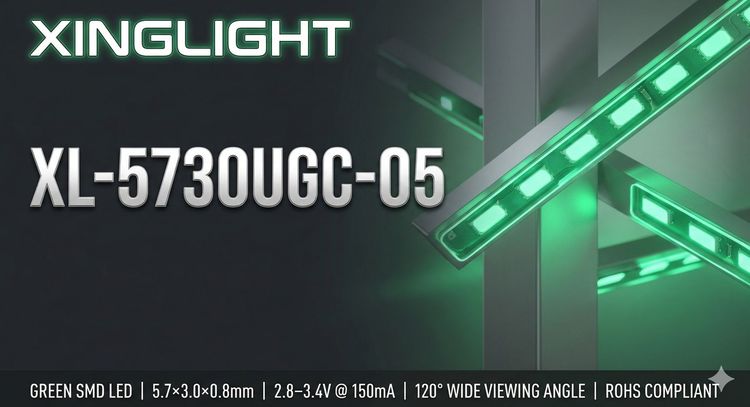
The XL-5730UGC-05 delivers 33-52 lumens at 150mA with a 120° viewing angle. Yet this brightness window represents a range, not a fixed value. Production consistency requires locking in specific bins across three parameters: luminous flux, forward voltage, and dominant wavelength.
📗 Technical Specifications
Package: 5730 SMD LED (5.7 × 3.0 × 0.8mm)
Power: 500mW maximum at 25°C ambient
Current: 150mA continuous, 300mA peak
Luminous flux: 33-52lm at 150mA
Dominant wavelength: 515-530nm
Forward voltage: 2.8-3.4V at 150mA
Viewing angle: 120°
Spectral half width: 30nm typical
Reverse current: ≤5μA at 5V reverse voltage
These parameters define the electrical and optical envelope. The datasheet also specifies absolute maximum ratings: 500mW power, 150mA continuous current, 5V reverse voltage, 2000V ESD resistance, and -40 to +85°C operating range.
🔍 Why Old Assumptions No Longer Work
Historical procurement treated LEDs as commodities selected by package size and nominal ratings. This approach fails in modern high-density lighting applications for three reasons.
First, bin variation directly impacts visual consistency. Signage, backlighting, and multi-string assemblies demand uniform brightness and color. Two XL-5730UGC-05 units from different bins produce visibly different results despite identical part numbers.
Second, thermal derating curves are frequently ignored in initial designs. As ambient temperature rises, forward current must decrease. Dense strip layouts and enclosed luminaires experience thermal buildup that reduces LED lifespan if the current remains constant.
Third, MSL 3 moisture sensitivity fundamentally changes handling requirements. Unlike earlier LED generations with unlimited floor life, this package requires controlled storage and limited exposure after opening. Standard component warehouse practices can induce popcorning or delamination during reflow.
⚡ Implications for OEM / EMS / Procurement
Sourcing teams face three primary risks in volume production.
Bin mismatch represents the most immediate failure mode. A substitute LED may mechanically fit the 5730 footprint while producing inconsistent brightness or shifted color points. This becomes visible immediately in signage or gradually in lighting applications as different lot performance drifts.
Reflow process variation introduces another reliability gap. The datasheet permits up to 255°C for 5-10 seconds in lead-free profiles, yet recommends a best practice of 240±5°C for 6 seconds. This differential signals that exceeding the recommended window creates cumulative stress. Multiple reflow cycles—common in double-sided assemblies—compound this risk.
Moisture handling creates batch-level failures if MSL 3 requirements are overlooked. The 168-hour floor life after opening means reel integrity and dry-pack condition must be verified at incoming inspection. Baking at 60±5°C for 24 hours becomes necessary when exposure limits are exceeded.
🚀 How Smart Teams Are Responding
Experienced OEMs implement four controls before volume release.
Bin code verification occurs on every approved lot. Rather than accepting the base part number, procurement confirms the specific luminous flux, forward voltage, and wavelength bins align with approved samples. This ensures interchangeability across multiple suppliers.
Reflow profile matching targets the recommended 240±5°C for 6 seconds rather than the maximum permissible temperature. Design-for-manufacturing reviews limit double-sided reflow to two passes maximum when possible.
Warehouse procedures incorporate MSL 3 controls. Dry-pack integrity verification, floor-life tracking, and baking protocols become part of standard receiving inspection. For alternates, the evaluation checklist includes pad design compatibility, current rating verification, and green wavelength window confirmation rather than dimensional fit alone.
Project evaluation with LDeepAI focuses on three starting parameters: target bin specifications, intended drive current, and PCB reflow profile. These inputs determine whether the XL-5730UGC-05 fits the application and which sourcing strategy supports consistent production.
✨ Closing
5730 green LED selection requires engineering precision, not commodity purchasing. Thermal derating, bin alignment, reflow limits, and moisture sensitivity define production可靠性. Reach out to discuss how to integrate these controls into your sourcing process.