💡 Key Takeaways
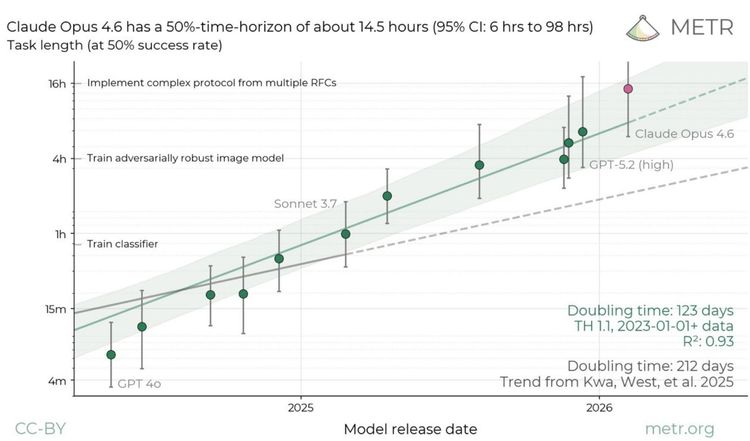
• AI work capacity doubles every 4 months, creating exponential growth
• By 2041, single AI agents could complete 58 billion years of human tasks
• Forward-looking strategy beats fixating on current AI limitations
🎯 Opening
AI work capability doubles every 4 months. At this rate, by 2041 a single AI agent will be able to complete tasks that would take one human 58 billion years — longer than age of universe. Everything depends on the future.
📊 What's Changing
The exponential growth curve in AI capability represents unprecedented technological acceleration. Every four-month interval brings 2x improvement in work output. This compounding effect creates hockey-stick trajectory. Current benchmarks show AI agents mastering complex tasks faster than anticipated. Code generation, data analysis, and creative work demonstrate this acceleration across domains.
📗 Data / Comparison
Current doubling rate: 4 months. Projected capacity by 2041: 58 billion human-year equivalents. Universe age: 13.8 billion years. AI agents could complete work exceeding 4x the age of universe. Historical comparison: Moore's Law doubled transistor count every 18 months. AI capability grows 4.5x faster than semiconductor scaling.
🔍 Why Old Assumptions No Longer Work
Traditional planning cycles fail when technology evolves this rapidly. Annual budget cycles cannot account for 8x capability changes. Multi-year procurement strategies become obsolete before implementation. Human-centric productivity models break down. Linear thinking cannot capture exponential reality. Organizations still measure AI success against today's benchmarks rather than future potential.
⚡ Implications for OEM / EMS / Procurement
R&D cycles accelerate dramatically. Product development timelines compress from years to months. Engineering teams shift from task execution to oversight and strategy. Supply chain optimization becomes fully automated. Procurement decisions leverage AI for real-time market analysis. Cost structures transform as AI handles increasing workload. Talent requirements evolve toward AI management roles rather than execution.
🚀 How Smart Teams Are Responding
Leading organizations adopt AI-first development strategies. Teams experiment with current capabilities to understand future potential. Investment shifts toward AI infrastructure and training. Cross-functional collaboration increases as AI bridges domain expertise. Companies build AI governance frameworks before capabilities mature. Forward-thinking leaders pilot AI in non-critical applications to gain experience. Long-term roadmaps account for AI capability curves.
✨ Closing
The future belongs to those who prepare for exponential AI growth rather than critique current limitations. Start thinking about what AI will enable, not what it cannot do today. Reach out to discuss strategic AI integration.