💡 Key Takeaways
• Apple N50 eyewear enters production December 2026, launching 2027
• All three AI devices serve as iPhone extensions, not standalone replacements
• Dual camera systems and computer vision capabilities create new component requirements
🎯 Opening
Apple's rumored AI hardware lineup marks a strategic departure from typical wearable approaches. Unlike competitors positioning AI devices as phone replacements, Apple's strategy emphasizes ecosystem reinforcement through accessory integration.
📊 What's Changing
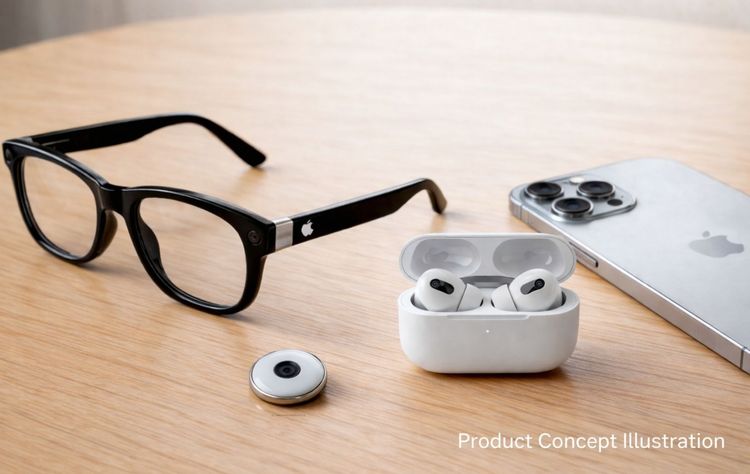
Three devices comprise Apple's AI hardware pipeline: N50 smart eyewear, a wearable pendant, and camera-equipped AirPods. The N50 eyewear, codenamed and positioned as premium AI hardware, targets Meta Ray-Ban segment but with higher-tier specifications. Production begins December 2026, with commercial launch scheduled for 2027.
N50 specifications include dual camera architecture: one high-resolution sensor for photography and recording, plus a dedicated computer vision camera. This configuration mirrors Vision Pro technology, enabling environmental understanding and distance measurement. Audio functionality relies on integrated microphones and speakers, with no display component.
The pendant device, roughly AirTag-sized, features low-resolution camera and microphone. Designed as clothing clips or necklaces, it functions solely as an iPhone accessory. Camera-integrated AirPods represent most advanced development, potentially launching within the current year.
📗 Technical Specifications and Supplier Implications
N50's dual camera system creates distinct supply chain requirements. The photography module demands high-resolution image sensors, likely requiring Sony or Samsung Semiconductor partnerships. Computer vision sensors emphasize depth perception capabilities, suggesting ToF (Time of Flight) or structured light component integration.
Battery architecture differs significantly from Meta Ray-Ban's external battery pack approach. Apple's prototypes reportedly house all components within the frame, necessitating compact high-energy-density battery solutions. Custom frame design, abandoned eyewear brand partnerships, implies Apple-managed manufacturing relationships with established optical component suppliers.
Microphone arrays across all three devices suggest MEMS microphone suppliers such as Knowles or STMicroelectronics. Speaker miniaturization presents engineering challenges for acoustic fidelity within form factor constraints.
🔍 Why Old Assumptions No Longer Work
Traditional wearable assumptions frame AI hardware as phone replacements with independent processing capabilities. Apple's approach reverses this logic. All three devices tether to iPhone for primary computation, reducing onboard processing requirements but creating dependency on iOS ecosystem participation.
This strategy leverages installed base rather than driving hardware replacements. For OEMs accustomed to standalone device supply chains, this model shifts value from autonomous processing to specialized input acquisition and ecosystem integration. The pendant's internal debate regarding speaker inclusion underscores this tension: additional functionality reduces iPhone dependency but increases device complexity.
🚀 How Smart Teams Are Responding
Forward-thinking suppliers are positioning around specialized component requirements rather than full device integration. Sensor manufacturers emphasizing computer vision capabilities, acoustic component suppliers optimizing for miniaturization, and battery providers delivering high-density solutions in compact form factors align with Apple's needs.
OEM partners with experience in Apple's accessory ecosystem, such as AirTag or AirPods manufacturing, gain advantage. The December 2026 production start for N50 suggests supplier qualification cycles are already underway, with component sampling and validation phases likely complete or concluding.
✨ Closing
Apple's AI hardware strategy prioritizes ecosystem extension over device independence. Supply chain partners aligning with specialized component needs and accessory manufacturing experience position for partnership opportunities. Reach out to discuss component qualification pathways for Apple's AI device pipeline.