📌 What Is COB LED Technology?
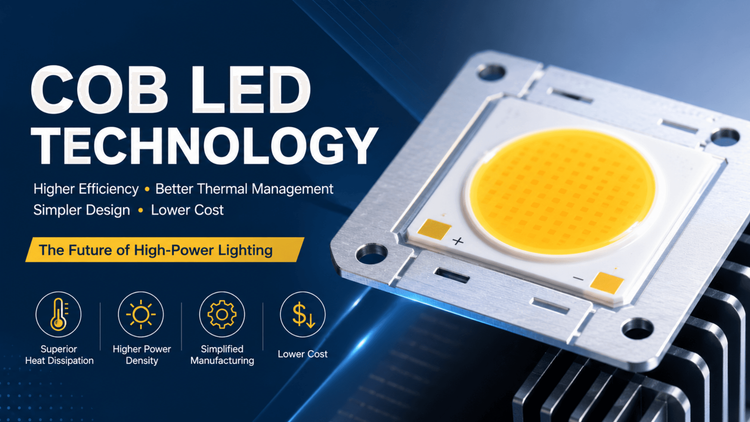
COB (Chip-on-Board) technology refers to a packaging method in which multiple LED chips are mounted directly onto a metal-core printed circuit board (MCPCB) or ceramic substrate.
Unlike traditional SMD (Surface-Mounted Device) packaging — where individual LED packages are soldered separately onto a PCB — COB integrates multiple bare LED dies into a single compact lighting module.
This architecture enables:
- Higher integration density
- Direct thermal conduction
- Simplified optical design
- Reduced assembly complexity
- Improved luminous uniformity
Because the LED chips are mounted directly onto the substrate, heat generated during operation can dissipate rapidly through the MCPCB, significantly improving thermal management performance.
🔥 Why Thermal Management Matters in LED Systems
Thermal performance is one of the most critical factors affecting LED reliability, efficiency, and lifespan.
Excessive junction temperature can cause:
- Lumen depreciation
- Color shift
- Reduced efficiency
- Shortened operational lifetime
- Accelerated material degradation
COB technology addresses these challenges by minimizing thermal resistance between the LED junction and the heat sink.
Compared with conventional SMD structures, COB modules typically achieve thermal conductivity levels of:
- 6–12 W/m·K thermal resistance performance
- Lower junction-to-board thermal path
- More efficient heat spreading over larger surface areas
This makes COB especially suitable for:
- High-power lighting
- Industrial luminaires
- Outdoor floodlights
- Automotive lighting
- Stage lighting
- Commercial downlights
⚙️ COB Structure vs Traditional SMD Structure
💡 Traditional SMD LED Structure
In traditional LED manufacturing:
- Individual LED packages are produced separately
- LEDs are mounted onto an MCPCB
- Additional optical and thermal components are assembled
- The complete module is integrated into the luminaire
This process involves:
- More assembly steps
- Higher labor cost
- Increased solder joints
- More thermal interfaces
- Larger optical spacing
As power density increases, thermal bottlenecks become more severe in SMD architectures.
💡 COB LED Structure
COB technology simplifies the entire manufacturing route.
The process typically includes:
- Bare LED chips mounted directly onto substrate
- Wire bonding or flip-chip interconnection
- Phosphor coating integration
- Direct module integration into luminaires
The resulting structure offers:
- Compact light-emitting surface
- Improved current consistency
- Better thermal conductivity
- Reduced optical loss
- Higher mechanical reliability
The simplified “COB module → LED luminaire” production route reduces:
- Packaging cost
- SMT processing steps
- Labor intensity
- Manufacturing time
- Material usage
🚀 Key Advantages of COB LED Technology
🔹 Higher Power Density
COB allows dozens or even hundreds of LED chips to operate within a compact area.
This enables:
- Extremely high lumen output
- Compact luminaire design
- High-intensity illumination
- Better beam uniformity
High-density integration is especially important in:
- Stadium lighting
- High-bay industrial fixtures
- Automotive headlamps
- Projection systems
🔹 Lower Thermal Resistance
Because chips are mounted directly onto the substrate, COB significantly shortens the thermal conduction path.
Benefits include:
- Lower junction temperature
- Improved energy efficiency
- Extended LED lifespan
- Stable lumen maintenance
Efficient heat spreading also reduces hotspot formation, improving overall system reliability.
🔹 Better Optical Uniformity
Traditional SMD arrays often produce visible multi-shadow effects due to spacing between LED packages.
COB creates a continuous light-emitting surface, resulting in:
- Smooth beam patterns
- Reduced glare
- Better color mixing
- Improved visual comfort
This is highly valuable for:
- Retail lighting
- Architectural lighting
- Studio lighting
- Museum illumination
🔹 Simplified Luminaire Design
COB modules reduce the number of discrete components required inside luminaires.
This enables:
- Smaller product size
- Reduced BOM complexity
- Faster assembly
- Improved system integration
Manufacturers can achieve both cost optimization and higher production scalability.
📈 COB vs SMD: Industry Trend Analysis
As LED lighting evolves toward:
- Higher efficacy
- Higher power density
- Smaller form factors
- Smart lighting integration
- Automotive-grade reliability
COB technology is becoming increasingly dominant in professional lighting applications.
Although SMD still maintains advantages in:
- Flexible layouts
- RGB applications
- Fine-pitch displays
- Decorative lighting
COB continues gaining market share in:
- Commercial lighting
- Industrial lighting
- Outdoor lighting
- Automotive systems
- High-power applications
🏭 Typical Applications of COB Technology
🚗 Automotive Lighting
COB modules are widely used in:
- Headlights
- Daytime running lights
- Adaptive lighting systems
Their compact size and thermal stability make them ideal for high-temperature automotive environments.
🏢 Commercial Lighting
COB is commonly deployed in:
- Downlights
- Spotlights
- Track lighting
- Retail illumination
The technology provides high CRI, smooth beam quality, and compact fixture design.
🏭 Industrial and Outdoor Lighting
High-power COB arrays are ideal for:
- Floodlights
- High-bay lighting
- Warehouse illumination
- Street lighting
Their superior thermal management supports long operating hours and high lumen output.
🎥 Stage and Studio Lighting
COB light sources provide:
- High-intensity directional lighting
- Uniform beam distribution
- Stable color performance
This makes them suitable for professional entertainment lighting systems.
🔬 Future Development Directions of COB Technology
The next generation of COB technology is evolving toward:
- Flip-chip COB structures
- Ceramic substrates
- Mini COB and Micro COB
- Integrated smart drivers
- Higher efficacy phosphor systems
- Advanced thermal interface materials
Future COB modules will increasingly support:
- AI-controlled smart lighting
- Adaptive beam shaping
- Automotive ADB systems
- Human-centric lighting
- High-density miniaturized luminaires
As manufacturing processes mature further, COB technology is expected to continue reducing system cost while improving performance, making it one of the most important directions in next-generation LED luminaire design.
❓ FAQ
💡 What is the difference between COB and SMD LEDs?
SMD (Surface-Mounted Device) LEDs package individual LED chips separately before mounting them onto a PCB, while COB (Chip-on-Board) directly mounts multiple LED chips onto a single substrate.
COB offers:
- Higher integration density
- Better thermal conductivity
- More uniform lighting
- Simplified luminaire assembly
SMD remains advantageous for flexible layouts, RGB lighting, and fine-pitch display applications.
🔥 Why does COB technology provide better heat dissipation?
COB reduces the thermal path between the LED junction and the heat sink by mounting chips directly onto MCPCB or ceramic substrates.
This structure:
- Lowers thermal resistance
- Improves heat spreading
- Reduces junction temperature
- Extends LED lifespan
Efficient thermal management is especially important for high-power lighting applications.
⚡ Is COB more energy efficient than SMD?
In many high-power applications, COB can achieve higher overall system efficiency due to:
- Lower thermal loss
- Improved current distribution
- Reduced optical loss
- Better lumen maintenance
However, efficiency also depends on driver design, optics, substrate materials, and thermal management systems.
🚗 Where is COB LED technology commonly used?
COB technology is widely used in:
- Automotive headlights
- Commercial downlights
- Industrial high-bay lighting
- Outdoor floodlights
- Studio and stage lighting
- Smart lighting systems
Its compact design and thermal stability make it suitable for high-performance luminaires.
🏭 Why is COB becoming mainstream in LED luminaire manufacturing?
The “COB module → luminaire” production route simplifies manufacturing compared with traditional SMD assembly.
Advantages include:
- Lower BOM cost
- Reduced SMT processing
- Faster assembly
- Improved reliability
- Higher system integration
As LED lighting moves toward higher power density and smarter system integration, COB continues gaining market adoption.
🔬 What is the future trend of COB technology?
Future COB development is moving toward:
- Flip-chip COB
- Mini COB and Micro COB
- Ceramic substrate integration
- Smart lighting compatibility
- Higher efficacy phosphor materials
- Automotive-grade adaptive lighting
COB is expected to remain a key direction for next-generation LED lighting systems.