📌 Product Overview
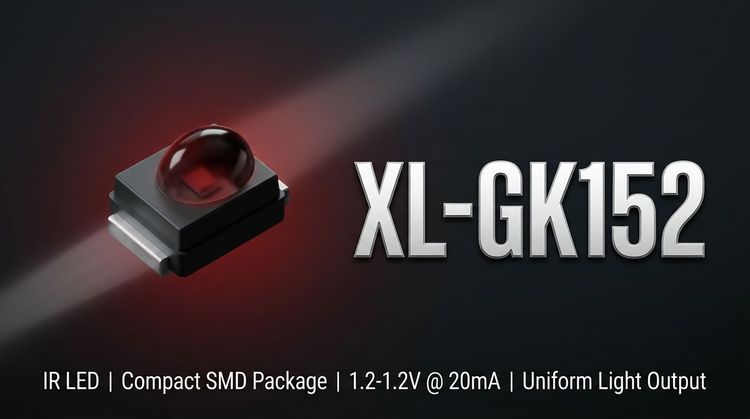
💡 The XINGLIGHT XL-GK152 is a through-beam photoelectric switch integrating an infrared emitter and detector. Unlike reflective sensors, this component uses a separate transmitter and receiver architecture, providing high-intensity radiant output and fast response times.
🚀 Designed for discrete automation sensing, this device is optimized for low-voltage drive scenarios (Vf typically 1.2V–1.6V). It is particularly suited for small home appliances and coin mechanisms where reliable object detection must be maintained within varying thermal environments. The design focuses on minimizing false triggers through a 940nm cut-off wavelength, effectively filtering visible light interference.
🏭 Typical Applications
- Automatic Sensors & Control: Used in non-contact detection for industrial automation systems requiring fast response switching.
- Office Automation: ideal for fax machines and scanners to detect paper presence or end-of-page positioning.
- Gaming & Vending: Targeted for slot machines and coin counters where precise object validation is critical.
- Consumer Electronics: Integration into small home appliances for safety interlocks or lid closure detection.
⚡ Key Technical Specifications
📉 The table below outlines critical performance characteristics under standard test conditions (Ta=25°C). Designers should pay close attention to the C-ESaturation voltage to ensure logic compatibility with downstream MCUs.
| Parameter | Symbol | Test Conditions | Min | Typ | Max | Unit |
|---|---|---|---|---|---|---|
| Forward Voltage | Vf | If=20mA | - | 1.2 | 1.6 | V |
| Peak Wavelength | λP | If=20mA | - | 940 | - | nm |
| Collector Current | Ic(on) | If=20mA, Vce=5V | 0.5 | 10 | - | mA |
| Saturation Voltage | Vce(sat) | Ic=2mA, Ee=1mW/cm² | - | - | 0.4 | V |
| Rise/Fall Time | tr / tf | Vce=5V, RL=100Ω | - | 15 | - | μs |
⚠️ Absolute Maximum Ratings & Process Limits
🔒 Exceeding these ratings may cause permanent device failure. The Power Dissipation (Pd) limit of 75mW (for both emitter and detector) is the critical constraint for high-ambient-temperature environments.
| Parameter | Symbol | Ratings | Unit |
|---|---|---|---|
| Power Dissipation | Pd | 75 | mW |
| Forward Current | If | 50 | mA |
| Peak Forward Current | Ifp | 1000 | mA |
| Collector-Emitter Voltage | Vceo | 30 | V |
| Reverse Voltage | Vr | 5 | V |
| Operating Temp. | Topr | -25 to +85 | °C |
| Storage Temp. | Tstg | -40 to +85 | °C |
📦 Package, Dimensions & Assembly Notes
✨ The XL-GK152 features a lead-through-hole design optimized for wave soldering or manual hand-soldering processes.
- Dimensions: Standard outline with a ±0.3mm tolerance unless specified.
- Soldering Guidelines: To prevent thermal damage, soldering must be performed at a distance of at least 2mm from the epoxy body. Maximum soldering temperature is 260°C for 5 seconds.
- Moisture Sensitivity: The component is classified at MSL Level 2, requiring proper handling to prevent moisture-induced damage during reflow (though hand soldering is typical for this package).
- Material: The device is RoHS compliant and lead-free.
🚢 Sourcing & Supply Considerations
💡 When integrating the XL-GK152 into BOMs, verify the specific "Bin Code" markings (e.g., R2-4 for voltage, IC24-29 for current) on the packaging label to match your circuit’s sensitivity requirements.
- Authentication: Source from authorized channels to ensure RoHS compliance and avoid counterfeit components that may not meet the 940nm wavelength specification.
- Availability: Check stock specifically for the emitter and detector pair to ensure matching characteristics.
- Samples: Request samples from XINGLIGHT to validate the Dark Current (Iceo) limits in your specific low-light circuit conditions.
❓ Frequently Asked Questions
Q: What is the difference between the Emitter and Detector ratings in the XL-GK152?
A: The Input Emitter acts as a diode (Forward Current 50mA), while the Output Detector is a phototransistor (Collector Current 20mA). The emitter converts electricity to 940nm light, while the detector switches current based on the light received.
Q: Can I use this sensor in a high-temperature environment near a motor or heater?
A: The Absolute Maximum Rating for the XL-GK152 is +85°C. While it can function at this limit, the Power Dissipation (75mW) must be derated to prevent thermal runaway. Ensure adequate ventilation or physical separation from heat sources.
Q: What does the "Pulse Forward Current" rating of 1000mA mean for my circuit design?
A: This rating allows for high-intensity bursts of light (pulses) to penetrate dust or oil, provided the pulse width is ≤100μs and the duty cycle is ≤1%. The continuous DC current must not exceed 50mA.
Q: How do I interpret the "IC24-29" code on the packaging label?
A: This code indicates the Current Transfer Ratio (CTR) or binning for the Collector Current. It ensures that the specific batch delivers between 5mA and 10mA of output current under standard test conditions (If=20mA, Vce=5V), helping maintain consistency across mass production.
Q: Is the XL-GK152 suitable for battery-powered devices?
A: Yes, the Low Forward Voltage (Typ 1.2V) and Low Power Dissipation make it suitable for battery-operated slot machines or portable sensors, provided the standby circuitry manages the 20mA drive current efficiently.
Q: What precautions are needed for soldering this component?
A: The epoxy body is sensitive to thermal shock. You must not solder within 2mm of the body, and the iron temperature should not exceed 260°C for more than 5 seconds.