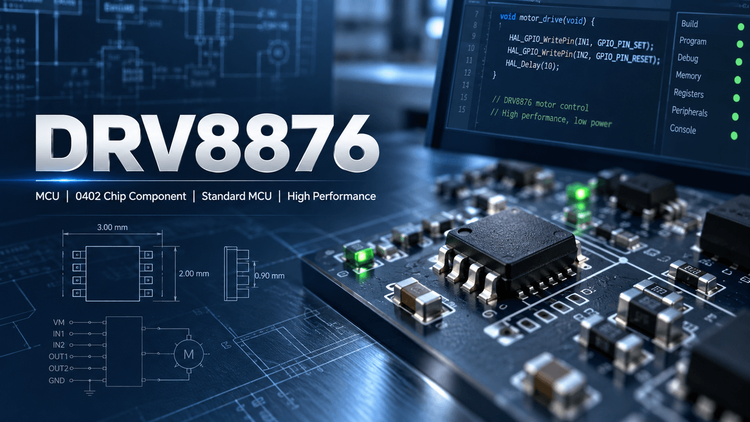
📌 Product Overview
The DRV8876 is an integrated N-channel H-bridge motor driver from Texas Instruments, operating from 4.5 V to 37 V with 3.5 A peak output current. It integrates the charge pump, current sensing/regulation, and protection circuitry that would otherwise require discrete FETs, a shunt resistor, and a gate driver stage.
The most critical selection variables for engineers are the 700-mΩ (HS+LS) RDS(on), the IPROPI proportional current output for stall detection, and the pin-to-pin scalability with the DRV8874 (200 mΩ / 6 A) — which defines both thermal headroom and upgrade paths.
🎯 Typical Applications & Design Context
- 🚗 Brushed DC motor drives in printers, scanners, and smart meters
- 🤖 Robotics loads: vacuum robots, actuators, servo and toy robotics
- 🏠 Major/small home appliances, ATMs, currency counters, EPOS terminals
The DRV8876 suits these scenarios because integrated current sensing eliminates the external power shunt resistor (saving PCB area and BOM cost), the charge pump enables 100% duty cycle, and sleep mode draws <1 µA — critical for battery-powered robotics and metering designs. Spread-spectrum clocking eases EMI/EMC certification in appliance environments.
📊 Key Technical Specifications
| Parameter | DRV8876 Value | Engineering Note |
|---|---|---|
| Supply voltage (VM) | 4.5 – 37 V | Covers 12V/24V rails |
| Peak output current | 3.5 A | RDS(on) = 700 mΩ (HS+LS) |
| Logic input levels | 1.8 / 3.3 / 5 V | Direct MCU interface, no level shifting |
| Control modes (PMODE) | PH/EN, PWM, independent half-bridge | Quad-level pin strap |
| Current regulation (IMODE) | Cycle-by-cycle or fixed off-time | Adjustable via VREF |
| Sleep current | <1 µA @ 24 V, 25°C | nSLEEP pulled low internally |
| Fault reporting | nFAULT (open-drain) | UVLO, CPUV, OCP, TSD |
| Packages | HTSSOP-16 (PWP), VQFN-16 (RGT) | PowerPAD / thermal pad required |
⚠️ Absolute Maximum Ratings & Process Limits
⚠️ The datasheet's headline specs hide the parameters that determine field survival:
| Limit | Boundary | Failure Mode if Exceeded |
|---|---|---|
| VM absolute max | 37 V operating | Motor inductive kickback above VM rating during fast PWM decay can overstress the bridge — bulk capacitance placement is not optional |
| OCP threshold | Set via VREF / IMODE | Misconfigured IMODE allows latch-off faults at motor start-up inrush |
| TSD | Thermal shutdown | Repeated TSD trips indicate PCB copper is insufficient — the thermal pad must connect to a real ground plane |
| Charge pump (CPH/CPL) | 22-nF X5R/X7R, VM-rated | Wrong capacitor voltage rating or DC-bias derating causes CPUV faults under load |
💡 E-E-A-T note: the most common field failure we see is CPUV faults traced to a generic 0402 charge-pump capacitor with excessive DC-bias derating, not a defective IC. Validate the actual capacitance at bias, not the nominal value.
🧩 Package, Dimensions & Assembly Notes
Two pin-compatible-within-variant options: HTSSOP-16 (5.00 × 4.40 mm, PWP) and VQFN-16 (3.00 × 3.00 mm, RGT). Note the two packages have different pinouts — they are not footprint-interchangeable; fix the package decision before layout freeze.
Assembly requirements:
- 👇 Exposed thermal pad must be soldered to a stitched ground plane; insufficient via count causes silent RDS(on) derating and premature TSD
- Standard reflow profile is acceptable (MSL per TI standard); VQFN-16 requires competent paste-aperture design on the center pad to avoid voiding
- VREF, IPROPI, and IMODE traces should be routed away from OUT1/OUT2 switching nodes to prevent false current regulation
🔍 Procurement & Sourcing Insights
- 🔒 Authenticity risk: DRV8876 is a frequent target for remarked HTSSOP parts in gray-market channels; demand date-code traceability to TI franchised distribution or verified Huaqiangbei sources with test reports.
- 📈 Pin-to-pin alternative logic: The DRV8874 (200 mΩ, 6 A) is the same-family drop-in for higher-load designs — validate thermal pad copper area before switching, not after.
- ⏱️ Lead time: TI motor drivers historically see 12–26 week allocation swings; secure sample quantities for EVT and negotiate a mass-production price break early.
- ✨ LDeepAI can support sample requests, cross-referencing, and traceable sourcing — contact our team for validated stock.
❓ FAQ
Q: Can I replace a DRV8876 with a DRV8874 without PCB changes?
A: Yes within the same package suffix (RGT↔RGT, PWP↔PWP), but verify your current regulation setting and thermal design — the 700 mΩ device runs hotter at the same load, while the 8874 has more margin.
Q: Why does my board fault (nFAULT low) only at motor start-up?
A: Typically IMODE/VREF is set too low for inrush current, or the charge-pump capacitor has excessive DC-bias derating causing CPUV. Check both before blaming the IC.
Q: Are the HTSSOP and VQFN versions interchangeable?
A: No. Pin functions differ between PWP and RGT packages. Do not treat them as footprint alternatives.
Q: Do I need a shunt resistor for current sensing?
A: No — IPROPI outputs a proportional analog current using an internal mirror. Size the external IPROPI resistor per your ADC range.
Q: What MOQ/samples does LDeepAI support for validation?
A: We support low-volume samples for EVT/DVT plus traceable mass-production supply with date-code and labeling verification.