📌 Key Takeaways
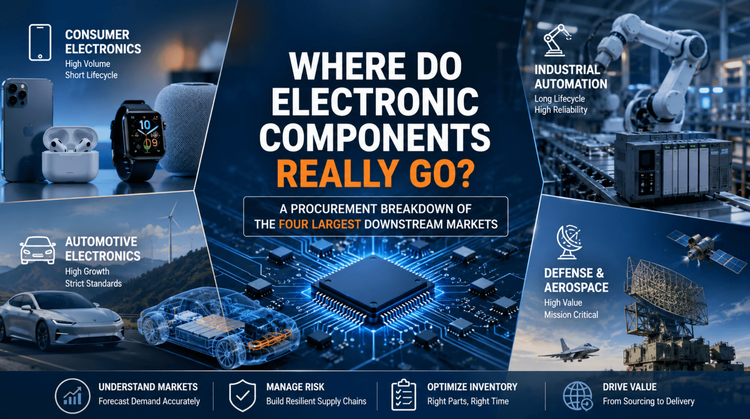
- • The Market: Electronic components are primarily consumed by four downstream sectors—Consumer Electronics, Industrial Automation, Automotive Electronics, and Defense & Aerospace.
- • The Difference: Each market has completely different purchasing behavior, product life cycles, qualification requirements, and inventory strategies.
- • The Opportunity: Understanding component consumption by industry helps distributors, OEMs, and procurement teams optimize inventory, sourcing priorities, and supply-chain risk.
🚀 Opening
Every electronic component eventually ends up inside a finished product—but not every customer buys components for the same reason.
A smartphone manufacturer values cost and production volume. A PLC manufacturer values long product lifecycles. Automotive companies prioritize reliability and traceability, while defense programs demand certified high-reliability components regardless of price.
If you're involved in electronic component distribution, procurement, or inventory planning, understanding where components are actually consumed is just as important as knowing which parts are popular.
Let's look at the four largest downstream markets.
📱 1. Consumer Electronics: Massive Volume, Fierce Competition
Consumer electronics remains the largest downstream market for electronic components.
Shipments are enormous, product cycles are short, and price competition is relentless. Inventory timing often matters more than gross margin.
💡 Smartphones
Representative OEMs:
- Apple
- Samsung
- Huawei
- Xiaomi
- OPPO
- vivo
- HONOR
A flagship smartphone typically carries a BOM value between US$200–500, with semiconductor devices accounting for well over half of the total electronic value.
Typical Component Distribution
| Component Category | Representative Components | Typical BOM Share |
|---|---|---|
| Application Processor (SoC/AP) | Apple A-Series, Qualcomm Snapdragon, MediaTek Dimensity | 15–25% |
| Memory | DRAM, NAND Flash | 10–15% |
| RF Front-End | PA, Filters, RF Switches | 8–12% |
| CMOS Image Sensor (CIS) | Sony, Samsung, OmniVision | 8–15% |
| PMIC | TI, Qualcomm PMIC | 5–8% |
| Display Driver IC | Novatek, LX Semicon | 3–5% |
| MLCC | Murata, Taiyo Yuden, Samsung Electro-Mechanics | 2–4% |
| Connectors | Amphenol, Luxshare | 2–3% |
Market Insight
Memory devices (DRAM and NAND Flash) remain the most actively traded components in the spot market because prices fluctuate rapidly. RF front-end devices, however, are largely controlled by a handful of suppliers, making spot opportunities relatively limited.
🎧 TWS Earbuds & Wearables
Representative Brands
- Apple AirPods
- Huawei FreeBuds
- Xiaomi
- Edifier
- Bose
- Garmin
Typical BOM
- Bluetooth SoC (Bestechnic, Airoha, Apple): 15–20%
- PMIC: 8–10%
- Audio Amplifier: 5–8%
- MEMS Microphone: 5–8%
- Battery Management IC: ~5%
- MLCC & Passives: 3–5%
Although each device has a relatively low BOM value, annual shipments reach hundreds of millions of units.
Volume—not unit price—drives this business.
🏠 Smart Home & AIoT
Representative Companies
- Ecovacs
- Roborock
- Xiaomi
- Huawei
- Tuya Ecosystem
Key Components
- MCU / SoC
- Power Management IC
- MOSFET
- Sensors (IMU, LiDAR)
- Motor Driver IC
- Connectors
LiDAR sensors have become one of the fastest-growing semiconductor categories inside robotic vacuum cleaners.
💻 Laptops & Tablets
Representative Brands
- Lenovo
- Apple
- Dell
- ASUS
- Huawei
Key Components
- CPU
- DRAM & NAND
- PMIC
- USB Type-C Controllers
- Wi-Fi / Bluetooth Modules
📦 Other Consumer Electronics
This category covers virtually every low-cost electronic product sold online or through retail channels:
- Generic chargers
- White-label accessories
- LED toys
- Budget smart devices
- Promotional electronics
These products are also one of the primary destinations for surplus inventory, refurbished ICs, and lower-grade components.
📈 Consumer Electronics Summary
High volume drives the market—but inventory timing determines profitability.
Miss the sales season, and inventory depreciation can happen very quickly.
🏭 2. Industrial Automation: Lower Volume, Higher Stability
Industrial customers rarely chase the lowest price.
Instead, they value:
- Long product lifecycles
- Stable supply
- Traceability
- Consistent quality
Once qualified, suppliers often remain in place for years.
⚙ PLC (Programmable Logic Controllers)
Representative Manufacturers
- Siemens
- Mitsubishi Electric
- Schneider Electric
- Rockwell Automation
- Inovance
- Xinje
Typical Component Distribution
| Component Category | Representative Suppliers | Typical BOM Share |
|---|---|---|
| MCU / Processor | ST, NXP, Renesas | 15–20% |
| IGBT / MOSFET | Infineon, onsemi, ST | 10–15% |
| Power Management IC | TI, ADI | 8–10% |
| Isolation Devices | TI, Chipanalog, Novosense | 5–8% |
| Operational Amplifier | TI, ADI | 3–5% |
| ADC / DAC | TI, ADI | 3–5% |
| Connectors | Phoenix Contact, Luxshare | 5–8% |
Industrial PLC systems frequently remain in production for more than ten years.
When mature MCU families reach end-of-life (EOL), spot-market demand often increases dramatically.
⚡ Variable Frequency Drives & Servo Systems
Representative Companies
- Siemens
- ABB
- Delta
- Inovance
- Yaskawa
Key Components
- IGBT Modules
- Driver IC
- MCU
- Isolation Devices
- Aluminum Electrolytic Capacitors
Power modules typically account for the largest percentage of BOM cost.
🤖 Industrial Robots
Representative Companies
- ABB
- FANUC
- KUKA
- Yaskawa
- Estun
- Inovance
Key Components
- Servo Controllers
- IGBT / SiC Modules
- Encoder ICs
- Sensors
- Industrial Ethernet Controllers
- Connectors
⚡ Energy Management Systems
Representative Companies
- Schneider Electric
- ABB
- Acrel
- Wasion
Key Components
- Energy Metering IC
- Isolation Amplifier
- ADC
- Communication Interface
- Relay
📈 Industrial Automation Summary
Industrial automation offers smaller shipment volumes but significantly longer customer relationships.
Qualification may take months, but successful design wins often generate repeat business for years.
🚗 3. Automotive Electronics: Fastest Growing, Highest Qualification Barrier
Automotive electronics has become one of the fastest-growing semiconductor markets.
At the same time, it also demands the highest quality standards.
🔋 New Energy Vehicles (Powertrain)
Representative OEMs
- BYD
- Tesla
- Li Auto
- NIO
- XPENG
- AITO
- GAC AION
- Zeekr
Typical Component Distribution
| Component Category | Representative Suppliers | Typical BOM Share |
|---|---|---|
| IGBT / SiC Power Devices | Infineon, ST, onsemi, Bosch | 15–25% |
| Automotive MCU | Renesas, Infineon, ST, ChipON | 10–15% |
| Power Management IC | TI, ADI, Novosense | 8–10% |
| Battery Management IC | ADI, TI, MPS | 5–8% |
| Sensors (Pressure/Temperature/IMU) | Bosch, Infineon, Sensata | 8–12% |
| Connectors | TE Connectivity, Amphenol, Luxshare | 5–8% |
| Automotive MLCC | Murata, TDK, Taiyo Yuden | 3–5% |
| Memory | Winbond, Macronix, GigaDevice | 3–5% |
Three procurement lessons stand out:
- Power semiconductors dominate EV BOM value.
- Automotive MCU shortages remain one of the industry's biggest supply-chain memories.
- Automotive connectors are frequently underestimated despite their enormous usage volume.
🚘 ADAS & Smart Cockpit
Representative Platforms
- NVIDIA Orin
- Qualcomm Snapdragon Ride
- Huawei ADS
- Horizon Robotics
Key Components
- AI SoC
- LPDDR5
- UFS
- Image Sensors
- LiDAR Processors
- Ethernet Switches
- PMIC
High-end autonomous driving platforms can contain semiconductor content worth several thousand dollars.
🚙 Traditional Automotive Electronics
Applications
- BCM
- Lighting
- TPMS
- Window Control
- Body Electronics
Key Components
- Automotive MCU
- LIN/CAN Transceivers
- Automotive MLCC
- Relays
- Discrete Devices
📈 Automotive Summary
Automotive electronics offers enormous long-term potential.
However, certifications such as AEC-Q100 make qualification expensive and time-consuming.
Winning one automotive program can secure business for an entire vehicle platform.
🛰 4. Defense & Aerospace: Small Market, High Value
Defense electronics represents a relatively small market in shipment volume.
However, it delivers exceptionally high component value and long product lifecycles.
📡 Radar & Electronic Warfare
Representative Organizations
- CETC Institutes
- Aerospace Science & Industry Corporation
- AVIC
Typical Component Distribution
| Component Category | Characteristics | Typical BOM Share |
|---|---|---|
| RF / Microwave Devices | GaN, GaAs Power Devices | 15–20% |
| FPGA | High-Reliability Xilinx / Intel FPGA | 10–15% |
| Radiation-Hardened IC | Radiation Tolerant, EMI Resistant | 15–20% |
| High-Reliability Discrete Devices | Automotive/Military Grade Diodes & Transistors | 8–10% |
| Precision ADC / DAC | High-Accuracy Analog Devices Series | 8–10% |
| High-Reliability Connectors | Aerospace Connectors | 5–8% |
Radar systems can contain electronic components worth hundreds of thousands of dollars.
🛰 Aerospace & Satellite Systems
Key Components
- Radiation-Hardened FPGA
- Radiation-Hardened MCU
- RF Front-End
- High-Precision ADC/DAC
- Optical Components
- High-Reliability Power Modules
Space-grade ICs often cost tens or even hundreds of times more than their commercial equivalents.
🎯 Missile Guidance Systems
Key Components
- High-Reliability MCU/DSP
- RF Guidance Chips
- MEMS IMU
- EEPROM
- High-Reliability Power Devices
- Hybrid Integrated Circuits
📡 Military Communications
Key Components
- RF Transceivers
- FPGA
- High-Speed ADC/DAC
- RF Filters
- Encryption IC
📈 Defense & Aerospace Summary
This is a highly specialized market with strict certification requirements and long qualification cycles.
Once suppliers enter approved vendor lists, business relationships often remain stable for many years.
💡 Procurement Insight
From years of serving OEMs, EMS providers, and international procurement teams, one observation remains consistent:
Different downstream markets require completely different inventory strategies.
- Consumer electronics rewards fast inventory turnover and accurate demand forecasting.
- Industrial automation values long-term availability and lifecycle management.
- Automotive procurement prioritizes certified supply chains, traceability, and PPAP documentation.
- Defense projects emphasize qualification history, reliability records, and approved sourcing channels.
Trying to manage all four markets with the same purchasing strategy almost always leads to either excessive inventory or missed opportunities.
Understanding who ultimately buys electronic components is the first step toward building a resilient procurement strategy.
🔍 Why Old Assumptions No Longer Work
A decade ago, distributors often focused on sourcing whichever parts were in short supply.
Today's market is far more sophisticated.
Successful procurement teams analyze downstream applications first, then build inventory strategies around customer industries, qualification requirements, and lifecycle expectations—not simply current spot prices.
📈 Implications for OEMs, EMS Providers & Distributors
- Build inventory based on downstream demand rather than headline shortages.
- Separate commercial, industrial, automotive, and defense inventory strategies.
- Prioritize traceability for automotive and industrial customers.
- Monitor lifecycle notifications for mature industrial MCUs and automotive-grade components.
- Balance high-volume consumer products with higher-margin industrial and automotive business.
✅ Closing
Electronic components may look identical on a reel, but the industries they ultimately serve operate under completely different rules.
Understanding downstream markets—from smartphones and PLCs to electric vehicles and radar systems—allows procurement teams to forecast demand more accurately, reduce sourcing risk, and build a more resilient component supply chain.
If you're evaluating sourcing strategies across multiple downstream industries, it's worth discussing how different application markets influence inventory planning, qualification requirements, and long-term supply resilience.