🚀 Key Takeaways
- Passive components remain one of the most supply-chain-critical categories despite representing a relatively small portion of total BOM cost.
- Japanese manufacturers continue leading high-end automotive, industrial, military, and AI infrastructure markets, while Taiwanese and Chinese suppliers rapidly expand production capacity and localization.
- Successful sourcing requires evaluating reliability, qualification, lifecycle, traceability, and ecosystem maturity—not simply unit pricing.
📌 Opening
Resistors, capacitors, and inductors are among the most widely used electronic components, appearing in virtually every PCB—from consumer electronics and industrial automation to electric vehicles and AI servers.
Although individual passive components are inexpensive, shortages or qualification failures can delay entire production programs. For procurement managers, hardware engineers, and EMS companies, understanding the global passive component ecosystem has become essential for building resilient supply chains.
This guide provides a comprehensive overview of the global resistor, capacitor, and inductor supply chain, highlighting major manufacturers, technology strengths, application recommendations, and procurement considerations for 2026.
🌍 Global Passive Component Market Landscape
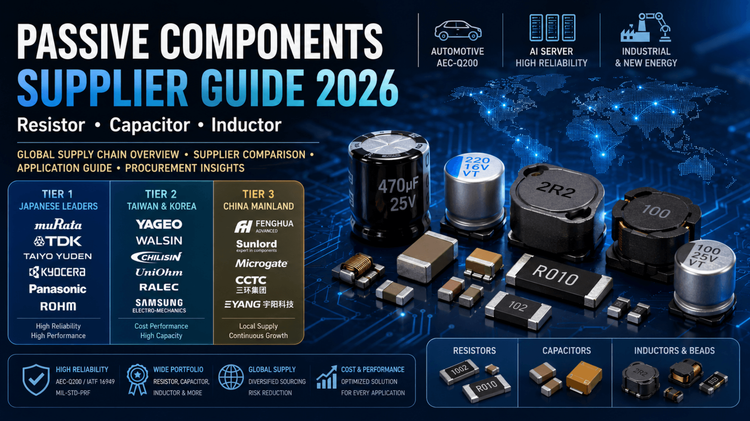
The passive component industry can generally be divided into four major supplier groups.
Tier 1 — Japanese Technology Leaders
These companies dominate high-reliability applications including automotive electronics, aerospace, defense, telecommunications, and AI computing infrastructure.
Representative manufacturers include:
- Murata
- TDK
- Taiyo Yuden
- Kyocera
- Panasonic
- ROHM
Competitive strengths include:
- Ultra-miniature packaging (01005 and below)
- High-frequency RF performance
- Automotive-grade qualification
- Military reliability
- High-voltage operation
- Long product lifecycle support
These manufacturers remain the preferred suppliers for mission-critical electronic systems.
Tier 2 — Taiwanese and Korean Suppliers
Taiwanese manufacturers have become global leaders in cost-performance optimization and large-scale production.
Major suppliers include:
- YAGEO
- Walsin
- Chilisin
- Uniohm
- Ralec
- Samsung Electro-Mechanics
- SAMWHA
Their products are widely deployed across:
- Consumer electronics
- Networking equipment
- Industrial control
- Power supplies
- Automotive electronics
They offer an attractive balance between pricing, quality, and manufacturing capacity.
Tier 3 — Mainland China Suppliers
China's passive component industry has expanded rapidly over the past decade.
Leading domestic manufacturers include:
- Fenghua Advanced Technology
- Sunlord
- Microgate
- CCTC
- EYANG
- Jianghai
- Faratronic
These suppliers increasingly serve:
- Consumer electronics
- Industrial automation
- Renewable energy
- Automotive electronics
- AI infrastructure
Domestic suppliers continue improving technology while reducing dependence on imported passive components.
European and American Specialists
Several Western manufacturers continue dominating niche high-performance markets.
Representative companies include:
- Vishay
- KEMET
- AVX
- EPCOS
These companies specialize in:
- Precision resistors
- Tantalum capacitors
- Film capacitors
- High-reliability industrial applications
🔧 Chip Resistors
Chip resistors remain one of the highest-volume electronic components.
Although technically mature, selecting the appropriate supplier depends heavily on application requirements.
Global Leading Suppliers
YAGEO
YAGEO is the world's largest resistor manufacturer.
Its portfolio includes:
- Thick-film resistors
- Thin-film resistors
- Precision resistors
- Current-sense resistors
- High-power resistors
Following the acquisition of KEMET, YAGEO significantly expanded its passive component portfolio.
Walsin
Walsin provides comprehensive automotive-qualified resistor families compliant with AEC-Q200 standards.
Its products are widely adopted across automotive electronics and industrial equipment.
KOA
KOA specializes in:
- Precision metal-film resistors
- Low TCR resistors
- Military applications
- Industrial instrumentation
Vishay
Vishay remains one of the industry's benchmark suppliers for:
- Precision current sensing
- Wirewound resistors
- High-power resistors
- Industrial-grade applications
Fenghua Advanced Technology
Fenghua has become China's leading chip resistor manufacturer.
Its portfolio covers:
- Consumer electronics
- Automotive electronics
- Industrial control
- General-purpose SMT resistors
The company continues expanding qualification for automotive applications.
⚡ Capacitors
Capacitors represent the largest passive component category by shipment volume.
Modern electronic systems often contain hundreds or even thousands of capacitors.
MLCC (Multi-Layer Ceramic Capacitors)
MLCCs remain indispensable across every major electronics market.
Murata
Murata continues leading the global MLCC market.
Core advantages include:
- Ultra-small packages
- High capacitance
- Automotive qualification
- AI server applications
- RF performance
Murata remains the preferred supplier for flagship smartphones and data-center hardware.
Samsung Electro-Mechanics
Samsung Electro-Mechanics has become one of the world's largest MLCC suppliers.
Its strengths include:
- Large-capacitance MLCC
- Competitive pricing
- Automotive products
- Consumer electronics
TDK
TDK focuses on:
- High-voltage MLCC
- Automotive electronics
- Industrial equipment
- High-frequency applications
Taiyo Yuden
Taiyo Yuden maintains strong positions in:
- RF communication
- High-speed networking
- Automotive electronics
- AI infrastructure
Kyocera
Kyocera primarily serves:
- Aerospace
- Defense
- High-temperature applications
- Mission-critical electronics
Chinese MLCC Manufacturers
China's domestic MLCC industry has made significant progress.
Leading suppliers include:
- Fenghua Advanced Technology
- CCTC
- EYANG
- Torch Electronics
- Hongyuan Electronics
These manufacturers increasingly support:
- Consumer electronics
- Industrial automation
- Automotive electronics
- Defense applications
Aluminum Electrolytic Capacitors
Electrolytic capacitors remain essential for power conversion and energy storage.
Leading suppliers include:
Japanese Manufacturers
- Nichicon
- Panasonic
- Rubycon
- Sanyo
These companies maintain strong reputations for reliability and endurance.
Taiwanese Manufacturers
Representative suppliers include:
- Lelon
- CapXon
- TEAPO
- Samxon
These products are widely used in power supplies and consumer electronics.
Chinese Manufacturers
Key suppliers include:
- Aihua
- Jianghai
- Faratronic
Chinese manufacturers continue improving quality while expanding automotive qualification.
Film Capacitors
Film capacitors play a critical role in:
- Electric vehicles
- Solar inverters
- Industrial drives
- Power conversion
- High-voltage systems
Representative manufacturers include:
- TDK EPCOS
- Faratronic
- Jianghai
- YAGEO
Among domestic suppliers, Faratronic remains one of the world's leading automotive film capacitor manufacturers.
Tantalum Capacitors
Tantalum capacitors remain preferred for high reliability and compact size.
Leading suppliers include:
- KEMET
- AVX
- Vishay
- Panasonic
Chinese manufacturers include:
- Zhenhua Technology
- Hongda Electronics
These products are commonly deployed in military, aerospace, and industrial electronics.
🧲 Inductors and Ferrite Beads
Inductors continue growing in importance as power density increases across AI servers, electric vehicles, and industrial equipment.
Murata
Murata leads:
- RF inductors
- Multilayer inductors
- Ferrite beads
TDK
TDK remains one of the world's largest suppliers of:
- Power inductors
- Automotive inductors
- Ferrite cores
- EMI suppression components
Taiyo Yuden
Taiyo Yuden specializes in:
- High-frequency inductors
- Communication systems
- RF applications
Chilisin
Chilisin has become one of the world's leading suppliers of molded power inductors.
Its products are widely deployed in:
- Servers
- Graphics cards
- Automotive electronics
- Power modules
Sunlord
Sunlord is China's leading inductor manufacturer.
Its portfolio includes:
- Integrated power inductors
- Automotive inductors
- RF inductors
- TLVR inductors for AI servers
The company has significantly expanded its presence in high-performance computing supply chains.
Microgate
Microgate focuses on:
- Multilayer inductors
- RF inductors
- High-current power inductors
Its products are increasingly adopted across automotive and networking applications.
📱 Supplier Recommendations by Application
Consumer Electronics
Recommended suppliers include:
- YAGEO
- Walsin
- Uniohm
- Samsung Electro-Mechanics
- Fenghua
- Sunlord
- Microgate
- EYANG
Industrial Automation
Preferred suppliers include:
- Murata
- TDK
- Taiyo Yuden
- KOA
- Vishay
- Jianghai
- CCTC
Automotive Electronics (AEC-Q200)
Recommended manufacturers include:
- Murata
- TDK
- Samsung Electro-Mechanics
- YAGEO
- Sunlord
- Faratronic
- Aihua
AI Servers and High-Performance Computing
Priority suppliers include:
- Murata high-capacitance MLCC
- Samsung large-capacity MLCC
- Chilisin power inductors
- Sunlord TLVR inductors
- Vishay precision current-sense resistors
Aerospace and Defense
Preferred suppliers include:
- Kyocera
- KOA
- Vishay
- Torch Electronics
- Hongyuan Electronics
- Zhenhua Technology
💡 Procurement Insight
From LDeepAI's experience supporting overseas OEMs and EMS companies, passive component sourcing is often underestimated until shortages occur.
Successful qualification extends well beyond selecting an approved manufacturer.
Procurement teams should verify:
- AEC-Q200 qualification
- Authorized distribution channels
- Lot traceability
- Manufacturing location
- Product lifecycle status
- Packaging compatibility
- Long-term capacity commitment
- Alternate supplier qualification
For AI servers, automotive electronics, and industrial equipment, changing a passive component may require thermal verification, EMC validation, impedance testing, or system-level redesign.
Many sourcing risks originate from uncontrolled substitutions rather than component quality.
🔍 Why Old Assumptions No Longer Work
Historically, passive components were treated as interchangeable commodities.
That assumption no longer holds.
Miniaturization, higher switching frequencies, increased power density, and AI infrastructure have significantly raised technical requirements.
For example:
- MLCC capacitance derating varies considerably between suppliers.
- Power inductors exhibit different saturation characteristics.
- Precision resistors differ in temperature coefficient and long-term stability.
- Automotive qualification standards continue becoming more stringent.
Engineering teams increasingly qualify complete passive component ecosystems rather than individual part numbers.
🏭 Implications for OEM and EMS Procurement
Leading manufacturers now emphasize supply-chain resilience alongside cost optimization.
Best practices include:
- Multi-source qualification
- Regional supplier diversification
- Authorized distributor management
- Long-term inventory planning
- Early lifecycle monitoring
- Design-for-substitution strategies
These approaches reduce production interruptions while improving sourcing flexibility.
🔒 Closing
Although passive components account for only a small percentage of total BOM cost, they frequently determine production continuity, qualification success, and product reliability.
Understanding the global ecosystem—from Japanese technology leaders and Taiwanese manufacturing specialists to China's rapidly expanding domestic suppliers—enables procurement teams to make more resilient sourcing decisions.
As AI computing, automotive electronics, renewable energy, and industrial automation continue driving demand, passive component supply chains will remain a strategic priority for OEMs, EMS providers, and hardware engineering organizations.
LDeepAI continues supporting global customers with component selection, supplier qualification, alternative sourcing strategies, and supply-chain intelligence built on real-world procurement experience.