📌 Product Overview
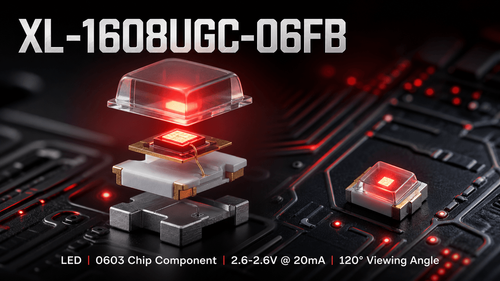
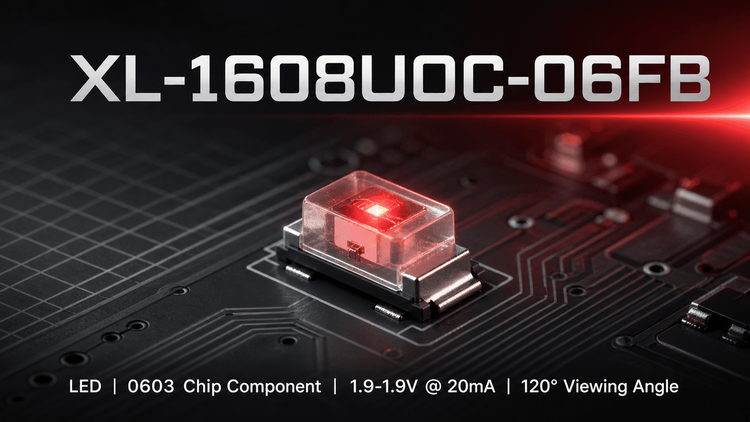
The XL-1608UOC-06FB is a standard 0603 (1608 metric) SMD Orange LED designed for general-purpose indication and backlighting. As a surface-mount device with a water-clear colloid, it offers a balance between compact form factor and luminous intensity. 💡
For design engineers, this component acts as a visual status indicator in consumer and industrial devices. The most critical selection variables are the Forward Voltage (Vf) range for driver matching and Moisture Sensitivity Level (MSL 3), which dictates strict handling before SMT reflow.
🎯 Typical Applications & Design Context
Based on its 0603 footprint and optical characteristics, this LED targets high-density electronic assemblies:
- Industrial Controls & Instrumentation: 👉 Used on electronic instrument panels where clear visual status is required without dominating the board space.
- Automotive Interior Indication: 👉 Suitable for non-critical dashboard backlighting and button illumination (interior only).
- Smart Home & White Goods: 👉 Indicator lights for routers, appliances, and DIY electronics.
- Medical Devices (Low Risk): 👉 Basic indicators for oximeters or non-invasive equipment where long-term optical stability is manageable.
The 120° wide viewing angle makes it ideal for panel indicators that must be visible from oblique angles, while the low power consumption fits battery-operated or densely populated PCBs.
📊 Key Technical Specifications
The following electrical and optical parameters are the baseline for your circuit design calculations. 📉
| Parameter | Symbol | Min | Typical | Max | Unit | Conditions |
|---|---|---|---|---|---|---|
| Luminous Intensity | Iv | 80 | - | 240 | mcd | IF = 20mA |
| Dominant Wavelength | λd | 600 | - | 610 | nm | IF = 20mA |
| Forward Voltage | Vf | 1.8 | - | 2.4 | V | IF = 20mA |
| Viewing Angle | 2Ø1/2 | - | - | 120 | deg | IF = 20mA |
| Reverse Voltage | Vr | - | - | 5 | V | - |
| ESD Tolerance | ESD | - | - | 2000 | V | (Machine Model) |
Note: Brightness and Voltage are subject to binning codes (D2-D6 and M17-9 to M18-5).
⚠️ Absolute Maximum Ratings & Process Limits
Exceeding these parameters risks immediate catastrophic failure or latent thermal degradation. 🚫
| Parameter | Symbol | Value | Unit | Notes |
|---|---|---|---|---|
| Max Forward Current | IF | 20 | mA | Continuous DC operation. |
| Peak Pulse Current | IFP | 60 | mA | Pulse width ≤0.1ms, Duty ≤1/10. |
| Max Power Dissipation | PD | 50 | mW | Derate above 25°C ambient. |
| Operating Temperature | TOPR | -40 ~ +85 | °C | junction temp must be managed. |
| Storage Temperature | TSTR | -40 ~ +85 | °C | |
| Soldering Temp | Tsol | 260 | °C | For ≤6 seconds (Manual/Hook). |
⚠️ E-E-A-T Engineering Insight:
While the datasheet permits a 260°C soldering temp, mass production typically uses Reflow Soldering. For this component, ensure your profile complies with MSL 3 standards (Floor life: 168 hours). If the component is moisture-sensitive, failure to bake before reflow will cause "popcorning" (internal cracking) during the high heat of lead-free reflow, leading to field failures months later.
🧩 Package, Dimensions & Assembly Notes
- Package: 0603 (Imperial) / 1608 (Metric).
- Dimensions (LxWxH): 1.6mm x 0.8mm x 0.6mm.
- SMT Compatibility: Designed for automated pick-and-place.
- Soldering Guide:
- Lead-Free Reflow: Max temp 255°C (Time above 217°C: 60-120s).
- Lead-Based Reflow: Max temp 235°C (Time above 183°C: 60-150s).
- Pad Layout: Ensure your PCB footprint matches standard 0603 land patterns. Incorrect pad sizing can lead to tombstoning (one end lifting) during reflow due to unequal wetting forces.
🔍 Procurement & Sourcing Insights
From a supply chain perspective, the XL-1608UOC-06FB requires strict incoming inspection protocols:
- Vf Binning Verification: 💡 If your circuit design has tight current limits, mixing bins (e.g., 1.9V and 2.3V) might cause visible brightness differences or drive issues. Always specify the bin code (e.g., M18-2) in your PO.
- Counterfeit Risk: LEDs are high-volume commodities. In Huaqiangbei or open markets, "up-marking" (e.g., relabeling lower brightness as higher brightness) is common.
- Alternative Evaluation: When substituting with other brands (e.g., Everlight, Lite-On), focus on the Wavelength (λd) range. A "Standard Orange" from one vendor might look yellowish compared to XINGLIGHT’s 600-610nm range.
LDeepAI supports cross-referencing and inspection services to secure your supply chain for these optical components.
❓ FAQ
Q: Can I drive this LED at 30mA for higher brightness?
A: No. The Absolute Maximum Rating for continuous current is 20mA. While pulses up to 60mA are allowed (≤0.1ms duty), driving it continuously at 30mA will rapidly degrade the epoxy and chip, shortening the lifespan significantly.
Q: What does "Water Clear Colloid" mean for my optical design?
A: It means the LED body is transparent when off. This usually results in a higher intensity and a narrower "hot spot" compared to diffused lenses, but the datasheet lists a wide 120° angle, making it suitable for indicator panels rather than focused light sources.
Q: The datasheet mentions MSL 3. Do I need a dry cabinet?
A: Yes. If your SMT line does not use the components within 168 hours (1 week) of opening the vacuum-sealed bag, you must bake them at 125°C (typically for 24-48 hours depending on moisture bar) to prevent delamination during soldering.
Q: How do I select the correct brightness bin?
A: The brightness is ranked from D2 (80mcd) to D6 (240mcd). For indoor dashboard indicators, the lower bins (D2/D3) are usually sufficient and prevent glare. For automotive backlights that need to compete with ambient light, specify the higher bins (D5/D6).