📌 Product Overview
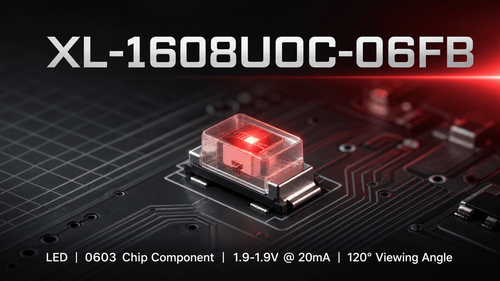
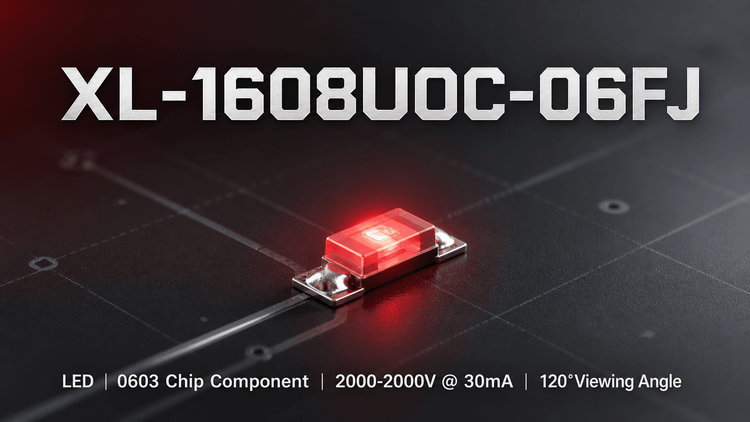
The XL-1608UOC-06FJ is a standard 0603 (1608 metric) Surface Mount Device (SMD) LED manufactured by XINGLIGHT. It utilizes a clear water colloid encapsulation to deliver high-intensity orange light with a wide viewing angle, making it ideal for space-constrained PCBs requiring clear status indication or backlighting.
For engineering teams, the critical selection variables are its forward voltage stability and brightness consistency across batches. This component is optimized for automated SMT processes but requires strict moisture management due to its MSL 3 classification. It is not suitable for high-power illumination but excels in low-power signal applications within consumer and industrial devices.
🎯 Typical Applications & Design Context
This component targets applications requiring low power consumption and high visibility in compact form factors.
- Industrial Instrumentation: Electronic dashboards and control panels where the wide 120° viewing angle ensures readability from various angles.
- Automotive Electronics: Indicator lights and key backlights (cabin electronics only, not exterior lighting).
- Smart Home & White Goods: Status indicators for appliances and routers.
- Medical Devices: Blood oximeter and endoscope indicator lights, leveraging the specific orange wavelength (600-615nm).
It is specifically chosen for these scenarios due to its low thermal footprint and compatibility with high-density SMT assembly lines.
📊 Key Technical Specifications
The following parameters define the performance window for prototype validation and mass production testing (Test Condition: $T_a = 25^\circ\text{C}, I_F = 20\text{mA}$).
| Parameter | Symbol | Min | Typ. | Max | Unit | Notes |
|---|---|---|---|---|---|---|
| Luminous Intensity | $I_V$ | 240 | - | 600 | mcd | See Brightness Grading (D7-E5) |
| Dominant Wavelength | $\lambda_d$ | 600 | - | 615 | nm | Orange Spectrum |
| Forward Voltage | $V_F$ | 1.9 | - | 2.4 | V | See Voltage Grading (M18) |
| Viewing Angle | $2\theta_{1/2}$ | - | - | 120 | Degrees | Wide angle |
| Reverse Voltage | $V_R$ | - | - | 5 | V | Max rating |
| ESD Capability | ESD | - | - | 2000 | V | Human Body Model (HBM) |
💡 Engineering Note: The wide spread in Luminous Intensity (240mcd to 600mcd) necessitates binning selection during procurement to ensure consistent panel brightness.
⚠️ Absolute Maximum Ratings & Process Limits
Exceeding these parameters risks irreversible damage or latent failure. Strict adherence is required for mass production yield.
| Parameter | Symbol | Max Value | Unit | Conditions |
|---|---|---|---|---|
| Power Dissipation | $P_D$ | 60 | mW | $T_a = 25^\circ\text{C}$ |
| Forward Current | $I_F$ | 30 | mA | Continuous DC |
| Peak Forward Current | $I_{FP}$ | 80 | mA | Pulse width $\le 0.1\text{ms}$, Duty $\le 1/10$ |
| Operating Temp | $T_{OPR}$ | -40 ~ +85 | $^\circ\text{C}$ | |
| Storage Temp | $T_{STG}$ | -40 ~ +85 | $^\circ\text{C}$ | |
| Soldering Temp | $T_{SOL}$ | 260 | $^\circ\text{C}$ | $\le 6$ seconds (Manual) |
⚠️ E-E-A-T Insight:
- Thermal Derating is Critical: While the absolute max current is 30mA, the typical test condition is 20mA. Driving this component at 30mA continuously in a high ambient temperature environment ($>60^\circ\text{C}$) will significantly accelerate lumen depreciation.
- ESD Risk: With a 2000V HBM rating, this LED is moderately sensitive. Grounded wrist straps and ionizers are mandatory on the production line to prevent "light death" or latent weakness during the "in-board" phase.
🧩 Package, Dimensions & Assembly Notes
- Package: 0603 (Imperial) / 1608 (Metric). Dimensions: $1.6 \times 0.8 \times 0.6 \text{ mm}$.
- Soldering Guide: This component supports both Lead-free and Leaded reflow profiles.
- Lead-free Peak Temp: Max $235^\circ\text{C}$ (limit), Recommended $225^\circ\text{C}$. Time above $217^\circ\text{C}$ should be 60-120 seconds.
- Leaded Peak Temp: Max $245^\circ\text{C}$.
- Moisture Sensitivity: Classified as MSL 3.
- Requirement: Floor life after opening the sealed bag is 168 hours. If exposed beyond this, the components must be baked at $80^\circ\text{C}$ for 24 hours (per J-STD-033) to prevent "popcorning" or delamination during reflow.
🔒 Validation Tip: Perform a cross-section analysis on the first article to verify the fillet shape. The 0.6mm height requires a balanced stencil aperture design to prevent tombstoning.
🔍 Procurement & Sourcing Insights
From a supply chain perspective, the XL-1608UOC-06FJ presents typical mid-volume availability risks.
- Binning Management: The supplier sorts brightness into bins (D7 through E5) and voltage into bins (M18-1 through M18-5). Procurement must specify the exact bin code (e.g., E3 / M18-2) on the PO. Accepting "random bins" will result in visible brightness variation on the end-product's dashboard.
- Alternative Evaluation: When swapping brands (e.g., swapping XINGLIGHT for Everlight or Lite-On), do not rely solely on dimensions. Verify the CIE coordinates and Viewing Angle. A narrower viewing angle from a substitute might appear brighter head-on but disappear at an angle.
- Traceability: Ensure labels clearly indicate the Date Code. LED brightness degrades over time even in storage; avoid receiving stock older than 18 months.
❓ FAQ
Q: Can I drive this LED at 30mA continuously?
A: While the datasheet allows 30mA as an "Absolute Maximum," this is usually for pulsed operation. For continuous illumination in a sealed enclosure, it is safer to design for 20mA to maintain long-term lifespan and avoid overheating the PCB substrate.
Q: What happens if I ignore the MSL 3 rating?
A: MSL 3 means the LED absorbs moisture from the air. If you skip baking and run it through a reflow oven, the internal moisture will expand into steam, cracking the epoxy casing (delamination) or causing the component to bulge ("popcorning"). This leads to immediate failure or field returns months later.
Q: How tight is the Vf binning?
A: The voltage is binned in 0.1V steps (e.g., M18-2 is 2.0V-2.1V). If you are driving multiple LEDs in parallel, mixing bins (e.g., a 1.9V with a 2.3V) will cause uneven current distribution, leading to one LED being brighter and burning out faster.
Q: Is the Orange color consistent?
A: The wavelength is specified as 600-615nm with a 30nm half-wave width. Human eye sensitivity to orange varies. For medical devices (oximeters), strict wavelength binning (HO01-HO04) is critical. For standard indicators, the standard tolerance is usually sufficient, but mixing batches should be avoided on a single panel.