📌 Product Overview
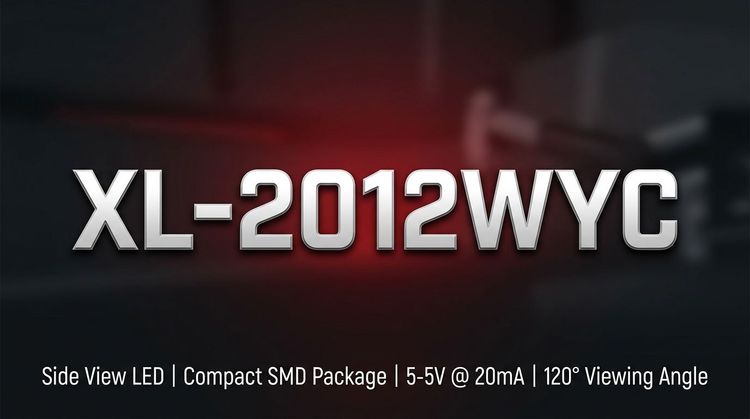
The XL-2012WYC is a standard 0805 (2012 metric) SMD LED component featuring a yellow light emitter and a matching yellow colloid body. 💡 It is optimized for automated SMT production lines, utilizing an EIA-compliant package that measures 2.0mm x 1.2mm x 0.8mm (LxWxH). This component is specifically designed to provide stable illumination in environments requiring ROHS compliance and reliable moisture sensitivity (MSL 3). 👇 Its primary design focus is balancing luminous intensity with compact footprint integration in space-constrained PCBs.
🔌 Typical Applications
Based on its electrical and mechanical specifications, the XL-2012WYC is suitable for integration into the following sectors:
- Medical Devices: Illumination for endoscopes and indicators in oximeters.
- Automotive Electronics: Backlighting for dashboard buttons and instrument panel indicators.
- Industrial Control: Status signals on electronic instrument panels and heavy equipment interfaces.
- Consumer Smart Home: Visual feedback in white appliances and nixie tube displays.
- Communication Devices: Router status LEDs and set-top box indicators.
⚡ Key Technical Specifications
The following table outlines the electro-optical characteristics under standard test conditions (Ta=25°C, IF=20mA), allowing engineers to assess power efficiency and light output consistency.
| Parameter | Symbol | Min. | Typ. | Max. | Unit | Condition |
|---|---|---|---|---|---|---|
| Luminous Intensity | IV | 350 | - | 1000 | mcd | IF = 20mA |
| Forward Voltage | VF | 2.7 | - | 3.4 | V | IF = 20mA |
| Viewing Angle | 2θ1/2 | - | 120° | - | Deg | IF = 20mA |
| Reverse Current | IR | - | - | 1 | μA | VR = 5V |
| Power Dissipation | PD | - | - | 70 | mW | Max Rating |
| Color Coordinates | x/y | 0.475 / 0.406 | - | 0.543 / 0.482 | - | Chromaticity |
💡 Note: Luminous intensity is subject to binning codes (E4-E9) to ensure uniformity across batches.
⚠️ Absolute Maximum Ratings & Process Limits
To ensure long-term reliability and prevent catastrophic failure during operation or assembly, the following stress limits must never be exceeded. 👇 These parameters are critical for designing driver circuits and setting up thermal management profiles.
| Parameter | Symbol | Value | Unit | Notes |
|---|---|---|---|---|
| Max Forward Current | IF | 20 | mA | Continuous operation |
| Peak Forward Current | IFP | 80 | mA | Pulse width ≤0.1ms, Duty ≤1/10 |
| Max Reverse Voltage | VR | 5 | V | - |
| ESD Susceptibility | ESD | 2000 | V | Human Body Model (HBM) |
| Operating Temperature | TOPR | -40 ~ +85 | °C | Ambient range |
| Storage Temperature | TSTR | -40 ~ +105 | °C | - |
| Soldering Temp/Time | TSOL | 260 | °C | ≤ 6 Seconds |
🔒 Warning: Exceeding these thermal or electrical boundaries significantly accelerates LED degradation and luminosity decay.
🏗️ Package, Dimensions & Assembly Notes
The component utilizes the standard 0805 footprint (2.0mm x 1.2mm) with a height of 0.8mm, making it compatible with most modern pick-and-place nozzles.
- Soldering Compatibility: The XL-2012WYC is rated for both leaded and lead-free reflow soldering processes. For lead-free assembly, the maximum peak temperature should not exceed 255°C (5-10s duration).
- Moisture Sensitivity: Classified as MSL 3. 🚀 Components must be baked or reflowed within 168 hours of opening the moisture-barrier bag to prevent popcorning defects.
- Adhesives: Compatible with standard SMT adhesives if wave soldering is required for secondary components.
📦 Sourcing & Supply Considerations
When integrating the XL-2012WYC into a BOM, consider the following supply chain and verification factors:
- Binning Consistency: Verify voltage (M-codes) and brightness (E-codes) bins to ensure uniform display appearance across mass production.
- Authenticity: Source through authorized channels to avoid counterfeits that may fail ROHS compliance or thermal specifications.
- Sample Evaluation: Request pre-production samples to validate the CIE color coordinates (x/y) against your specific design requirements.
- Lead Time: Standard EIA packaging usually offers better availability than custom-specified reels.
❓ FAQ
Q: What is the voltage grading range for the XL-2012WYC?
A: The forward voltage is binned between 2.7V and 3.4V. Specific codes range from M18-9 (2.7V-2.8V) up to M19-6 (3.3V-3.4V), allowing engineers to match LEDs to the driver circuit's output capabilities.
Q: Can this component be used for outdoor automotive applications?
A: While it is rated for automotive electronics (indicators), it is not specifically categorized as AEC-Q101 qualified in the provided data. It is suitable for interior non-critical lighting (dashboards) but requires validation for exterior harsh environments.
Q: What are the specific reflow soldering profile requirements?
A: For lead-free processes, the ramp-up rate should be ≤3°C/s, with a peak temperature of 255°C (+0/-5°C) held for 5-10 seconds. The cooling rate should not exceed 6°C/s to prevent thermal shock.
Q: How is the brightness intensity categorized?
A: Luminous intensity is sorted into bins ranging from 500 mcd to 1000 mcd at 20mA (Codes E4 to E9). This allows for tighter control of light output consistency in the final product.
Q: Does the yellow colloid affect the viewing angle?
A: Yes, the combination of the yellow colloid and the specific chip geometry results in a typical viewing angle of 120 degrees, which is suitable for wide-area indicator lights rather than focused spot illumination.