📌 Product Overview
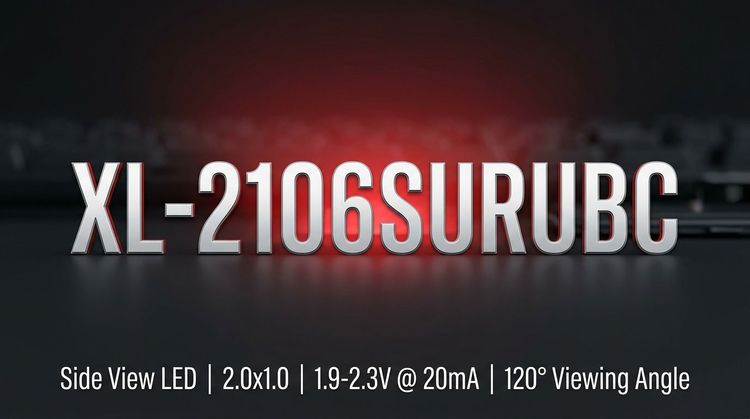
The XL-2106SURUBC is a compact 0603 (2.0x1.0mm) bi-color (Red/Blue) SMD LED designed by XINGLIGHT. It features a transparent water-clear lens with high-brightness chips, suitable for indicator lights, status feedback, and compact backlighting. Unlike standard single-color LEDs, this component integrates two distinct emission wavelengths (Red ~625nm and Blue ~465nm) into a single footprint, optimizing PCB real estate for consumer electronics and smart devices.
🎯 Typical Applications & Design Context
Based on its compact 2.0x0.6x1.0mm outline and 120° viewing angle, this component is engineered for space-constrained applications requiring visual feedback.
- Smart Home & IoT: Status indicators on smart switches, sensors, and buttons.
- Consumer Appliances: Logic level indication on washing machines, air conditioners, and microwaves.
- Bluetooth/Audio: Pairing status or battery level indicators on PCBs inside portable audio devices.
- Automotive Interior: Non-critical dashboard indicators (cluster illumination) where AEC-Q100 is not mandatory.
⚡ Key Technical Specifications
| Parameter | Red (R) | Blue (B) | Conditions |
|---|---|---|---|
| Forward Voltage (VF) | 1.9 - 2.3 V | 2.7 - 3.1 V | IF = 20mA |
| Luminous Intensity (IV) | 80 - 180 mcd | 80 - 210 mcd | IF = 20mA |
| Dominant Wavelength | 620 - 630 nm | 460 - 475 nm | IF = 20mA |
| Half Angle (2θ1/2) | 120 deg | 120 deg | IF = 20mA |
| Reverse Voltage (VR) | 5 V | 5 V | - |
💡 Engineering Insight: The VF spread (N11-4/5 for Red, N11-8/9 for Blue) suggests a standard binning process. Ensure your constant current driver accounts for the higher VF of the Blue chip (up to 3.1V) to avoid current matching issues if driving in parallel.
🛡️ Absolute Maximum Ratings & Process Limits
Exceeding these parameters risks catastrophic thermal runaway or delamination.
| Parameter | Rating | Unit | Notes |
|---|---|---|---|
| Power Dissipation (Pd) | 55 (R) / 75 (B) | mW | Per chip |
| Forward Current (IF) | 30 | mA | Continuous |
| Peak Current (IFP) | 80 | mA | Pulse ≤0.1ms, Duty ≤1/10 |
| ESD Tolerance | 2000 | V | Human Body Model (HBM) |
| Operating Temperature | -40 ~ +85 | °C | Ambient (Ta) |
| Storage Temp (Tstg) | -40 ~ +85 | °C | |
| Soldering (Reflow) | 260 / 6 | °C / sec | Max peak temp / time |
*⚠️ Reliability Warning (MSL 3): This part has a Moisture Sensitivity Level (MSL) of 3. It must be baked (125°C) prior to reflow if the floor life (168 hours at <70% RH) has been exceeded. Failure to bake will cause "popcorning" (internal cracking) during the high-temperature reflow process.
📦 Package, Dimensions & Assembly Notes
- Footprint: 0603 Metric (EIA standard 1608 metric). Standard pad dimensions apply.
- Dimensions: 2.0mm (L) x 0.6mm (W) x 1.0mm (H).
- Soldering: Compatible with standard Lead-Free Reflow profiles (Peak 245°C ±5°C) and manual soldering (<300°C for <3s).
- Taping: EIA standard embossed carrier tape for automated pick-and-place.
🚀 Procurement & Sourcing Insights
- Availability: As a standard catalog component from XINGLIGHT, it generally offers better availability than niche Nicha or Rohm equivalents.
- Alternative Validation: When swapping for this model, verify the Height (H) parameter. Some 0603 alternatives are 1.1mm tall, which might interfere with housing or touch panels in slim devices.
- Binning Risks: The datasheet indicates loose brightness bins (D2-D5). For mass production, insist on a specific bin code (e.g., D4) to ensure uniform visual brightness across your product line.
- Supply Chain: LDeepAI recommends verifying the source to avoid "off-brand" rejects that may suffer from epoxy yellowing or forward voltage drift.
❓ FAQ
Q: Can I drive the Red and Blue chips in parallel with a single resistor?
A: ❌ No. The Blue chip has a forward voltage (3.0V) significantly higher than the Red chip (2.1V). A parallel connection with one resistor would result in the Red chip dominating the current, potentially damaging it, while the Blue chip remains dim. Use separate resistors or a controlled current source.
Q: What happens if I exceed the MSL floor life?
A: Exceeding the 168-hour floor life (at 30°C/70% RH) without baking introduces moisture into the epoxy. During reflow (260°C), the water expands into steam, causing delamination or cracking the internal bond wires. Always follow the MSL3 bake-out guide (usually 24-48 hours at 125°C depending on shelf life).
Q: Is this LED suitable for outdoor use?
A: The datasheet specifies an operating range of -40°C to +85°C. While it handles temperature extremes well, the transparent epoxy is not inherently UV-resistant. Prolonged exposure to direct sunlight may cause the epoxy to yellow over time, reducing brightness. Consider a secondary UV-coating or housing for outdoor applications.
Q: How do I interpret the brightness codes (D2-D5) in the BOM?
A: The codes range from D2 (80-100mcd) to D5 (180-210mcd). If your design requires high visibility, specify D5 in your procurement contract. Mixing bins (e.g., using D2 and D5 on the same dashboard) will result in visible unevenness, which is a common cause of cosmetic rejection in QC.