📌 Product Overview
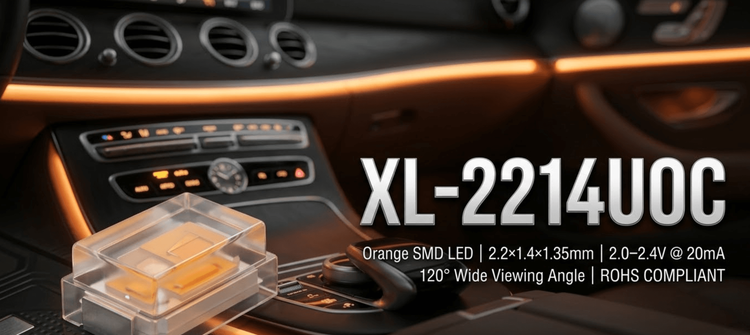
The XL-2214UOC is a compact, surface-mount device (SMD) LED from XINGLIGHT, featuring a 2.2x1.4x1.35mm package with a transparent colloid and orange light emission (605nm peak). 📦 Designed for high-density automated assembly, it complies with ROHS directives and supports standard infrared reflow soldering processes.
While the primary application is illumination, the real design focus lies in managing its Moisture Sensitivity Level (MSL 3) and thermal boundaries during SMT production. Engineers must balance the 120-degree viewing angle with the 260°C soldering limit to prevent degradation in commercial lighting and automotive interior displays.
🔦 Typical Applications
Based on its luminous intensity (900-1300 mcd) and dominant wavelength (600-610nm), the XL-2214UOC is optimized for environments requiring warm orange indicators or accent lighting.
- Commercial & Signage: Ideal for advertising light boxes and light strip decoration due to high intensity.
- Automotive Interiors: Suitable for dashboard lighting and interior ambiance lights.
- Backlighting: Effective for LCD indicators and switch illumination.
- General Indoor: Used in status indicators and flexible strip lighting.
📊 Key Technical Specifications
⚡ Electrical & Optical Performance (Ta=25°C)
These parameters define the operational window. Note the binning codes for voltage and brightness to ensure batch consistency.
| Parameter | Symbol | Test Conditions | Min | Typ | Max | Unit |
|---|---|---|---|---|---|---|
| Luminous Intensity | IV | IF=20mA | 900 | - | 1300 | mcd |
| Dominant Wavelength | λd | IF=20mA | 600 | - | 610 | nm |
| Peak Wavelength | λp | IF=20mA | - | 605 | - | nm |
| Forward Voltage | VF | IF=20mA | 2.0 | - | 2.4 | V |
| Viewing Angle | 2θ1/2 | IF=20mA | - | 120 | - | deg |
| Reverse Current | IR | VR=5V | - | - | 1 | μA |
⚠️ Absolute Maximum Ratings & Process Limits
🔒 Exceeding these limits risks immediate catastrophic failure or latent reliability issues. Pay close attention to the ESD and Thermal constraints during circuit design and handling.
| Parameter | Symbol | Value | Unit | Notes |
|---|---|---|---|---|
| Power Dissipation | PD | 50 | mW | Derate above 25°C ambient |
| Forward Current | IF | 20 | mA | Continuous DC operation |
| Peak Forward Current | IFP | 80 | mA | 1/10 Duty, 0.1ms Pulse |
| ESD Capability | ESD | 2000 | V | Human Body Model (HBM) |
| Operation Temperature | Topr | -40 ~ +85 | °C | Junction temperature dependent |
| Storage Temperature | Tstg | -40 ~ +85 | °C | |
| Soldering Temp | Tsol | 260 | °C | ≤ 6 Seconds (Hand) |
🛠️ Package, Dimensions & Assembly Notes
The XL-2214UOC utilizes a standard EIA-compliant package measuring 2.2 x 1.4 x 1.35mm.
- MSL Level: Rated at Level 3. Components must be baked (pre-conditioning) if floor life exceeds 168 hours before reflow to prevent "popcorning" or internal cracking.
- Soldering Guidelines:
- Hand Soldering: Only for repair. Use <30W iron, <300°C tip, for <3 seconds per pad.
- Reflow: Follow the Pb-Free profile. Reflow should not exceed 2 cycles.
- Physical Tolerance: Unless noted, tolerances are ±0.25mm for the component body.
📦 Sourcing & Supply Considerations
✅ When sourcing the XL-2214UOC, consider these critical supply chain factors to ensure production stability:
- Binning Consistency: Specify brightness (E9, F1, F2) and voltage (N12-8, N12-9) codes to ensure uniformity across batches.
- Moisture Control: Verify the supplier uses vacuum-sealed packaging with dry desiccant, given the MSL 3 classification.
- Authenticity: Source through XINGLIGHT authorized channels to guarantee ROHS compliance and reliability standards.
❓ FAQ
Q: What does the MSL 3 rating mean for my assembly line?
A: MSL 3 (Moisture Sensitivity Level) means the components can absorb moisture from the air. You must bake them if they have been out of the sealed bag for more than 168 hours (1 week) before reflow soldering to prevent internal damage.
Q: Can I drive this LED at 40mA for higher brightness?
A: No. The Absolute Maximum Forward Current is 20mA. While pulses up to 80mA are allowed, continuous operation above 20mA will rapidly degrade the LED or cause thermal failure.
Q: What is the difference between the E9, F1, and F2 brightness codes?
A: These are "binning" codes that sort the LEDs by luminous intensity. E9 is 900-1000 mcd, F1 is 1000-1150 mcd, and F2 is 1150-1300 mcd. Selecting a specific bin ensures consistent brightness across your light panel.
Q: Is this LED suitable for outdoor street lighting?
A: No. The operating temperature range is -40°C to +85°C, but the package is not specifically rated for high UV exposure or waterproofing (IP rating) required for outdoor environments without additional protection.
Q: What is the maximum soldering temperature I can use?
A: For reflow, follow the standard Pb-Free profile (max ~250°C). For hand soldering repairs, the tip temperature must not exceed 300°C and contact time must be under 3 seconds.