📌 Product Overview
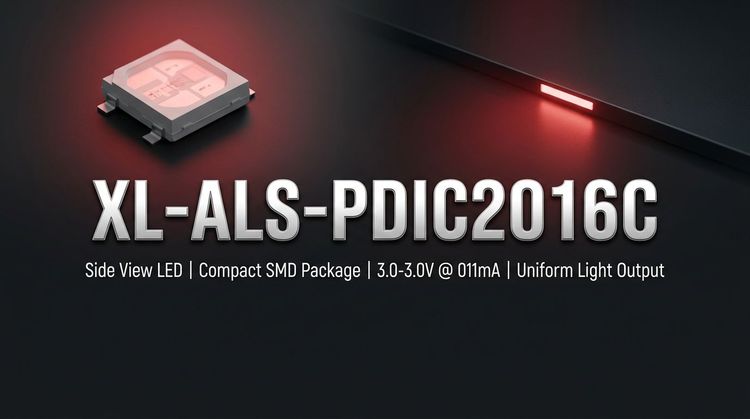
The XL-ALS-PDIC2016C is a high-performance Color Temperature and Ambient Light Sensor (ALS) manufactured by XINGLIGHT. Designed with a focus on low-power management and precision, it utilizes a 16-bit ADC resolution to deliver accurate light sensing across various spectrums. 💡 This component is specifically engineered for integration into space-constrained portable devices where power efficiency and precise light data are critical for automatic brightness adjustment and display management.
Target applications primarily include consumer electronics such as notebooks, handheld devices, and scanners, requiring reliable environmental sensing. The device operates via a standard I2C serial compatible interface, simplifying connectivity with modern microcontrollers. 👇 Its design architecture supports programmable gain and integration time, allowing engineers to optimize performance specific to their environmental lighting conditions and power constraints.
🚀 Typical Applications
Based on the device's spectral sensitivity and low-power operating modes, the XL-ALS-PDIC2016C is suited for the following specific implementations:
- Display Backlight Control: Automatic brightness adjustment in notebook PCs and tablets to enhance user visual comfort and extend battery life.
- Color Temperature Sensing: Utilized in lighting systems to measure Correlated Color Temperature (CCT) for screen calibration or "True Tone" adjustments.
- Wearable Technology: Integration into smartwatches and fitness trackers due to low active current (300 uA) and sleep modes (< 10 uA).
- Optical Scanning: Document or image scanners requiring precise RGB and IR differentiation to improve color accuracy.
📈 Key Technical Specifications
The electrical and optical performance of the XL-ALS-PDIC2016C is characterized by high sensitivity across Red, Green, Blue, Clear, and IR channels. 💡 The device operates at a typical supply voltage of 3.0V (range 2.6V - 3.6V) and communicates via an I2C Fast Mode interface (up to 400 kHz).
| Parameter | Symbol | Test Conditions | Min | Typ | Max | Unit |
|---|---|---|---|---|---|---|
| Supply Current | IDD | Active Mode | -- | 300 | 350 | uA |
| Sleep (ADDR high) | -- | 1 | 10 | uA | ||
| ADC Resolution | -- | 16-bit | 0 | -- | 65535 | counts |
| Peak Sensitivity | $\lambda_{peak}$ | Red Channel | -- | -- | 630 | nm |
| Green Channel | -- | -- | 550 | nm | ||
| Blue Channel | -- | -- | 480 | nm | ||
| Dark Count | -- | Integration 100ms | 0 | 1 | 3 | counts |
| SCL Frequency | $f_{SCL}$ | I2C Fast Mode | -- | -- | 400 | kHz |
🔒 Absolute Maximum Ratings & Process Limits
Exceeding these ratings may cause permanent damage to the device. Stress beyond these limits is not implied for functional operation. 🔒 These parameters are critical for establishing robust system protection boundaries and ensuring long-term reliability.
| Parameter | Symbol | Min | Max | Unit |
|---|---|---|---|---|
| Power Supply Voltage | $V_{DD}$ | -0.5 | 3.6 | V |
| Input Voltage | $V_{in}$ | -0.5 | $V_{DD}$ | V |
| Junction Temperature | $T_j$ | - | 80 | °C |
| Operating Temp. | $T_A$ | -30 | 70 | °C |
| ESD (HBM) | $V_{ESD}$ | -2000 | +2000 | V |
| ESD (MM) | $V_{ESD}$ | -800 | +800 | V |
| Storage Temp. | -- | - | 80 | °C |
📦 Package, Dimensions & Assembly Notes
The device follows the model designation 2016, implying a standard 2.0mm x 1.6mm surface-mount footprint suitable for high-density PCB layouts.
Assembly & Handling:
- Package Type: Surface Mount Device (SMD).
- Dimensions: 2016 metric form factor (approx. 2.0 x 1.6 x 0.6 mm).
- Moisture Sensitivity: The component is classified at MSL (Moisture Sensitivity Level) 4-5. This necessitates strict adherence to dry packing procedures and baking before reflow to prevent popcorning.
- Soldering: Reflow profiling should follow standard guidelines for similar-sized SMDs to ensure optimal joint integrity without thermal stress.
- I2C Addressing: Supports selectable addresses b1000_011 and b1000_010 via hardware pin configuration to avoid bus conflicts.
🤝 Sourcing & Supply Considerations
When integrating the XL-ALS-PDIC2016C into production, procurement teams should consider the following factors:
- Supply Chain Stability: Verify current lead times for the XINGLIGHT ALS series, as optoelectronic components can face variable availability.
- Cross-Reference: While this is a specific fixed-function sensor, ensure software compatibility if considering drops-in replacements; the I2C register map must match.
- MSL Compliance: Confirm that distributors supply parts in sealed, vacuum-sealed bags with appropriate desiccant, given the 4-5 MSL rating.
- Sample Evaluation: Request pre-production samples to validate the 16-bit ADC resolution against your specific enclosure transparency and LED placement.
❓ FAQ
Q: What is the power consumption difference between Active and Sleep modes?
A: In Active mode, the sensor typically consumes 300 uA. In Sleep mode (dependent on the ADDR pin state), consumption drops to as low as 1 uA (ADDR high) or 16 uA (ADDR low), making it highly efficient for battery-powered devices.
Q: What is the gain scaling factor for this sensor?
A: The XL-ALS-PDIC2016C supports programmable gain scaling (AGAIN). The factors are: AGAIN=0 (1x), AGAIN=1 (1.5x), AGAIN=2 (2x), and AGAIN=3 (2.5x). This allows for dynamic range adjustment in varying light conditions.
Q: Does the sensor support standard I2C communication speeds?
A: Yes, the datasheet specifies support for I2C Standard and Fast Mode, with an SCL operating frequency up to 400 kHz.
Q: What precautions are necessary for soldering this component?
A: Due to the MSL 4-5 rating, components must be baked according to IPC/JEDEC standards if the dry pack has been exposed to moisture. Standard reflow soldering profiles for SMD components should be applied to avoid thermal damage.
Q: Can I use this sensor for infrared (IR) detection?
A: Yes, the datasheet specifies a separate IR channel with a peak sensitivity wavelength of 870 nm, making it suitable for applications requiring IR light measurement or basic proximity sensing logic.