📌 Product Overview
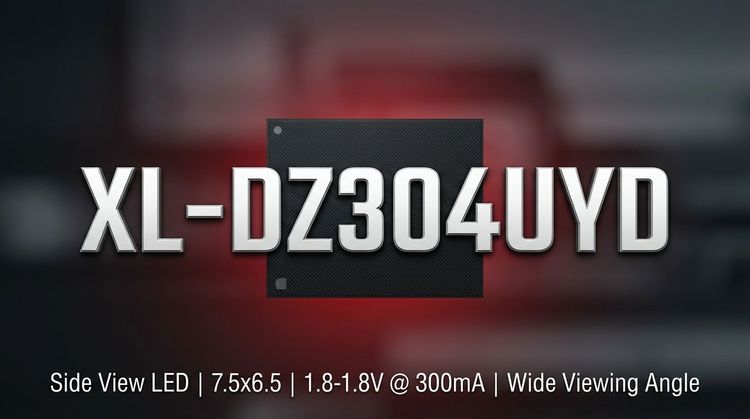
The XL-DZ304UYD is a standard 3mm through-hole (THT) light-emitting diode manufactured by XINGLIGHT. It utilizes a yellow water-clear colloid to produce luminous intensity between 300 and 900 mcd at a dominant wavelength of 585–595 nm. This component is specifically engineered for general-purpose status indication in electronic assemblies. Its design focuses on high energy efficiency and long operational life, making it suitable for continuous monitoring applications in industrial and server environments where physical visibility and PCB integration density are critical constraints.
💡 Typical Applications
Based on the provided datasheet parameters and MSL (Moisture Sensitivity Level) ratings, the XL-DZ304UYD is optimized for the following use cases:
- Industrial Status Indicators: Visual feedback for converters, power supplies, and control panels.
- IoT & Networking Devices: Link activity and status lights for storage servers and communication modules.
- Medical Instruments: Signal indicators for electronic testing equipment and bedside monitors.
- Consumer Electronics: Front-panel display lighting requiring standard 20mA drive currents.
📊 Key Technical Specifications
The following table outlines the electro-optical characteristics under standard test conditions ($T_a = 25^\circ C$):
| Parameter | Symbol | Min | Typ | Max | Unit | Test Conditions |
|---|---|---|---|---|---|---|
| Luminous Intensity | $I_v$ | 300 | - | 900 | mcd | $I_F = 20$ mA |
| Dominant Wavelength | $\lambda_d$ | 585 | - | 595 | nm | $I_F = 20$ mA |
| Forward Voltage | $V_F$ | 1.8 | - | 2.4 | V | $I_F = 20$ mA |
| Viewing Angle | $2\theta_{1/2}$ | - | - | 45 | deg | $I_F = 20$ mA |
| Reverse Current | $I_R$ | - | - | 1 | $\mu$A | $V_R = 5$ V |
⚠️ Absolute Maximum Ratings & Process Limits
Exceeding these ratings may cause permanent device failure. Designers must incorporate safety margins to account for thermal spikes and voltage transients.
| Parameter | Symbol | Value | Unit | Notes |
|---|---|---|---|---|
| Max Power Dissipation | $P_D$ | 50 | mW | Derate above 25°C ambient |
| Max Continuous Forward Current | $I_F$ | 20 | mA | DC operation |
| Peak Forward Current | $I_{FP}$ | 80 | mA | Pulse width $\leq 10\mu s$ |
| Max Reverse Voltage | $V_R$ | 5 | V | |
| ESD Tolerance | ESD | 2000 | V | Human Body Model (HBM) |
| Operating Temperature | $T_{OPR}$ | -40~+85 | $^\circ C$ | |
| Soldering Temp | $T_{SOL}$ | 260 | $^\circ C$ | $\leq 6$ Seconds |
📦 Package, Dimensions & Assembly Notes
The device features a molded 3mm epoxy lamp package with an overall dimension of 7.5mm (height) x 6.5mm (width) x 4.5mm (thickness).
- Lead Configuration: Standard axial lead frame for PCB insertion.
- Tolerance: Unless specified, mechanical dimensions allow a tolerance of $\pm 0.25$mm.
- Soldering: Manual or wave soldering processes should not exceed 260°C for 6 seconds to prevent epoxy degradation.
- MSL Level: Rated at Level 2 (indicating sensitivity to moisture; baking may be required if opened for > 1 year).
🚀 Sourcing & Supply Considerations
To guarantee production yield and visual uniformity, procurement teams should adhere to the following:
- Strict Binning: Order codes must specify brightness (e.g., A4, A5, A6, A7) and voltage bins (N12-7/8/9) to ensure consistent panel lighting.
- RoHS Compliance: Verify that the stock meets the "Environmental protection" and ROHS requirements specified in the datasheet.
- Packaging: Components are shipped in moisture-proof, anti-static foil bags to preserve ESD integrity and prevent moisture ingress during transit.
❓ FAQ
Q: What is the difference between the brightness binning codes A4 through A7?
A: The codes represent the luminous intensity range measured at 20mA. Code A4 covers 300-400 mcd, while A7 covers 700-900 mcd. Selecting the correct bin ensures uniform brightness across a batch of status indicators.
Q: Can this LED be used in outdoor environments?
A: The datasheet specifies an operating temperature range of -40°C to +85°C, which covers most industrial climates. However, the water-clear colloid is primarily designed for indoor indication; for outdoor use, additional UV protection and waterproofing measures are recommended.
Q: What are the storage requirements to prevent performance degradation?
A: Storage must occur in environments with temperatures not exceeding 30°C and relative humidity below 70%. If the LEDs are stored for more than three months, use of a desiccant or nitrogen-filled dry cabinet is recommended.
Q: How should I design the drive circuit for forward voltage variations?
A: The forward voltage ($V_F$) can range from 1.8V to 2.4V depending on the bin and temperature. A constant current source or a simple resistor calculation based on the maximum $V_F$ (2.4V) is advised to prevent current runaway.
Q: Is this component suitable for automatic assembly processes?
A: Yes, the 7.5x6.5mm dimensions and EIA standard packaging allow for compatibility with standard radial lead insertion equipment and automated soldering machines.