📌 Product Overview
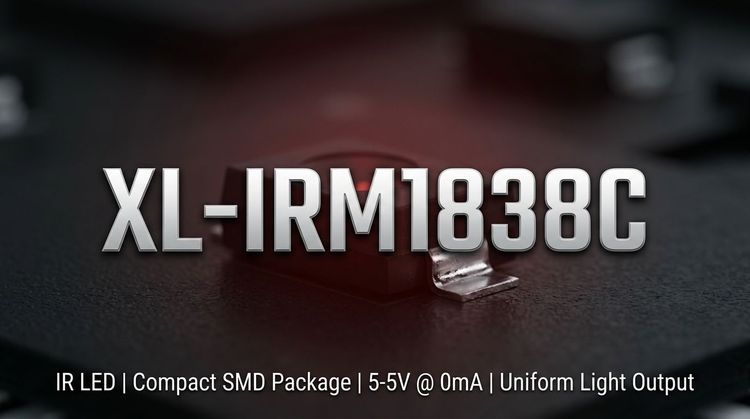
The XL-IRM1838C from XINGLIGHT is a 3-pin infrared receiver head designed for signal detection in remote control systems. 💡 It integrates a high-sensitivity PIN photodiode and a low-power, high-gain preamplifier IC into a single epoxy resin package, reducing the need for external circuit components.
This device features dual internal and external shielding to minimize electromagnetic interference, ensuring stable operation in electrically noisy environments like home appliances or automotive cabins. 🎯 Target applications primarily include household appliances (air conditioners, fans), multimedia equipment (set-top boxes, DVDs), and industrial automation interfaces.
🔌 Typical Applications
Based on its 37.9kHz carrier frequency and wide voltage tolerance, this component is suited for:
- Consumer Electronics: IR reception for TVs, DVDs, and Set-Top Boxes (STBs).
- Home Automation: Control interfaces for air conditioners, fans, heaters, and humidifiers.
- Automotive & Mobile: In-car DVD players and dashboard controls.
- Industrial Control: Instrumentation and automation panels requiring wireless input.
- Peripherals: Computer accessories and induction sanitaryware.
⚙️ Key Technical Specifications
The electrical performance is characterized by low power consumption and compatibility with standard logic levels.
| Parameter | Symbol | Min | Typical | Max | Unit | Test Conditions |
|---|---|---|---|---|---|---|
| Supply Voltage | VDD | 2.7 | - | 5.5 | V | - |
| Carrier Frequency | f₀ | - | 37.9 | - | kHz | - |
| Working Current | ICC | 0.21 | 0.27 | 0.34 | mA | VDD=5V |
| Reception Distance | L | - | 12 | - | m | 0° angle |
| BPF Width | fBW | - | 6 | - | kHz | - |
| Low Level Output | VoL | - | - | 250 | mV | Isink = 2.0mA |
| High Level Output | VoH | 4.5 | - | 5.0 | V | VCC = 5V |
💡 Note: The transmission data supports TTL and CMOS levels with active low output.
⚠️ Absolute Maximum Ratings & Process Limits
Exceeding these limits may cause permanent damage to the device. 👇 These parameters are critical for designing protection circuits and ensuring reliability during thermal events.
| Parameter | Symbol | Rating | Unit | Notes |
|---|---|---|---|---|
| Supply Voltage | VDD | 6.0 | V | - |
| Operating Temp. | Topr | -20 ~ +85 | °C | Ambient temperature |
| Storage Temp. | Tstg | -40 ~ +125 | °C | - |
| Wave Soldering | Tsol | 260 | °C | ≤ 6 seconds |
| Manual Welding | Tsol | 300 | °C | ≤ 3 seconds |
🔒 Ensure the soldering profile does not exceed these limits to prevent degradation of the internal epoxy shielding or IC bonds.
📦 Package, Dimensions & Assembly Notes
The device utilizes a semi-circular spherical epoxy package optimized for focused light reception.
- Dimensions: 6.5mm (L) x 5.4mm (W) x 4.1mm (H), excluding pins.
- Pin Length: 23.8mm (typical assembly length).
- Tolerance: ±0.25mm unless specified.
- Shielding: Features dual-shielding design (internal + external) to prevent interference from fluorescent lamps (200±50 Lux) and other IR sources.
🚀 Assembly Note: For wave soldering, peak temperature must be controlled strictly at 260°C for a maximum of 6 seconds. The component is packaged in moisture-proof and anti-static foil bags to maintain ESD safety (rated for 4KV static discharge) prior to assembly.
📈 Sourcing & Supply Considerations
- Compliance: The XL-IRM1838C is REACH and ROHS certified, meeting standard environmental requirements for EU and general export markets.
- Quality Control: Reliability testing includes high-temperature storage (85°C) and vibration testing, with a 100% pass rate on static sensitivity (20 samples tested).
- Supply Chain: Recommended for mass production due to stable ICC characteristics (0.27mA typical), reducing power supply variance issues.
- Verification: Always confirm the specific carrier frequency (37.9kHz) matches the remote control transmitter coding (e.g., NEC protocol) to avoid pairing failures.
❓ FAQ
Q: What is the carrier frequency tolerance for the XL-IRM1838C?
A: The typical carrier frequency ($f_o$) is 37.9 kHz. The Band Pass Filter (BPF) width is typically 6 kHz.
Q: Can this receiver be used in battery-operated devices?
A: Yes. The device features a wide operating voltage range (2.7V to 5.5V) and low working current (0.27mA typical at 5V), making it suitable for low-power designs.
Q: How does the dual shielding design benefit performance?
A: The internal and external shielding minimizes electrical interference (EMI) from environmental sources like fluorescent lights or other switching power supplies, ensuring signal stability.
Q: What are the soldering limits for this component?
A: For wave soldering, do not exceed 260°C for 6 seconds. For manual welding, do not exceed 300°C for 3 seconds.
Q: Is the output TTL compatible?
A: Yes, the output matches TTL and CMOS logic levels. It features an active low output, meaning the signal drops to low voltage when a signal is received.