📌 Product Overview
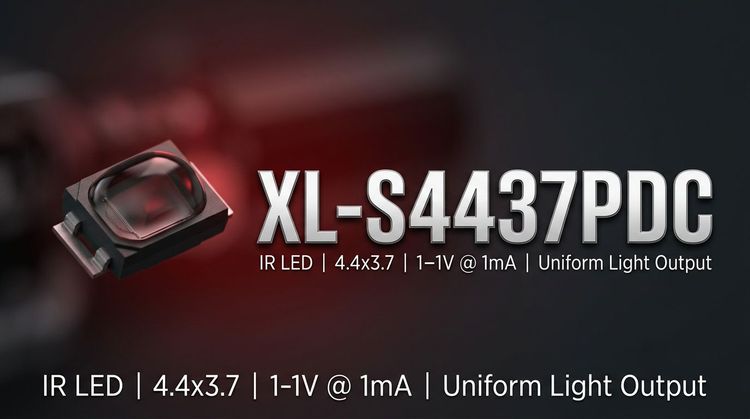
The XL-S4437PDC is a silicon photodiode packaged in a compact 4.4 x 3.7 x 0.55mm SMD form factor, designed primarily for light sensing in health monitoring electronics. 💡 It features a radiant sensitive area of 7.8mm² and a wide sensitivity wavelength range from 400nm to 1100nm (Visible to IR).
Target applications include pulse oximeters, smart electronic watches, and heart rate monitors where accurate detection of blood oxygen and pulse is required. 👇 The component is optimized for automated assembly (SMT) and is fully compliant with RoHS environmental standards.
🔌 Typical Applications
This photodiode is engineered for integration into portable medical and consumer wellness devices. Key application scenarios include:
- Pulse Oximetry: Detection of blood oxygen saturation (SpO2) levels.
- Heart Rate Monitoring: Real-time tracking of cardiac pulse via optical sensors.
- Electronic Watches: Integration into wearable smart devices for health tracking.
- General Health Monitoring: Usage in various electronic devices requiring optical feedback for physiological metrics.
📊 Key Technical Specifications
The following electrical and optical characteristics are measured at Ta=25°C. The device exhibits specific light current responses at critical wavelengths used in medical monitoring.
| Parameter | Symbol | Test Conditions | Min. | Typ. | Max. | Unit |
|---|---|---|---|---|---|---|
| Light Current (@940nm) | IL | VCE=1V, Ee=1mW/cm² | 38 | 55 | - | μA |
| Light Current (@660nm) | IL | VCE=1V, Ee=1mW/cm² | 29 | 35 | - | μA |
| Light Current (@525nm) | IL | VCE=1V, Ee=1mW/cm² | 20 | 25 | - | μA |
| Dark Current | ID | VCE=1V, Ee=0 | - | - | 20 | nA |
| Forward Voltage | VF | IF=1mA | - | 0.7 | - | V |
| Capacitance | C0 | VR=1V, f=1MHz | - | 28 | 80 | pF |
| Sensitivity Range | λ | - | 400 | - | 1100 | nm |
⚠️ Absolute Maximum Ratings & Process Limits
Exceeding these values may cause permanent damage to the device. Stress relief parameters for manufacturing processes are defined below.
| Parameter | Symbol | Value | Unit | Notes |
|---|---|---|---|---|
| Max Reverse Voltage | VR | 5 | V | |
| Operating Temp. | TOPR | -40 ~ +85 | °C | |
| Storage Temp. | TSTR | -40 ~ +100 | °C | |
| Soldering Temp/Time | TSOL | 260 | °C | ≤ 6 Seconds |
| Moisture Sensitivity | MSL | - | Level 3 | Floor life < 168 hours |
| Pulse Width | PW | - | ms | ≤ 0.1ms (Note) |
| Duty Cycle | D | - | - | ≤ 1/10 (Note) |
📦 Package, Dimensions & Assembly Notes
The component utilizes EIA standard packaging suitable for high-volume SMT production.
- Dimensions: 4.4mm (L) x 3.7mm (W) x 0.55mm (H). Dimensional tolerance is ±0.1mm.
- Process Compatibility: Suitable for reflow soldering processes.
- Hand Soldering: Recommended for repair only; use iron < 30W, temp < 300°C, time < 3s.
- Moisture Sensitivity: Classified as MSL Level 3. Pre-baking is required if the floor life (168h) is exceeded prior to reflow to prevent pop-corning or package cracking.
🚀 Sourcing & Supply Considerations
Procurement teams should verify the MSL level (Level 3) to ensure proper handling during incoming logistics and storage. The part uses EIA standard packaging dimensions, allowing for compatibility with standard automated pick-and-place machines. 💡 When validating supply chain authenticity, cross-reference the 4.4x3.7mm outline and the specific 940nm/660nm light current ratios provided in the technical specifications.
❓ FAQ
Q: What are the key wavelengths this photodiode detects?
A: The XL-S4437PDC has a sensitivity range of 400nm to 1100nm. It provides typical light currents of 55μA at 940nm (IR) and 35μA at 660nm (Red), making it suitable for SpO2 and heart rate monitoring applications that rely on these specific spectrums.
Q: Is this component suitable for automatic assembly lines?
A: Yes, it is designed for SMT automatic production. It complies with EIA standard packaging specifications and dimensions (4.4x3.7mm) and is suitable for standard reflow soldering processes (Max 260°C for ≤6s).
Q: What is the Moisture Sensitivity Level (MSL) and why does it matter?
A: The MSL is Level 3. This means the component can be exposed to a factory floor life of up to 168 hours (after the bag is opened) before it must be reflow soldered to avoid moisture-induced damage. If stored longer, baking is required.
Q: What are the limits for hand soldering this component?
A: Hand soldering should be limited to repairs. Use a soldering iron with power under 30W. The tip temperature must not exceed 300°C, and contact time should be limited to 3 seconds maximum to prevent thermal damage.
Q: How does the package size fit into compact wearable designs?
A: With a height of just 0.55mm and a compact 4.4x3.7mm footprint, the device offers a low-profile solution ideal for slim electronic watches and wearable health monitors where board space is constrained.
Q: What is the maximum reverse voltage this part can withstand?
A: The absolute maximum reverse voltage (VR) is 5V. Exceeding this risk may cause irreversible damage to the photodiode junction.