📌 Product Overview
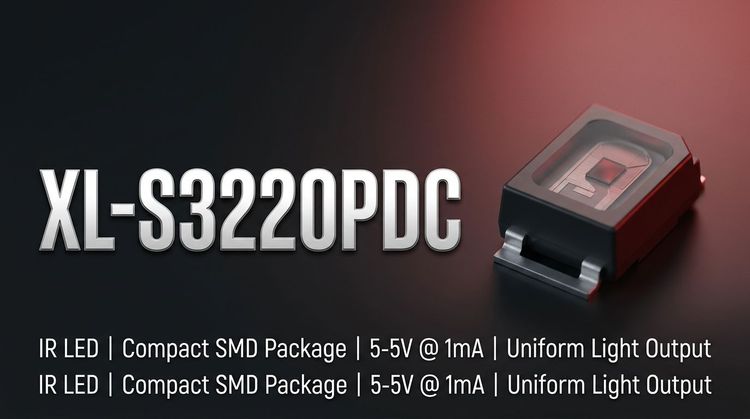
The XL-S3220PDC is a silicon photodiode designed for precise light detection within the 400nm to 1100nm spectrum. Housed in a compact 3220 (3.2mm x 2.0mm) SMD package with a 0.6mm height profile, it provides a radiant sensitive area of 2.9mm². 💡 This component is specifically engineered to support high-density integration in consumer electronics, particularly where ambient light sensing and bio-signal detection are required.
Targeting the wearable technology sector, this model addresses the critical need for stable optical response in compact form factors. Its design prioritizes compatibility with standard SMT processes, facilitating automated assembly. The device features a wide reception angle (±60°), offering flexibility in optical mechanical design without strict alignment constraints.
🔍 Typical Applications
The XL-S3220PDC is tailored for applications requiring precise optical monitoring and signal conversion.
- Bio-Signal Monitoring: Essential for Heart Rate Monitoring (HRM) and pulse detection systems using photoplethysmography (PPG).
- Medical Wearables: Integrated into Pulse Oximeters for blood oxygen level (SpO2) measurement.
- Consumer Smart Devices: Utilized in electronic watches and fitness trackers for health tracking functions.
- General Sensing: Suitable for various health monitoring electronics requiring broad-spectrum light detection.
📊 Key Technical Specifications
The electrical performance is characterized by specific light current thresholds and capacitance values at standard test conditions (Ta=25°C).
| Parameter | Symbol | Test Conditions | Min. / Typ. / Max. | Unit |
|---|---|---|---|---|
| Light Current (Green) | IL(G) | VR=5V, Ee=1mW/cm² @525nm | Min: 8 | μA |
| Light Current (Red) | IL(R) | VR=5V, Ee=1mW/cm² @655nm | Min: 10 | μA |
| Light Current (IR) | IL(IR) | VR=5V, Ee=1mW/cm² @940nm | Min: 11 | μA |
| Dark Current | ID | VR=5V, Ee=0 | Max: 20 | nA |
| Forward Voltage | VF | IF=1mA | Typ: 1 | V |
| Capacitance | C0 | VR=0V, f=1KHz~1MHz | Max: 200 | pF |
| Sensitivity Range | λ | - | 400 - 1100 | nm |
| Half Angle | θ1/2 | - | ±60 | deg |
⚠️ Absolute Maximum Ratings & Process Limits
Exceeding these ratings may cause permanent damage to the device. Stress beyond these limits for extended periods is not recommended.
| Parameter | Symbol | Value | Unit | Notes |
|---|---|---|---|---|
| Reverse Voltage | VR | 5 | V | - |
| Operating Temp. | TOPR | -40 ~ +85 | °C | - |
| Storage Temp. | TSTR | -40 ~ +100 | °C | - |
| Soldering (Time/Temp) | TSOL | 260 / ≤6 | °C / s | Lead soldering |
| Pulse Width | PW | ≤ 0.1 | ms | Duty ≤ 1/10 |
Process Notice: ⚠️ Moisture Sensitivity Level (MSL) is classified as Level 3. Proper baking and handling per IPC/JEDEC standards are required prior to reflow soldering to prevent popcorn cracking or delamination.
📦 Package, Dimensions & Assembly Notes
- Package Type: 3220 Surface Mount Device (SMD).
- Dimensions (L x W x H): 3.2mm × 2.0mm × 0.6mm.
- Packaging: EIA standard compliant tape and reel for automated pick-and-place.
- Soldering Guidelines:
- Hand Soldering: Only for repair. Use <30W iron at <300°C for max 3 seconds per terminal.
- Reflow: Compatible with Pb-free profiles. Max 2 reflow cycles. Avoid mechanical stress during heating.
🚀 Sourcing & Supply Considerations
- MSL Handling: Confirm storage and dry-pack conditions upon receipt to mitigate MSL 3 risks during assembly.
- Quality Validation: For mass production, prioritize lots that have passed the 1000h High-Temperature Operating Life (HTOL) tests.
- Alternative Sourcing: Verify the specific light current (Min) bins if cross-referencing, as sensitivity varies by wavelength.
❓ FAQ
Q: What is the Moisture Sensitivity Level (MSL) of the XL-S3220PDC?
A: The XL-S3220PDC is classified as MSL Level 3. This means it can be exposed to a factory floor environment of 30°C/60% RH for up to 168 hours before baking is required.
Q: Can this photodiode be used for SpO2 (Blood Oxygen) detection?
A: Yes, the datasheet specifically lists "Blood oxygen detection" and "Pulse oximeter" as primary applications. Its sensitivity range covers the Red (655nm) and Infrared (940nm) wavelengths typically used for SpO2 calculation.
Q: What are the constraints for reflow soldering?
A: The device withstands a maximum of 260°C for lead soldering (≤6s). For reflow, it supports up to 3 cycles at 260°C±5°C for 10s. Stress should not be applied to the component during the heating process.
Q: How is the light current defined for different colors?
A: The datasheet provides minimum Light Current (IL) values for specific wavelengths: 8μA for Green (525nm), 10μA for Red (655nm), and 11μA for IR (940nm), all measured at Ee=1mW/cm² and VR=5V.