📌 Product Overview
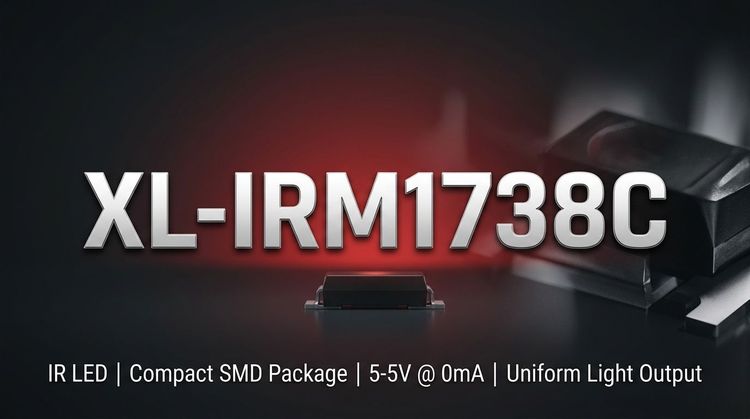
The XL-IRM1738C is a surface-mount infrared receiver designed for XINGLIGHT’s LED technology lineup. It integrates a high-sensitivity PIN photodiode and a low-power, high-gain preamplifier IC into a single epoxy resin package. 💡 The device functions as the primary signal reception component in infrared remote control systems, converting optical signals into electrical TTL/CMOS compatible outputs. Its design emphasizes low power consumption and environmental resilience, making it suitable for high-density PCB assemblies in consumer appliances and automotive electronics.
🔌 Typical Applications
This component is versatile across multiple sectors requiring remote control capabilities. 🛠 Key application scenarios include:
- Home Appliances: Air conditioners, fans, heaters, and humidifiers.
- Multimedia Equipment: Televisions, DVD players, set-top boxes, and vehicular mobile DVD systems.
- Industrial & Computing: Instrumentation, industrial automation controls, computer peripherals, and induction sanitary ware.
- Specialty Electronics: Financial electronics, automotive lighting systems, remote-controlled toys, and communication devices.
📊 Key Technical Specifications
The XL-IRM1738C operates with a wide supply voltage range, accommodating various system power designs. Below are the standard electro-optical characteristics under typical test conditions (Ta=25°C):
| Parameter | Symbol | Min. | Typ. | Max. | Unit | Test Conditions |
|---|---|---|---|---|---|---|
| Supply Voltage | VDD | 2.7 | - | 5.5 | V | - |
| Carrier Frequency | f0 | - | 37.9 | - | kHz | - |
| Working Current | ICC | 0.2 | 0.3 | 0.5 | mA | VDD=5V |
| Reception Distance | L | 10 | 12 | - | m | 0° angle, standard test* |
| Low Level Output | Vol | - | - | 250 | mV | Isink=2.0mA |
| High Level Output | Voh | 4.5 | - | 5.0 | V | VCC=5V |
Note: Testing typically involves a CH3018-12U transmitter without direct sunlight.
⚠️ Absolute Maximum Ratings & Process Limits
To ensure reliability and prevent catastrophic failure during operation or assembly, design boundaries must be strictly observed. ⚡ Exceeding these limits risks permanent damage to the internal PIN diode or amplifier IC.
| Parameter | Symbol | Rating | Unit | Notes |
|---|---|---|---|---|
| Supply Voltage | VDD | 6.0 | V | Continuous operation limit |
| Operating Temp. | Topr | -40 ~ +85 | °C | Ambient temperature range |
| Storage Temp. | Tstg | -40 ~ +125 | °C | Non-operating environment |
| Soldering Temp/Time | Tsol | 260 | °C | ≤ 6 seconds (Lead Soldering) |
| Moisture Sensitivity | MSL | 3 | Level | Requires baking if floor life exceeded |
📦 Package, Dimensions & Assembly Notes
The XL-IRM1738C utilizes a large volume, semi-circular spherical epoxy resin package optimized for SMT processes. The design features dual shielding (internal and external) to minimize electromagnetic interference, which is crucial for maintaining signal integrity in noisy environments.
📏 Key Dimensions: 6.8mm (L) x 5.3mm (W) x 4.4mm (H), with a foot length of 3.1mm.
Standard tolerances are ±0.25mm unless noted. The MSL 3 rating dictates careful handling; if the moisture barrier bag is opened and components are not used within 168 hours, a baking procedure is required prior to reflow soldering to prevent popcorning.
🚢 Sourcing & Supply Considerations
For procurement teams, the XL-IRM1738C offers a balance of performance and environmental compliance (REACH/RoHS). When integrating this component into mass production, verify the tape-and-reel packaging dimensions to ensure compatibility with existing pick-and-place feeders. 💡 Given the specific 37.9 kHz carrier frequency, cross-reference verification is recommended if substituting legacy receivers to avoid shifts in remote control range or sensitivity. Securing samples for initial environmental testing—specifically EMI susceptibility—is advised before full-scale rollout.
❓ FAQ
Q: What is the supply voltage tolerance for the XL-IRM1738C?
A: The device supports a wide working voltage range from 2.7V to 5.5V, making it adaptable for both 3.3V and 5V microcontroller systems without needing extra regulation.
Q: Does this receiver require specific moisture handling?
A: Yes, the XL-IRM1738C is classified as Moisture Sensitivity Level (MSL) 3. Floor life is limited once the sealed package is opened; components must be soldered within a specific timeframe or baked to remove moisture.
Q: What is the typical reception distance and angle?
A: Under standard conditions, the reception distance is approximately 10m to 12m at 0 degrees. At off-angles (±35 degrees), the distance reduces to a typical range of 5m to 6m.
Q: Is the output compatible with standard logic gates?
A: Yes, the output is designed to interface directly with TTL and CMOS logic levels. The low-level output is active, ensuring easy integration with standard microcontrollers.
Q: What are the absolute maximum soldering conditions?
A: The device can withstand soldering temperatures up to 260°C for a maximum of 6 seconds. Exceeding this duration or temperature may degrade the epoxy seal or internal connections.
Q: How does the package design handle interference?
A: The module employs an epoxy resin encapsulation with semi-circular spherical shaping and dual shielding (internal and external) to effectively withstand environmental light and electromagnetic interference.