📌 Product Overview
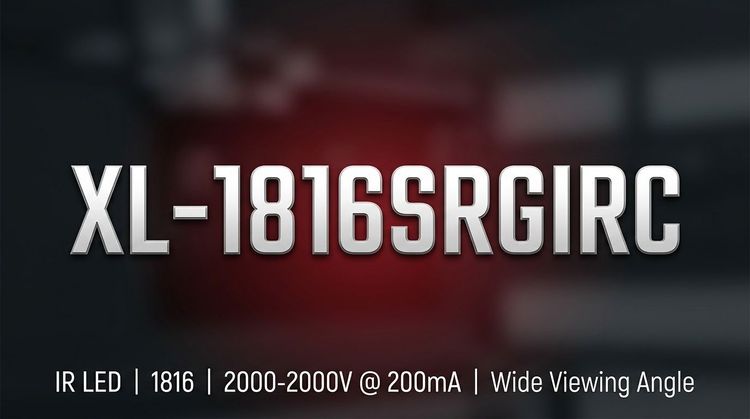
The XL-1816SRGIRC is a specialized 4-pin SMD LED from XINGLIGHT, combining three distinct emission wavelengths into a single compact 1816 package (1.8mm x 1.6mm). 💡 It integrates a 655nm Red chip, a 522nm Green chip, and a 940nm Infrared chip to function as a multi-spectral light source.
🎯 Targeted primarily at the wearable technology sector, this component is essential for optical bio-sensing modules. Its design prioritizes high-intensity output and precise spectral positioning to ensure accurate data capture in heart rate monitoring and blood oxygen detection systems. The device supports standard SMT processes, making it suitable for high-density automated assembly in smartwatches and health trackers.
⚙️ Typical Applications
Based on its optical and electrical characteristics, the XL-1816SRGIRC is optimized for applications requiring specific light transmission through skin tissue.
- Pulse Oximetry (SpO2): Utilizes the Red and Infrared chips to measure oxygen saturation levels by analyzing light absorption differences.
- Heart Rate Monitoring (PPG): Employs the Green LED (typically 522nm) for motion-tolerant heart rate detection in wrist-worn devices.
- Smart Wearables: Integration into electronic watches and fitness bands for 24/7 health tracking.
- Medical Diagnostics: Used in compact, professional-grade pulse detection instruments requiring high reliability.
📉 Key Technical Specifications
The following table outlines the optoelectronic performance under standard test conditions ($T_a = 25^\circ C$).
| Parameter | Symbol | Red (Typ) | Green (Typ) | Infrared (Typ) | Unit | Test Condition |
|---|---|---|---|---|---|---|
| Peak Wavelength | $\lambda_p$ | 655 | 522 | 945 | nm | $I_F = 20\text{mA}$ |
| Forward Voltage | $V_F$ | 2.0 | 2.6 | 1.3 | V | $I_F = 20\text{mA}$ |
| Optical Power | $P_o$ | 8 | 8 | 8 | mW | $I_F = 20\text{mA}$ |
| Optical Power | $P_o$ | 40 | 70 | 63 | mW | Pulse (200mA, 1/10 Duty) |
| Half Viewing Angle | $\theta_{1/2}$ | - | - | ±62 | deg | - |
💡 Note: Pulse performance is critical for maximizing signal-to-noise ratio while minimizing power consumption in battery-operated devices.
⚠️ Absolute Maximum Ratings & Process Limits
Exceeding these ratings may cause permanent device failure or significant degradation in optical output. Designers must ensure that operational limits stay within these boundaries, particularly during high-drive pulse modes.
| Parameter | Symbol | Max. Value | Unit | Notes |
|---|---|---|---|---|
| Forward Current (Pulse) | $I_{FP}$ | 200 | mA | Pulse Width = 0.5ms, Duty = 1/10 |
| Forward Current (DC) | $I_F$ | 50 | mA | Per chip |
| Reverse Voltage | $V_R$ | 5 | V | - |
| Power Dissipation | $P_D$ | Derate | mW | Depends on pad layout |
| Operating Temp. | $T_{OPR}$ | -40 ~ +85 | $^\circ C$ | - |
| Storage Temp. | $T_{STG}$ | -40 ~ +100 | $^\circ C$ | - |
| Soldering Temp | $T_{SOL}$ | 260 | $^\circ C$ | $\le 6\text{ seconds}$ |
🔒 ESD Sensitivity: Handle with appropriate precautions. The device is tested up to HBM 2000V.
📦 Package, Dimensions & Assembly Notes
- Package Type: 1816 SMD (Surface Mount Device)
- Dimensions (L x W x H): 1.85mm $\times$ 1.65mm $\times$ 0.6mm
- Packaging Standard: EIA compliant tape and reel, suitable for automated pick-and-place machines.
- Moisture Sensitivity: MSL Level 3. 🏭 Floor Life: 168 hours. If exposed beyond this, bake before reflow to prevent "popcorning" or internal delamination.
- Soldering Guidelines: Compatible with standard reflow soldering profiles. Ensure peak temperature does not exceed 260°C and time above 217°C is minimized to prevent thermal shock to the encapsulant.
🚢 Sourcing & Supply Considerations
- Supply Chain: Verify stock through authorized XINGLIGHT distributors to avoid counterfeit components, which are common in multi-die LEDs.
- Binning Management: Due to variations in wavelength and intensity, coordinate with suppliers on binning parameters (e.g., Dominant Wavelength $\pm 1\text{nm}$) if your optical algorithm requires strict consistency.
- Sample Evaluation: Request samples specifically from the same manufacturing batch code intended for mass production to validate photometric consistency.
❓ Frequently Asked Questions
Q: What is the specific function of the Green LED in this module?
A: While Red and IR are used for SpO2, the Green LED (typically 522nm) is primarily used for reflective heart rate monitoring (PPG). It offers better absorption on the skin surface compared to Red, making it effective for motion-tolerant HR tracking in fitness wearables.
Q: Can I drive all three chips simultaneously at maximum current?
A: You must strictly observe the thermal limits. While the electrical limits allow 50mA DC per chip, driving all three simultaneously at maximum current will exceed the package's thermal dissipation capacity. Pulse driving is recommended for simultaneous operation.
Q: Is this component compatible with lead-free soldering processes?
A: Yes, the datasheet indicates suitability for reflow soldering. However, lead-free profiles often peak higher than 260°C. Ensure your profile does not exceed the maximum rated solder temperature (260°C for 6 seconds) or component damage may occur.
Q: How critical is the Moisture Sensitivity Level (MSL 3)?
A: Very critical. MSL 3 means the component can absorb moisture from the air. If not baked after opening the vacuum seal and before reflow, the trapped moisture can expand rapidly during heating, causing internal cracking (delamination) or "popcorning," which kills the LED.
Q: What is the tolerance on the viewing angle?
A: The typical half-viewing angle is $\pm 62^\circ$. The datasheet specifies a tolerance of $\pm 10^\circ$ on this viewing angle. Designers should account for this variation when designing light guides or optical housings to ensure signal strength meets requirements across all units.